

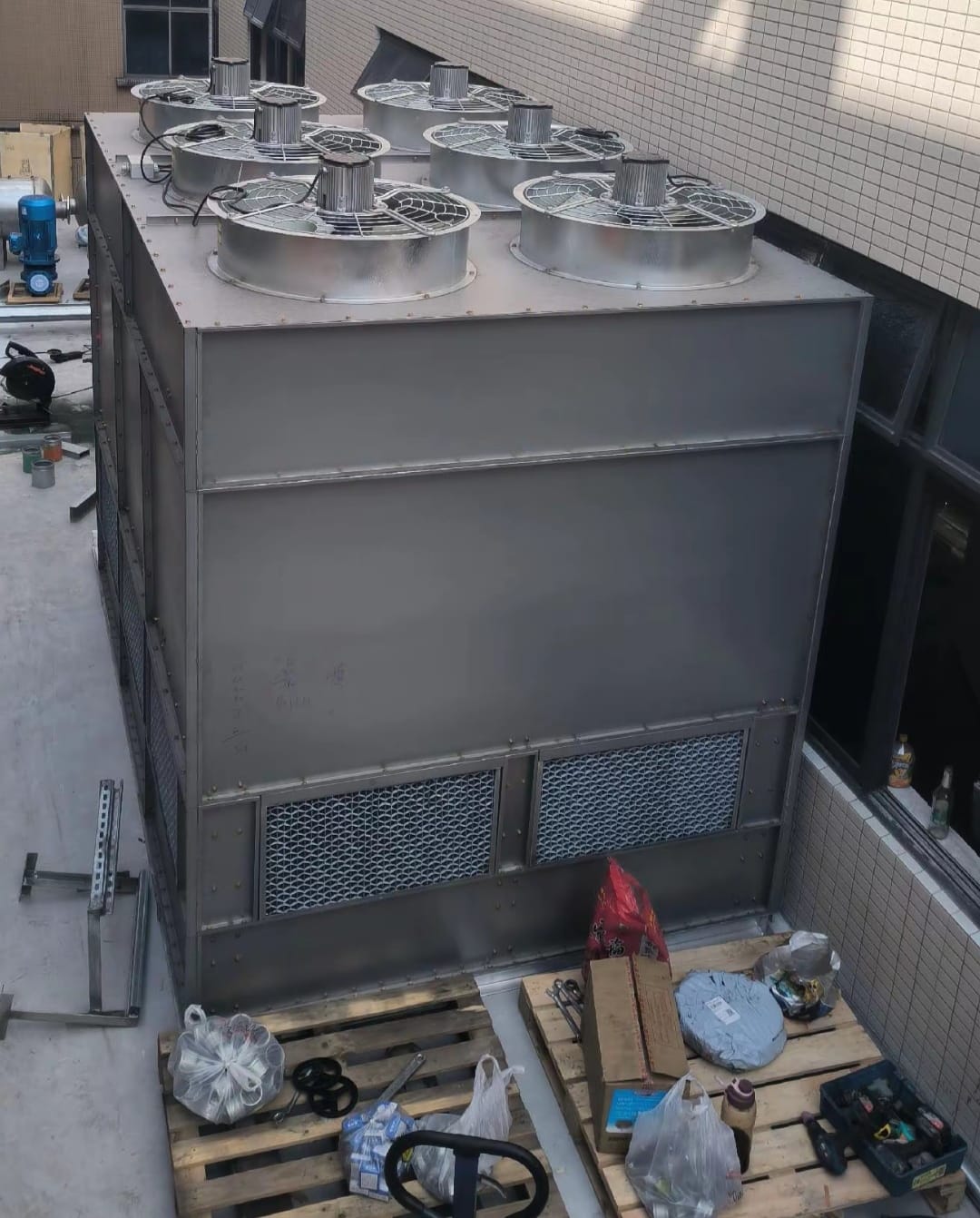
Role of Closed-Circuit Cooling Tower in Food and Beverage industry.
In the food and beverage industry, the primary role of a closed-circuit cooling tower is to provide hygienic, reliable, and efficient process cooling while strictly preventing any contamination of the product or production environment . This is critical in an industry with stringent safety standards from bodies like the FDA and HACCP .
The table below outlines the core functions and benefits in this specific sector:
| Role/Function | How It Works | Key Benefit for Food & Beverage |
| Prevents Contamination | Process fluid (water/glycol) circulates in a sealed loop, never exposed to air or spray water . | Eliminates the risk of airborne dust, debris, and biological contaminants (e.g., Legionella) from entering the cooling process . |
| Supports Critical Processes | Provides precise, stable cooling for heat-intensive steps. | Ensures product quality and safety during pasteurization, fermentation, dairy processing, and beverage production . |
| Meets Hygiene Standards | Designed for cleanability, often using stainless steel and smooth surfaces . | Helps facilities comply with strict FDA and HACCP regulations by maintaining sanitary conditions . |
| Improves Efficiency | Uses an isolated loop, reducing the need for constant chemical treatment and water discharge. | Simplifies system design, lowers water consumption, and reduces operating costs . |
Key Applications in Food Processing
Closed-circuit cooling towers are used in several critical stages of food and beverage production:
- Pasteurization and Sterilization: After products like milk, juice, or canned goods are heated to eliminate harmful microorganisms, they must be rapidly cooled. The cooling tower provides the chilled water necessary for this critical step, preserving product quality and shelf life .
- Fermentation Control: In the production of beer, wine, and yogurt, fermentation generates heat. Precisely managing this temperature is essential for achieving the desired taste and consistency. Cooling towers provide the stable cooling needed for this process .
- Dairy and Beverage Production: Cooling towers are used to cool milk after pasteurization to prevent spoilage and maintain freshness. They also help maintain the precise temperatures required for carbonating soft drinks and processing juices .
- Equipment Cooling: Beyond direct process cooling, these towers cool vital support equipment, including compressors, hydraulic systems, and Clean-in-Place (CIP) systems, preventing overheating and ensuring smooth production .
Critical Design and Operational Considerations
Given the sensitivity of food production, the design and operation of these cooling towers focus heavily on hygiene and risk prevention:
- Corrosion-Resistant Materials: Many units are constructed using stainless steel (e.g., AISI 304 or 316L) to resist corrosion, ensuring a long service life and providing a surface that is easy to clean and sanitize .
- Design for Cleanability: Leading manufacturers like BAC design their towers with features for easy access and cleaning. This includes patented, cleanable fill media and “hygienic design” principles that minimize areas where biological growth can occur .
- Chemical and Maintenance: While the closed loop drastically reduces contamination risk, the secondary water loop used for spray cooling may still require careful treatment. Industry experts recommend using advanced and controlled biocides to prevent the growth of microorganisms like Legionella in the system . Regular maintenance, including basin cleaning, is crucial, and systems are designed to allow this without stopping production .
For the food and beverage industry, a closed-circuit cooling tower is more than just a heat-rejection device—it is a critical component for protecting public health and ensuring product integrity.