

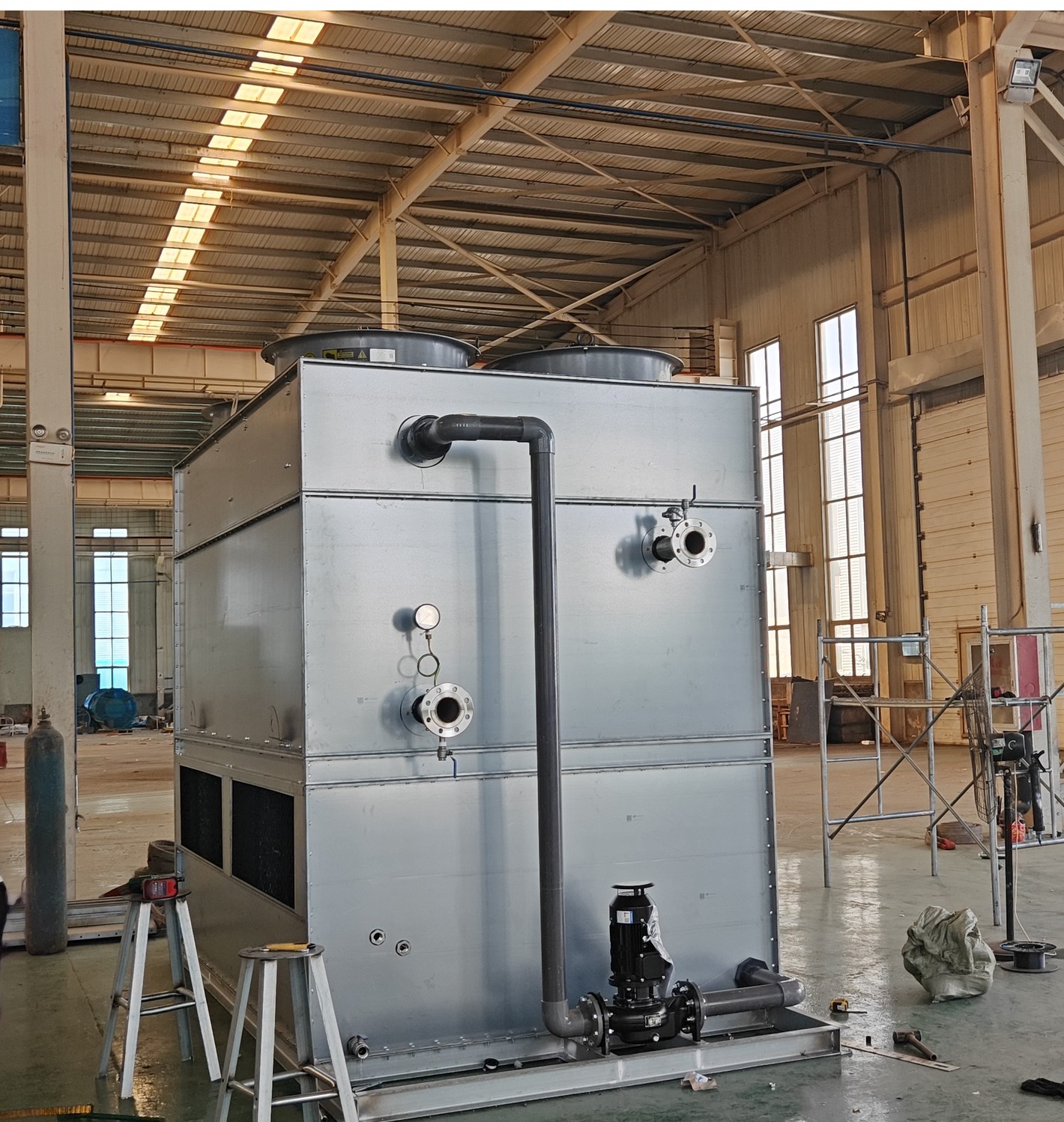
Major Parts of Closed Circuit Cooling Tower?
closed circuit cooling tower is composed of several critical systems working in tandem. Its design is more complex than a standard open tower because it must manage two separate water circuits.
Here are the major parts and their functions:
- The Heat Exchange Coil (The Core)
This is the most important component, as it houses the Internal Circuit.
• Function: The hot process fluid (water or glycol) flows through these sealed tubes. Heat is transferred from the fluid, through the tube walls, to the spray water outside.
• Materials: Usually made of Galvanized Steel, Stainless Steel (for corrosion resistance), or Copper (for high thermal conductivity). - Water Spray System (External Circuit)
This system provides the evaporative cooling effect on the outside of the coils.
• Spray Pump: A dedicated pump that moves water from the basin to the top of the tower.
• Spray Header & Nozzles: These distribute the water evenly over the coil bundle. Modern nozzles are designed to be “non-clogging” to ensure the entire coil surface stays wet. - Air Movement System
• Fan: Can be Axial (propeller-style for high airflow) or Centrifugal (quieter, used for higher pressure). It pulls or pushes air over the wet coils to drive evaporation.
• Motor & Drive: The motor powers the fan, often connected via a V-belt or gearbox. Many modern towers use Variable Frequency Drives (VFDs) to adjust fan speed based on the cooling load.
• Air Inlet Louvers: These allow air into the tower while blocking sunlight (to prevent algae growth) and keeping debris out. - Moisture Management
• Drift Eliminators: Specialized baffles located above the spray nozzles. They “catch” water droplets that try to escape with the exiting air and return them to the basin. This prevents water loss and chemical drift.
- Fill Media (Only in Combined Flow units): Some closed circuit towers include a section of plastic “fill” to cool the spray water further before it hits the coils.
5. Collection & Control
- Cold Water Basin: The reservoir at the bottom that collects the spray water.
- Float Valve: Automatically adds “make-up water” to the basin to replace what was lost to evaporation.
- Immersion Heaters: Often found in the basin to prevent the water from freezing during winter operation or idle periods.
- Strainer: A mesh screen that prevents debris from entering the spray pump and clogging the nozzles.