

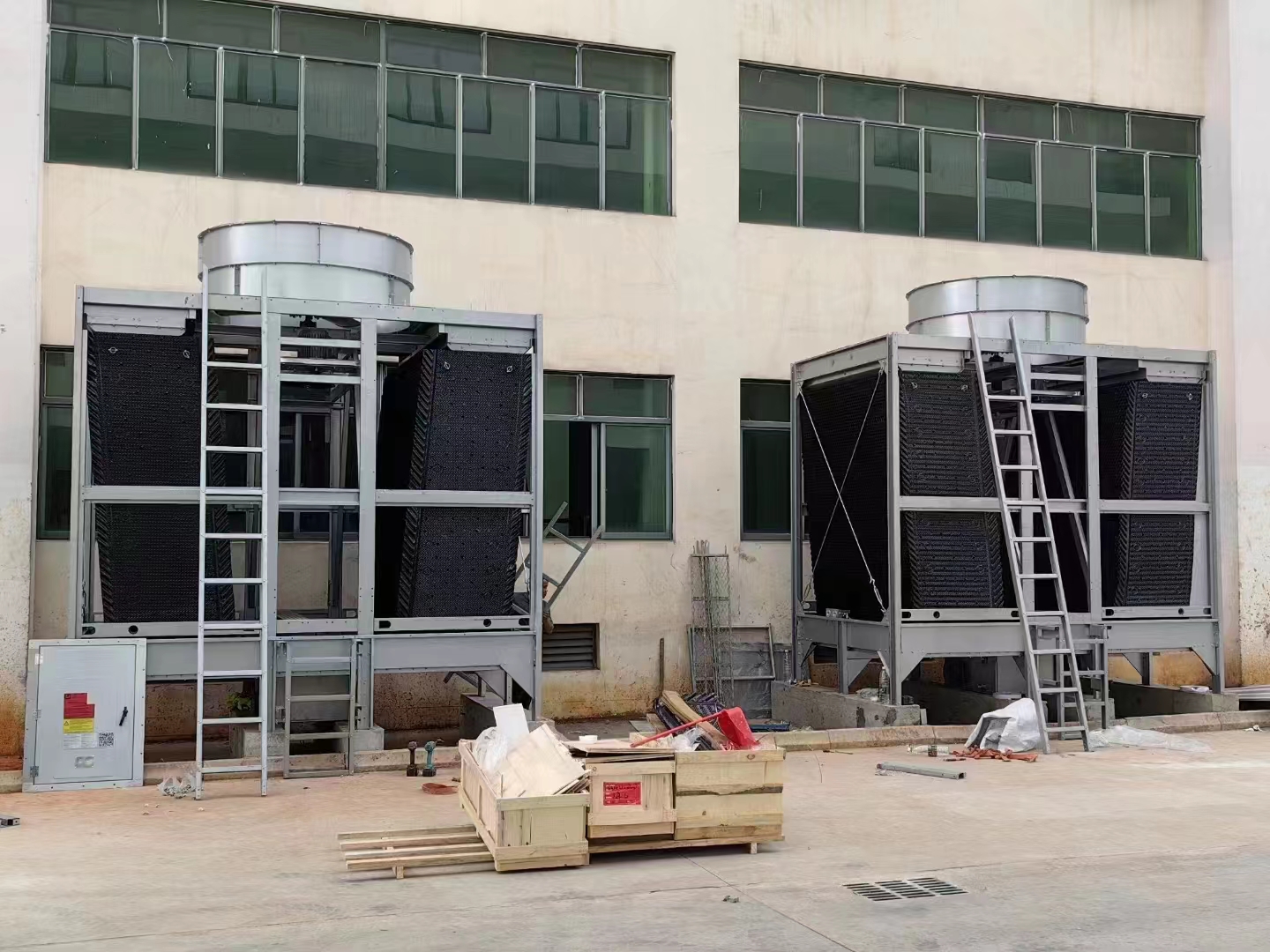
Types of Closed Circuit Cooling Tower ?
Closed circuit cooling towers are primarily classified by how the air and spray water move in relation to one another and how the fans are positioned.
Here are the four main types you will encounter:
. Counterflow Closed Circuit Towers
In this design, air and water move in opposite directions.
- How it works: The spray water falls downward over the coils while the air is drawn upward from the bottom.
- Best for: Small footprints. Because the air and water are in constant “head-on” contact, these towers are highly efficient and take up less floor space.
- Maintenance: Can be slightly harder to service because the internal spray system is tucked inside the unit above the coils.
2. Combined Flow (or Mixed Flow)
This is a hybrid design that uses both a heat exchange coil and a section of “fill” (the material used in open towers) to maximize cooling.
- How it works: Air and water flow in parallel (the same downward direction) over the coil. The water then falls through a separate fill section where it is cooled by a cross-flowing air stream before being pumped back to the top.
- Best for: Reducing “dry spots” and scaling. The parallel flow ensures the coil stays completely drenched, which prevents mineral buildup. It is often the most energy-efficient for large industrial loads.
3. Crossflow Closed Circuit Towers
In this version, air moves horizontally across the falling water and the coil.
- How it works: The spray water falls vertically while the fan pulls air through the sides of the tower at a 90-degree angle.
- Best for: Easy maintenance and cold climates. These towers often feature large internal walkways (plenums) that allow technicians to stand inside the unit for inspections while it is running.
4. Induced Draft vs. Forced Draft
This refers to where the fan is located:
- Induced Draft: The fan is at the top, pulling air through the tower. This is the most common type because it prevents “recirculation” (re-inhaling the hot air it just blew out).
- Forced Draft: The fan is at the bottom or side, pushing air into the tower. These are often quieter and easier to service because the mechanical parts are at ground level, making them popular for indoor installations or tight urban spaces.