

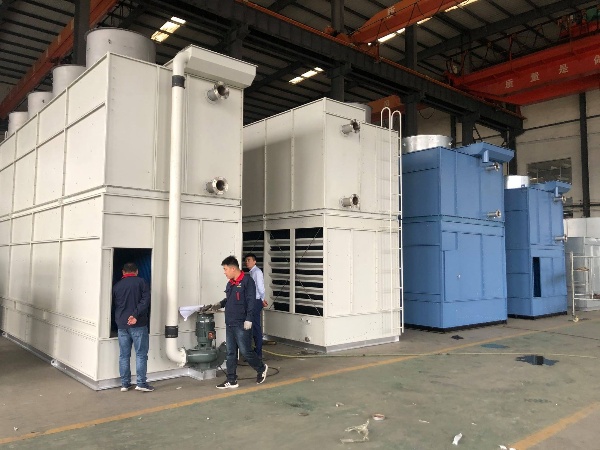
Role of Closed-Circuit Cooling Tower in Data Centres.
In the demanding environment of a data centre, where servers generate immense heat and uptime is critical, the role of a closed-circuit cooling tower is to provide highly reliable, efficient, and often water-conserving cooling. It achieves this by using a sealed loop to protect the critical cooling fluid from contamination, a key advantage over traditional open towers.
The table below summarizes the core functions and benefits:
| Role/Function | How It Works | Key Benefit for Data Centers |
| Protects Critical Fluid | Process fluid (water/glycol) circulates in a sealed coil, never exposed to air. | Prevents contamination, ensuring system reliability and long equipment life. |
| Enables “Free Cooling” | System can operate in “dry mode” during cold weather, using only fans. | Reduces energy consumption and improves Power Usage Effectiveness (PUE). |
| Conserves Water | Drastically reduces or eliminates evaporation compared to open towers. | Cuts operating costs, conserves a critical resource, and improves Water Usage Effectiveness (WUE). |
| Supports High-Density Cooling | Often paired with liquid cooling for servers, efficiently removing high heat loads. | Essential for cooling modern, powerful AI and HPC hardware. |
Why Data Centres Choose Closed-Circuit Cooling
The choice for data centres comes down to a few critical operational advantages over traditional, open-loop cooling towers:
- Unmatched Reliability and Cleanliness: In an open cooling tower, the water is exposed to the atmosphere, collecting dust, debris, and biological material like algae. This contaminated water can foul and corrode sensitive equipment, leading to failures. A closed-circuit system uses a sealed, clean fluid loop, dramatically reducing maintenance and the risk of downtime.
Significant Water and Energy Savings: Data centers are massive water consumers. Closed-circuit and hybrid systems can significantly reduce this consumption. For
- example, one data center achieved 80% water savings by using an adiabatic closed-circuit cooler instead of a traditional evaporative tower. Another key benefit is “free cooling,” where the system can reject heat using only fans during cooler weather, saving substantial energy and lowering PUE.
Key Types of Closed-Circuit Systems
While all closed-circuit systems protect the fluid loop, they vary in how they reject heat, providing options to balance water and energy use:
- Hybrid Coolers: These systems combine a dry cooler with an evaporative section. During hot weather, they can use a small amount of water sprayed on the coil to boost cooling capacity through evaporation. In cooler weather, they operate completely dry to save water. This provides an excellent balance of efficiency and water conservation.
- Adiabatic Coolers: These cool the incoming air before it passes over the coil by using water spray to lower the air temperature. Like hybrid systems, they offer a water-saving middle ground for sites where water is less abundant.
- Dry Coolers (Closed-Circuit Fluid Coolers): These are the ultimate choice for water conservation, as they reject heat using only air and fans with zero water evaporation. However, this is the least energy-efficient option, often requiring more power and a larger footprint.
A Case Study in Efficiency
A real-world example comes from a data center in Pune, India, which needed to cool its supercomputer. They implemented a closed-loop liquid cooling system paired with an adiabatic dry cooling tower. The system uses a glycol loop to absorb heat from the computing panels and then transfers it to a secondary water loop. The adiabatic cooler then dissipates this heat. The result was stable, reliable cooling with an 80% reduction in water usage compared to a traditional cooling tower. In summary, the closed-circuit cooling tower is a cornerstone of modern, sustainable data centre design. It provides the reliability needed for mission-critical operations while offering the flexibility to prioritize water or energy savings through evaporative, hybrid, dry, or adiabatic operation modes
If you are considering this technology for a specific application and would like to explore the different types further, I can provide additional details.