

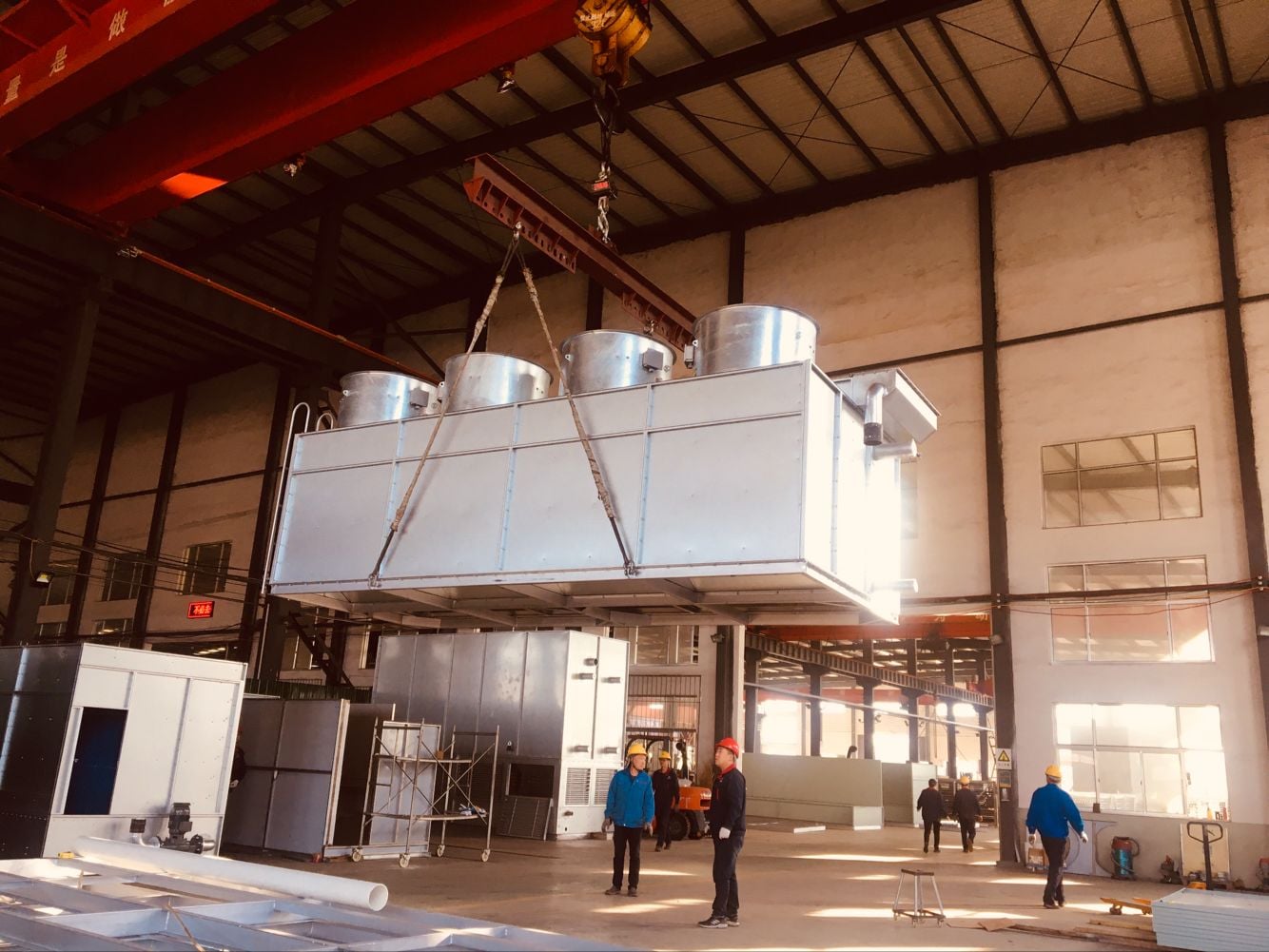
Role of Closed-Circuit Cooling Tower in HVAC industry.
In the HVAC industry, a cooling tower acts as a dedicated heat-rejection device, removing excess heat from a building or process and releasing it into the atmosphere. Its primary role is to enable water-cooled chiller systems to operate more efficiently than their air-cooled counterparts, especially in large commercial buildings like offices, hospitals, and schools .
The Core Mechanism: Evaporative Cooling
Cooling towers primarily use the principle of evaporative cooling to achieve their heat rejection. This process leverages the fact that water absorbs a significant amount of heat as it changes from a liquid to a vapor . In an HVAC system, the process works as follows:
- Heat Absorption: A water-cooled chiller absorbs heat from the building’s air or process. This heat is transferred to a separate “condenser water” loop, warming the water .
- Heat Rejection: This warm condenser water is pumped to the cooling tower, where it is sprayed over a material called “fill.” The fill increases the water’s surface area to maximize contact with air .
- Evaporative Cooling: A fan draws air through the tower, causing a small portion of the water to evaporate. The energy (latent heat) required for this evaporation is drawn from the water itself, which cools the remaining water significantly .
- Recirculation: The cooled water collects in a basin at the bottom of the tower and is pumped back to the chiller’s condenser to absorb more heat, completing the cycle .
Key Efficiency Advantage
This method allows cooling towers to cool water to a temperature very close to the ambient wet-bulb temperature, which is lower than the ambient dry-bulb temperature . This is a crucial advantage because a water-cooled chiller paired with a cooling tower can reject heat more efficiently than an air-cooled chiller, which must expel heat at the higher dry-bulb temperature . This efficiency translates to lower energy consumption .
A typical HVAC cooling tower is designed to reject about 15,000 BTUs per hour for each “ton” of cooling provided, which accounts for both the heat removed from the building and the heat generated by the chiller’s compressor .
Operational Considerations
While highly efficient, cooling towers introduce specific operational needs:
- Water Treatment: In open-circuit towers, the water is exposed to the air, making it susceptible to contamination. Regular water treatment is essential to control scale, corrosion, and biological growth, including the potentially hazardous Legionella bacteria .
- Water Consumption: Water is lost through evaporation and a small amount is discharged as “blowdown” to control mineral concentration. This water must be replenished, making water conservation a consideration .
In summary, the cooling tower is an essential component for achieving highly energy-efficient cooling in large buildings. It performs the critical task of rejecting the collected heat to the outdoors, enabling the entire HVAC system to function effectively