

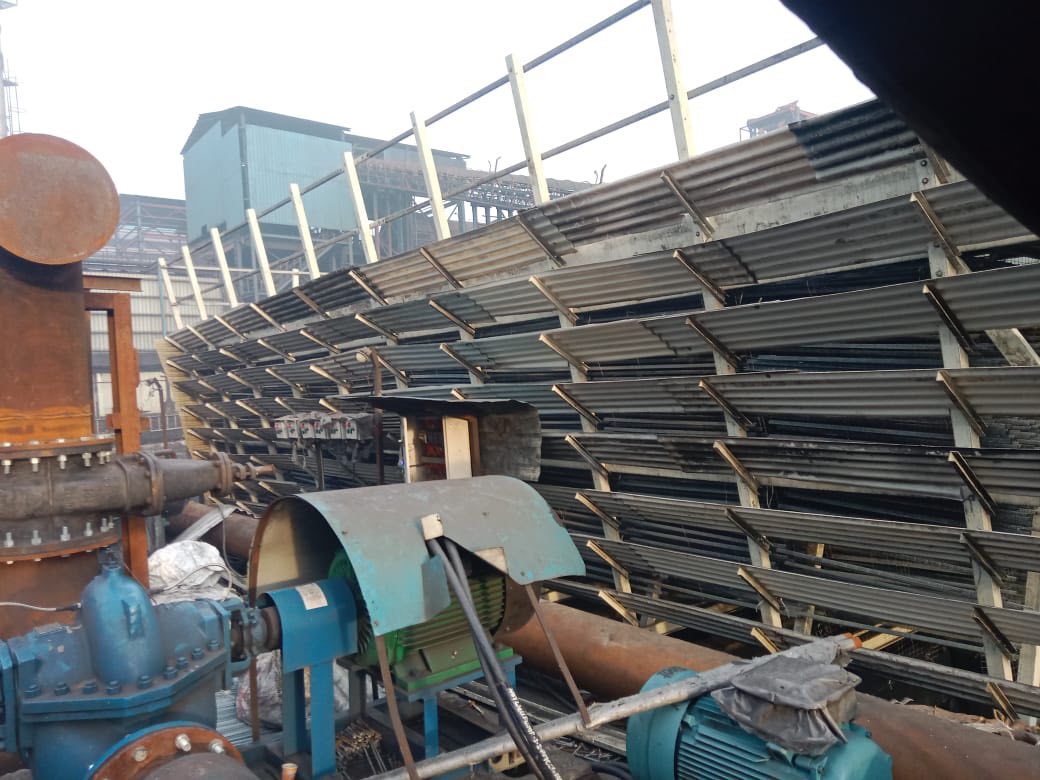
Use of cooling tower in Geothermal plants
The use of cooling towers in geothermal power plants is fundamental, but it differs in key ways from fossil fuel or nuclear plants. Here, the cooling tower is not an auxiliary component; it is often the primary and sometimes the only heat rejection cycle for the entire plant.
Its role is dictated by the unique characteristics of geothermal resources: lower temperature heat sources and the critical need to manage geothermal fluid (brine).
Core Function: Maximizing Efficiency in a Low-Temperature Cycle
Geothermal plants operate on a low-to-moderate temperature heat source (typically 150°C to 370°C, compared to 550°C+ in fossil plants). The Carnot efficiency of such cycles is inherently lower. Therefore, minimizing the turbine exhaust (condenser) temperature is paramount to maximizing power output. The cooling tower’s job is to create the lowest possible condensing temperature, which in turn creates the largest possible pressure drop across the turbine, extracting the maximum work from the geothermal steam or binary fluid.
Two Primary Plant Types Dictate Cooling Tower Use:
. Flash Steam Plants (The most common type)
Here, high-pressure geothermal brine is “flashed” into steam to drive a turbine.
- Use of Cooling Tower: The cooling tower serves the Direct-Contact Condenser (DCC) or Surface Condenser.
- Process: Exhaust steam from the turbine is mixed with cold water (condensate) from the cooling tower in a DCC, condensing the steam and creating a vacuum. This mixture is pumped out. A large portion is sent to the cooling tower to be cooled by evaporation, and the rest is reinjected.
Why it’s Critical: The tower cools the condensing water, which allows it to effectively condense the turbine exhaust steam at a very low pressure (~0.1 bar absolute). This low
- condensing pressure is the key to plant efficiency. The cooling tower loop is integral to the main power cycle, not auxiliary.
2. Binary Cycle Plants (For lower temperature resources)
Here, geothermal brine heats a secondary “working fluid” (like isopentane or R-134a) with a low boiling point in a heat exchanger. This organic fluid vaporizes, drives a turbine, and is then condensed.
- Use of Cooling Tower: The cooling tower serves the condenser of the binary cycle.
- Process: The vaporized organic working fluid exits the turbine and enters a condenser, which is cooled by water from the cooling tower. The condensed fluid is then pumped back to the heat exchanger.
- Why it’s Critical: The binary cycle’s efficiency is extremely sensitive to condensing temperature. A well-designed cooling tower that produces colder water directly increases net power output. This is a 100% closed-loop cooling tower system for the working fluid cycle, isolating it from the geothermal brine.
Unique Aspects & Challenges in Geothermal Applications:
- Non-Condensable Gases (NCGs): This is a major differentiator. Geothermal steam contains gases like Hydrogen Sulfide (H₂S), CO₂, Methane, and Ammonia.
- Impact on Cooling Tower: In flash plants with Direct-Contact Condensers, these gases are released in the condenser and can be carried over into the cooling tower water and vented to the atmosphere.
- Result: This leads to corrosion (from H₂S and CO₂) and potential air emissions. Cooling towers in geothermal plants must be constructed from highly corrosion-resistant materials (e.g., fiberglass, specialized coatings, stainless steel) and are often designed with integrated NCG extraction systems.
- Material Selection is Paramount: The combination of NCGs, warm water, and sometimes brackish make-up water creates an extremely aggressive environment. Wood and standard galvanized steel are often avoided. Fiberglass-reinforced plastic (FRP) towers are the industry standard for shell and structure, with PVC fill and stainless steel or coated fans/hardware.
- Reinjection Integration: The cooling tower’s blowdown (concentrated water drained to control solids) is almost always mixed with the spent geothermal brine and reinjected back into the reservoir. This is a zero-liquid-discharge requirement, making water treatment and blowdown management crucial.
- Air-Cooled Condensers (ACC) as an Alternative: In water-scarce regions or areas with strict H₂S emission controls, geothermal plants may use dry cooling towers (Air-Cooled Condensers). While they eliminate water consumption and NCG release, they are more expensive, less efficient (higher condensing temperature), and have a much larger footprint. They are a trade-off for environmental compliance.
- Hybrid Wet/Dry Systems: Some plants use a hybrid to balance water use and efficiency. The wet section operates during hot hours for peak efficiency, while the dry section operates during cooler hours or to meet water use limits.
Auxiliary Cooling:
Yes, geothermal plants also have auxiliary cooling needs (lube oil, generator air coolers, etc.), but these are typically served by a small, separate closed-circuit cooling tower or are tied into the main cooling water loop via a heat exchanger
Comparison to Fossil Fuel Plants:
| Feature | Fossil Fuel/Nuclear Plant | Geothermal Plant (Flash) |
| Primary Role | Reject low-grade heat from steam cycle condenser. | Integral part of the main cycle; creates vacuum for turbine exhaust. |
| Cycle Temperature | High temp, high efficiency. | Low temp, efficiency is highly dependent on cooling tower performance. |
| Biggest Challenge | Water consumption, Legionella. | Corrosion from NCGs (H₂S, CO₂), water chemistry (silica scaling), and air emissions. |
| Material of Choice | Galvanized steel, concrete. | Fiberglass (FRP), specialized plastics, stainless steel. |