

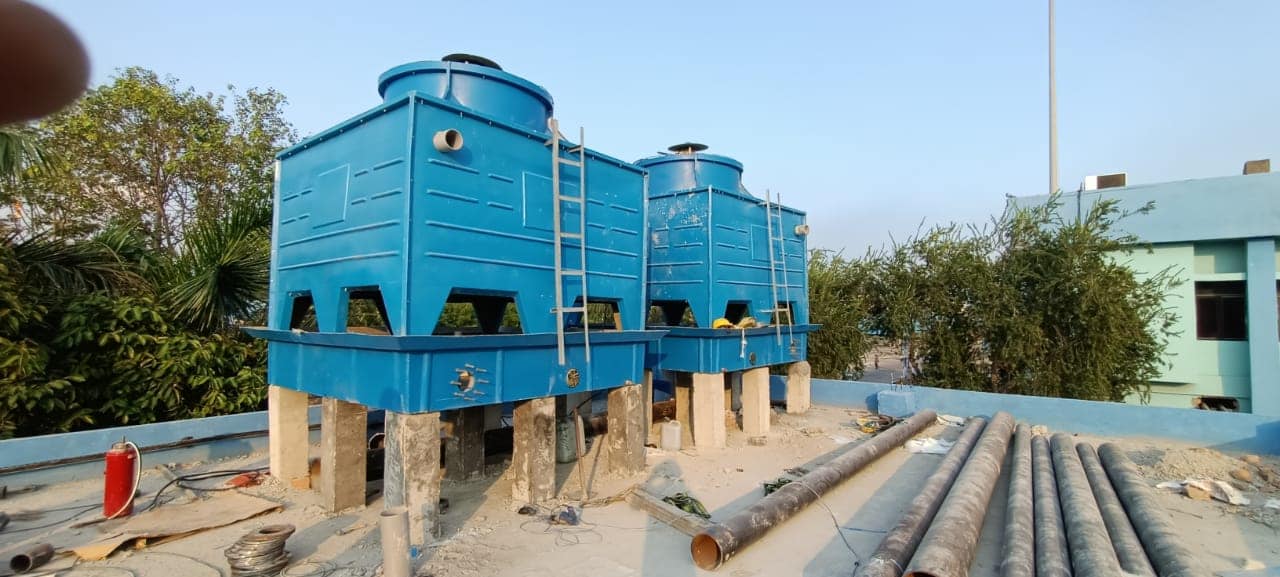
Energy Conservation Opportunities (ECOs) in Cooling Tower Systems
Cooling tower systems offer significant energy savings through fan/pump optimization, water management, and intelligent control. Here are the key opportunities, categorized for clarity:
I. FAN SYSTEM OPTIMIZATION (Largest Savings Potential)
1. Variable Frequency Drives (VFDs) on Fan Motors
- Opportunity: Match fan speed precisely to cooling demand instead of on/off or 2-speed cycling.
- Savings: 30-50% of fan energy. Fan power follows the Cube Law (Power ∝ Speed³). A 20% speed reduction yields ~50% power reduction.
- Implementation: Install VFDs and control based on leaving water temperature or approach.
2. Optimize Fan Operation & Sequencing
- Opportunity: In multi-cell towers, sequence fans strategically.
- Action: Operate more cells at lower speeds rather than fewer cells at full speed (reduces parasitic losses per cell). Use the most efficient cell(s) as the “lead.”
3. High-Efficiency Fan Blades & Motors
- Opportunity: Upgrade to airfoil-shaped fan blades for better aerodynamic efficiency. Replace standard efficiency motors with NEMA Premium or IE4 class.
- Savings: 5-15% improvement in fan system efficiency.
4. Proper Fan Maintenance
- Opportunity: Ensure blades are clean, undamaged, and at correct pitch/pitch angle. Tighten belts or use direct drives to avoid transmission losses.
. PUMP SYSTEM OPTIMIZATION
5. Cooling Tower Pump VFDs
- Opportunity: Many systems run pumps at constant speed, throttling flow with valves. A VFD reduces pump speed to match required flow.
- Savings: 20-30% of pump energy (follows Pump Affinity Laws).
- Caveat: Ensure minimum flow for even distribution and prevent fill dry-out.
6. Optimize Condenser Water Delta-T (ΔT)
- Opportunity: Maintain design Range (e.g., 10°F ΔT). A “low ΔT syndrome” (e.g., 6°F instead of 10°F) forces higher water flow for the same heat rejection, increasing pump energy.
- Root Causes: Dirty chiller condenser tubes, improper control valves, or bypassing.
- Savings: Restoring design ΔT can reduce pump energy by 30-40%.
7. Parallel Pumping Optimization
- Opportunity: In multiple pump systems, optimize pump combination for part-load conditions. Often, one large pump at part load is less efficient than two smaller pumps.
- Action: Install automated controls to select the most efficient pump combination.
III. WATER MANAGEMENT & TREATMENT
8. Optimize Cycles of Concentration (COC)
- Opportunity: Increase COC to the maximum allowable by water quality.
- Savings: Reduces makeup water pump energy, water heating energy (for warm makeup), and chemical treatment costs.
- Action: Use automated bleed controllers tied to conductivity sensors.
9. Side-Stream Filtration
- Opportunity: Continuously filter a portion of the circulating water (2-10% of flow).
- Savings: Maintains clean heat transfer surfaces in the tower fill and chiller condenser, improving overall system efficiency (lower approach, better ΔT). Reduces fouling-related energy penalty.
10. Advanced Water Treatment
Opportunity: Use non-chemical or precision chemical treatment (e.g., pulsed, demand-
- based) to minimize scaling/fouling without excess chemical drag-out.
- Savings: Protects efficiency, reduces Blow down volume, and cuts chemical costs.
IV. OPERATIONAL & CONTROL STRATEGIES
11. Waterside Free Cooling (Water-Side Economizer)
- Opportunity: When ambient wet-bulb is low enough, use the cooling tower directly to produce chilled water, bypassing the chiller.
- Savings: Chiller energy drops to near-zero during suitable conditions. One of the largest ECOs in temperate climates.
12. Wet-Bulb Reset of Leaving Water Temperature
- Opportunity: Automatically reset the tower’s setpoint (cold water temp) based on ambient wet-bulb, not a fixed value.
- Mechanism: As WBT drops, allow tower to produce colder water. This lowers the chiller’s condenser temperature, improving chiller COP significantly (each 1°F drop in condenser water can improve chiller efficiency by 1-2%).
- Savings: Primarily in chiller energy, with a slight increase in fan energy.
13. Optimal Approach Control
- Opportunity: Dynamically balance fan energy against chiller energy. Find the point where fan energy increase = chiller energy savings.
- Action: Use integrated control algorithms that vary tower fan speed to maintain the most cost-effective approach, not the smallest approach.
14. Reduce Parasitic Loads & Heat Gain
- Opportunity: Insulate hot water lines to the tower and cold water lines in hot environments. Ensure sump is shaded/insulated to avoid solar heat gain.
V. MAINTENANCE & RETROFITS
15. Upgrade Fill Media
- Opportunity: Replace old splash fill with modern, high-efficiency film fill (if water quality permits).
- Savings: Improves heat transfer, allowing either reduced fan/pump energy for same duty or increased capacity in same footprint.
16. Ensure Airflow Integrity
- Opportunity: Fix leaks around access doors, seal gaps between fill bundles and walls to prevent air “short-circuiting.”
- Impact: All fan energy is used for cooling, not bypassing.
17. Eliminate Air Inlet/Outlet Obstructions
- Opportunity: Clear debris from louvers, remove nearby structures causing recirculation or interference.
- Impact: Lowers effective entering wet-bulb temperature, improving tower capacity and efficiency.
Summary: The Energy Conservation Hierarchy
Priority 1: Operational & Control Tweaks (Low/No Cost)
- Wet-bulb reset, ΔT optimization, fan/pump sequencing, COC optimization.
Priority 2: Advanced Controls & VFDs (Medium Cost, High ROI)
- Fan VFDs with approach control, pump VFDs, automated bleed, side-stream filtration.
Priority 3: Component Upgrades (Higher Cost)
- High-efficiency fans/motors, fill media replacement, waterside free cooling installation.
Priority 4: System Redesign (Major Retrofit)
- Variable primary flow, optimized pipe sizing, tower replacement.
Key Performance Metrics to Track for Energy Conservation:
- kW/Ton of the entire chilled water system.
- Approach Temperature (trend and vs. design).
- Condenser Water ΔT (Range).
- System COC and makeup water consumption.
- Fan & Pump kWh (sub-metered).
The greatest energy savings typically come from integrating tower operation with chiller optimization (wet-bulb reset, free cooling) rather than viewing the tower in isolation.