

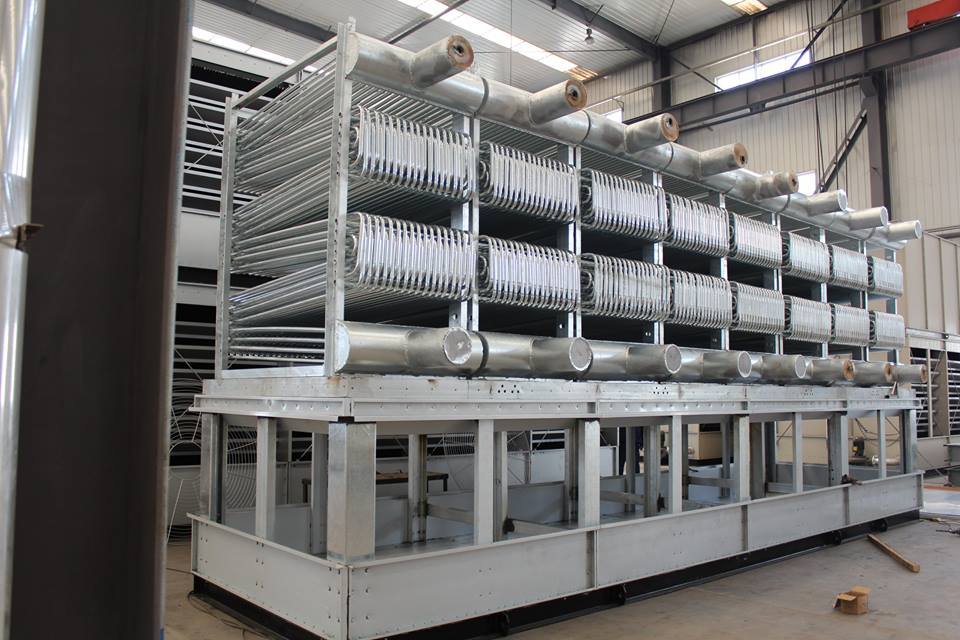
Counter Flow Vs Cross Flow Cooling Tower
The choice between a counterflow and a crossflow cooling tower ultimately comes down to balancing space, energy efficiency, and maintenance accessibility. There isn’t one universally “best” type; the optimal choice depends entirely on your specific project priorities, space constraints, climate, and budget.
Here’s a breakdown of their key differences to help you decide.
How They Work: Air and Water Flow
The names describe the fundamental difference in how air and water interact.
- Counterflow: Air is drawn upwards (vertically), while hot water is sprayed downwards from the top. This means the air and water flow in opposite directions, creating a “counter” flow pattern. The water is distributed via a pressurized spray nozzle system.
Crossflow: Air is drawn horizontally across the falling water. The hot water is simply released from a basin at the top and flows down through the fill by gravity, with no spray nozzles required
Direct Comparison: Pros and Cons
| Feature | Counterflow Cooling Tower | Crossflow Cooling Tower |
| Space (Footprint) | Typically smaller footprint, especially up to ~750 tons of capacity. | Generally larger footprint due to open plenum space. |
| Energy & Pumping | Higher pump head required due to pressurized spray nozzles (adds 3-6 psig). Higher fan power can be required. | Lower pump head as water is gravity-fed. Often requires lower fan power. |
| Maintenance & Access | More limited access; components are stacked vertically, making inspection of the spray system and fill harder. Pump must be off to clean nozzles. | Easier access for inspection and maintenance; the open plenum allows for visual inspection of the fill and cleaning of the water basin while the tower is running. |
| Winter / Cold Weather Operation | Fill is enclosed within the tower, offering some protection from ice. However, low-flow operation can lead to uneven water distribution and ice formation on louvers. | Performs well in cold weather due to gravity-fed basin. Can distribute water evenly even at low flow rates (down to 30%), helping prevent ice on the fill. Better for high turndown. |
| Water Distribution | Pressurized system with spray nozzles. | Gravity-fed from an open hot water basin. |
| Flow Turndown Capability | Up to ~50% turndown. Can struggle with uneven distribution at lower flows. | Up to 70% or more turndown. Distributes water evenly even at low flows. |
| Heat Transfer Efficiency | Potentially more efficient due to longer contact time between opposing air and water flows. | May have slightly lower thermal efficiency for a given size, but this can be offset by design. |
Making Your Choice
Here is a simple guide to help you choose based on your priorities:
- Choose Counterflow if:
- Your floor space is limited and you need a smaller footprint.
Lower operating weight is a critical factor for your installation
- You prefer a more enclosed system that may offer some protection from sunlight and elements.
- Choose Crossflow if:
- Easy maintenance and accessibility are your top priorities. Being able to inspect and clean parts while the tower runs is a major advantage.
- You expect a highly variable heat load (high turndown) and need to operate efficiently at low water flow rates.
- You are in a cold climate and want the most robust protection against ice formation during winter operation.
- You want to minimize pumping and fan energy costs.
Fouling Prevention Considerations
As we discussed earlier, fouling is a key concern. In this context, the crossflow tower’s design gives it a distinct advantage:
- Its open, gravity-fed water distribution system is easily accessible, allowing you to clean the hot water basin while the tower is still online.
- Its high turndown capability prevents the “water channeling” that can lead to scale buildup at low flows.
However, if your water source has a high level of suspended solids, the counterflow tower can be better suited to accommodate a wide variety of fill types (like splash fill) that are more tolerant to dirty water.
In summary, counterflow towers are often the default for space-constrained new installations, while crossflow towers are frequently chosen for their superior maintainability, operational flexibility, and cold-weather performance. If you can share more about the specific application and space constraints, I might be able to provide a more specific recommendation.