

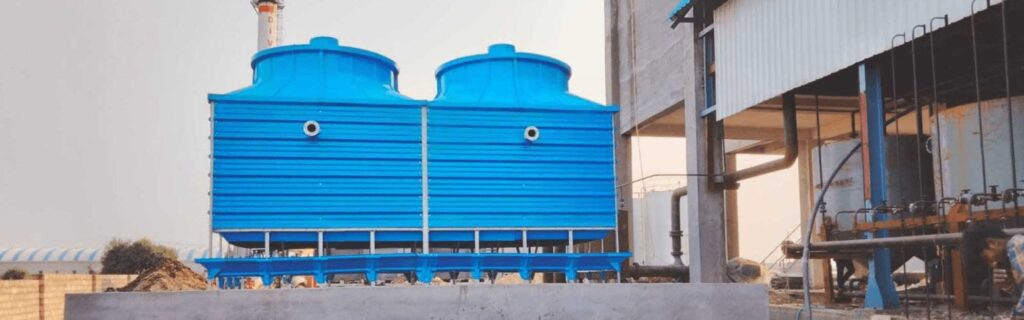
The Fundamental Heat Rejection Process
To understand these terms, visualize the process:
- Hot water from a process (e.g., a chiller condenser) enters the tower at temperature T1.
- It is cooled by evaporation and leaves the tower at a lower temperature T2.
- Ambient air enters with a Wet-Bulb Temperature (WBT).
a) Approach
- Definition: The difference between the temperature of the cold water leaving the tower (T2) and the ambient wet-bulb temperature (WBT).
- Formula: Approach = Cold Water Temperature (T2) – Wet-Bulb Temperature (WBT)
- What it Means: Approach is the ultimate measure of a cooling tower’s capability. It indicates how close the tower can bring the water temperature to the theoretical, physical limit of cooling (which is the wet-bulb temperature, the lowest possible temperature achievable by evaporative cooling).
- Key Insights:
- A smaller approach means better performance (water is closer to the wet-bulb limit). It typically requires a larger tower, more fan power, or better fill.
- A larger approach indicates less effective cooling or an undersized/underperforming tower.
- Design Approach is a critical specification (e.g., “Designed for a 5°F approach”). It directly determines the tower’s size and cost.
b) Cooling Duty (or Cooling Capacity)
- Definition: The total rate of heat rejection the tower can achieve, typically measured in BTU/hour, Tons of Refrigeration, or kilowatts (kW).
- Formula (in BTU/hr):Duty = Water Flow Rate (GPM) x 500 x Range (°F)
- (Where 500 is a constant: 8.33 lb/gal x 60 min/hr x 1 BTU/lb·°F ≈ 500)
- Formula (in BTU/hr):Duty = Water Flow Rate (GPM) x 500 x Range (°F)
- What it Means: This is the “size” or “capacity” of the cooling tower. It answers the question: “How much heat can this tower remove from the water stream?”
- Key Insights:
- 1 Ton of Refrigeration = 12,000 BTU/hr. A tower rated for 1,000 tons can reject 12,000,000 BTU/hr.
- Cooling Duty depends on both water flow and the temperature drop (Range).
c) Range
- Definition: The temperature drop of the water as it passes through the tower. It is the difference between the hot water inlet temperature (T1) and the cold water outlet temperature (T2).
- Formula: Range = Hot Water Inlet (T1) – Cold Water Outlet (T2)
- What it Means: Range is determined by the process heat load, not the tower itself. It tells you how much heat the process (e.g., a power plant condenser, a chiller) is putting into the water.
- Key Insights:
- A large range (e.g., 15°F) means a high heat load is being rejected.
- A small range (e.g., 6°F) means a lower heat load.
- The tower must be sized to achieve this range under specific ambient conditions.
d) Cooling Tower Effectiveness (or Thermal Efficiency)
- Definition: The ratio of the actual cooling (Range) achieved to the maximum possible cooling that could be achieved if the water were cooled to the wet-bulb temperature. It is expressed as a percentage.
- Formula: Effectiveness (%) = (Range) / (Range + Approach) x 100
- Alternatively: = (T1 – T2) / (T1 – WBT) x 100
- What it Means: Effectiveness is a measure of how perfectly the tower is performing its thermodynamic task relative to the ideal limit.
- Key Insights:
- If Approach = 0 (water leaves at WBT), then Effectiveness = 100% (theoretically impossible in practice).
- A higher percentage indicates more efficient heat exchange within the tower.
- Effectiveness is influenced by fill media quality, air/water contact time, and airflow.
Visual Summary & Relationship
Imagine a cooling tower with these conditions:
- Ambient Wet-Bulb Temp (WBT) = 78°F
- Hot Water Inlet (T1) = 95°F
- Cold Water Outlet (T2) = 85°F
Calculations:
- Range = T1 – T2 = 95 – 85 = 10°F
- The process heat load caused a 10°F water temperature drop.
- Approach = T2 – WBT = 85 – 78 = 7°F
- *The tower cooled the water to within 7°F of the ambient wet-bulb limit.*
- Cooling Duty (for 3,000 GPM flow) = 3,000 GPM x 500 x 10°F = 15,000,000 BTU/hr
- *This equals 1,250 Tons of Refrigeration (15,000,000 / 12,000).*
- Effectiveness = Range / (Range + Approach) x 100 = 10 / (10+7) x 100 ≈ 58.8%
- *The tower achieves about 59% of the ideal cooling potential between its inlet water and the wet-bulb temperature.*
Practical Analogy:
Think of cooling a hot cup of coffee in a room.Range: How much the coffee’s temperaturedrops (e.g., from 180°F to 120°F = 60°F Range). This is your “heat load.”
Wet-Bulb Temp: The room’s temperature, but adjusted for humidity’s cooling effect.
Approach: How close the coffee gets to the room’s temperature (e.g., 120°F coffee in a 70°F room = 50°F Approach).
Effectiveness: How good your cooling method is (just sitting vs. blowing air over it vs. adding an ice cube).
Cooling Duty: The total amount of heat removed from the coffee (in BTUs).