

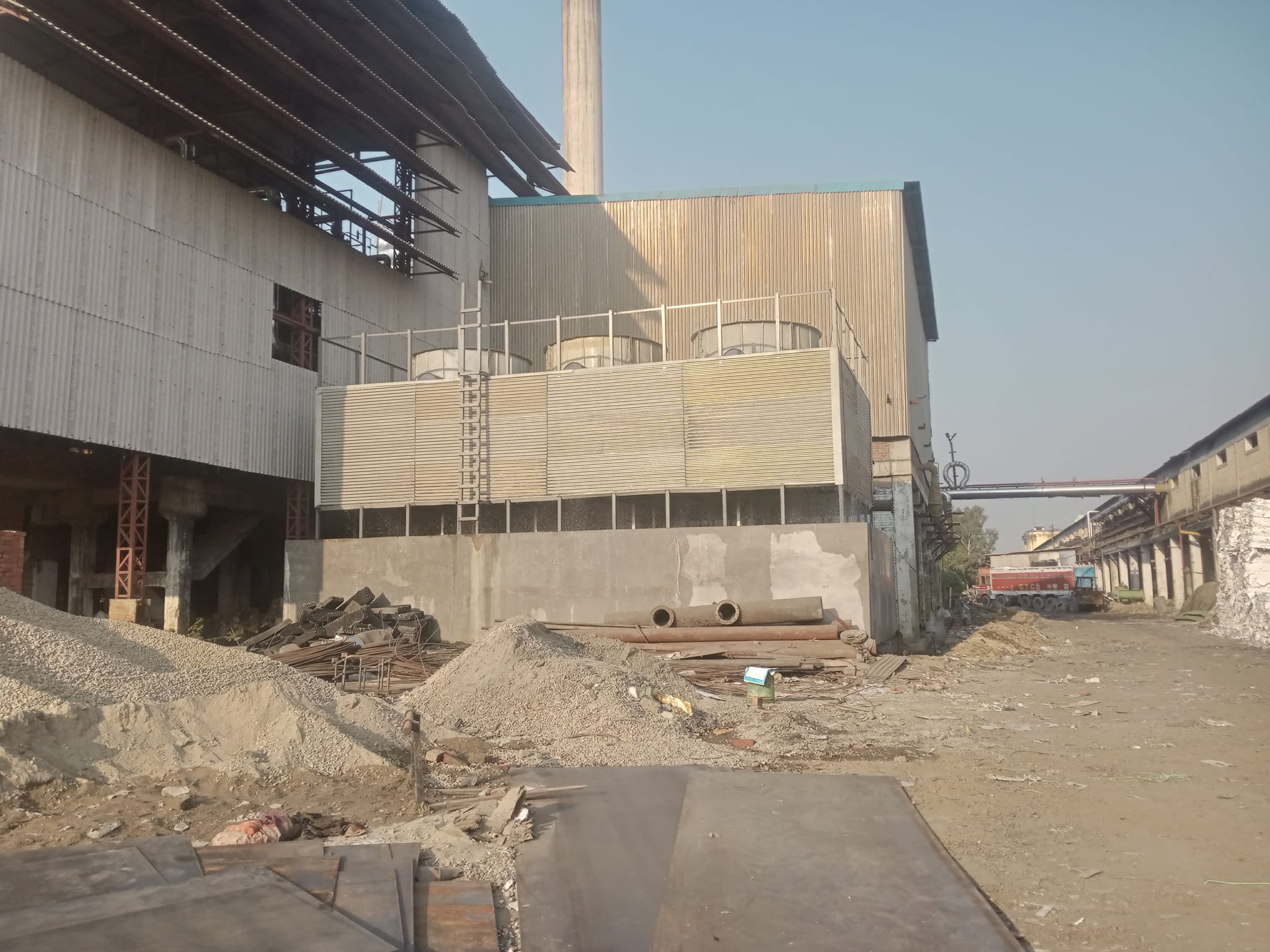
Purpose of a Cooling Tower:
To reject waste heat from a process (like HVAC or industrial cooling) to the atmosphere by evaporating a small portion of the circulating water, thereby cooling the remaining water.
Major Components & Their Functions
1. Structure & Casing
- Function: Provides the tower’s skeletal support and external enclosure. It must withstand environmental loads (wind, seismic) and support the weight of internal components and water.
- Materials: Typically galvanized steel, stainless steel, or for large towers, reinforced concrete. Fiberglass-reinforced plastic (FRP) is common for casing and components.
2. Fill (or Packing) – The “Heart” of Heat Transfer
- Function: Creates a large surface area for maximum contact between hot water and air, enabling efficient heat transfer and evaporation.
- Types:
- Splash Fill: Breaks falling water into small droplets using arranged slats. Durable and resistant to fouling.
- Film Fill: Water spreads into a thin film over closely spaced sheets. More efficient in a smaller space but more prone to clogging from poor water quality.
3. Cold Water Basin
- Function: Located at the bottom, it collects the cooled water after it passes through the fill. It acts as a reservoir for the system’s circulating water pump suction.
4. Drift Eliminators
- Function: Critical for water conservation. They capture entrained water droplets from the exhaust air stream, preventing water loss and chemical treatment bleed-off (visible as the tower’s “plume” or mist).
5. Air Inlet LouversFunction: Located on the sides (in cross flow towers) or at the base (in counter flow
- towers). They help evenly distribute incoming air into the fill zone and prevent water splash-out from the tower.
6. Fan & Drive System – The “Lungs”
- Function: Forces or induces air flow through the tower to maximize heat exchange.
- Components:
- Fan: Large axial fans (propellers) for induced draft; centrifugal fans are sometimes used for forced draft.
- Motor: Provides rotational power.
- Drive Assembly: Transfers power from motor to fan. Can be direct drive (shaft) or gearbox/belt-driven.
- Draft Types:
- Induced Draft: Fan at the top pulls air upward. Most common, offers better air distribution and reduced recirculation.
- Forced Draft: Fan at the bottom pushes air inward. Easier maintenance but more prone to recirculation.
7. Water Distribution System – The “Circulatory System”
- Function: Evenly distributes the hot return water over the top of the fill.
- Components:
- Hot Water Inlet / Basin: Receives hot water from the process.
- Distribution Piping & Nozzles: Spray nozzles or orifices spread the water uniformly. In cross flow towers, open gravity-fed basins with metering orifices are common.
8. Makeup Water Line & Valve
- Function: Automatically replaces water lost by evaporation, drift, and Blow down (bleed-off) to maintain system level. Connected to a float valve or electronic level sensor.
9. Blow down (Bleed-off) Line
- Function: Removes a controlled portion of concentrated circulating water to limit the buildup of dissolved solids (scale and corrosion control). Essential for water treatment.
10. Access & Maintenance Features
- Function: Enable safe inspection and upkeep.
- Components: Ladders, platforms, access doors, and sometimes an interior walkway.
Flow Paths: How It All Works Together
Water Path (Blue Arrow – Typical Counter flow Tower):
- Hot water (from industrial process or chiller condenser) enters the distribution system at the top.
- It is sprayed uniformly over the fill.
- As it trickles down the fill, a thin film or droplets are exposed to upward-moving air.
- A small portion evaporates, removing latent heat and cooling the remaining water.
- Cooled water collects in the cold water basin.
- It is pumped back to the process to absorb more heat, completing the cycle.
Air Path (Green Arrow – Induced Draft):
- Ambient air is drawn in through the inlet louvers.
- It moves upward through the fill, coming into direct contact with the falling hot water.
- The air heats up and becomes humidified.
- It passes through the drift eliminators, which remove water droplets.
- The warm, moist air is exhausted out the top by the fan.
Key Supporting Systems (Often External but Critical)
- Water Treatment System: The most important factor for tower longevity and efficiency. Includes chemical feed (biocides, scale/corrosion inhibitors) and filtration to control biological growth (like Legionella), scaling, and corrosion.
- Controls: Include fan motor VFDs (Variable Frequency Drives) for energy savings, water level controllers, and temperature sensors to modulate tower operation based on the heat load.