

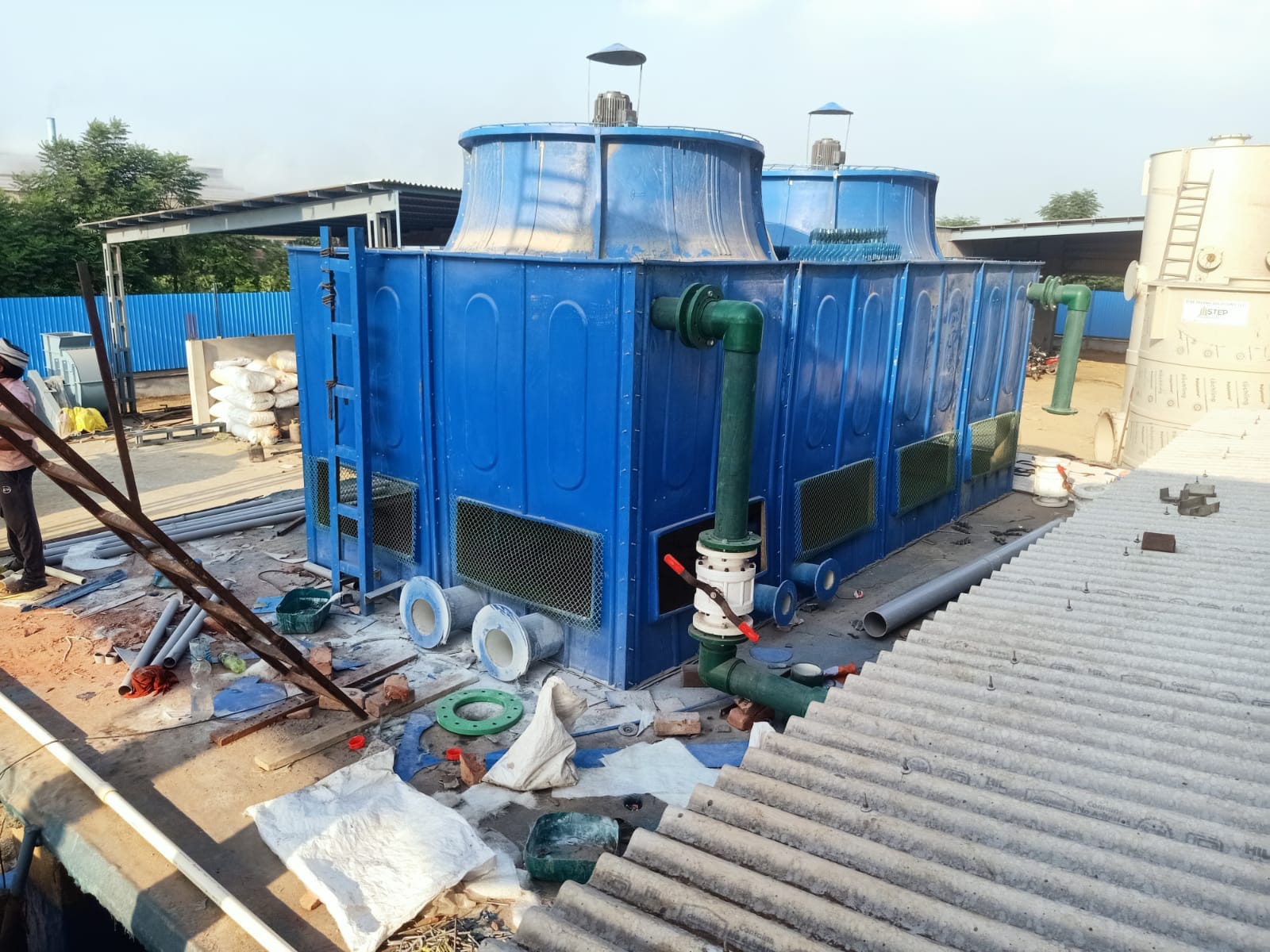
COOLING TOWER
Purpose:
- To reject waste heat from industrial processes or HVAC systems to the atmosphere.
- Uses evaporation to cool water.
Basic Principle:
- Heat transfer through evaporative cooling.
- Warm water is exposed to air; a small portion evaporates, removing latent heat and cooling the remaining water.
Main Types:
- Natural Draft:
- Large hyperbolic towers (common in power plants).
- Relies on natural convection; no fans.
- High capital cost, low operating cost.
- Mechanical Draft:
- Uses fans to move air.
- Forced Draft: Fan at air inlet (noisy, high exit velocity).
- Induced Draft: Fan at top (most common, better air distribution).
Key Components:
- Fill/Packing: Increases water-air contact surface.
- Drift eliminators: Reduce water loss via droplets.
- Cold water basin: Collects cooled water.
- Fans (in mechanical draft).
- Nozzles: Distribute warm water over fill.
Applications:
- Power plants (condenser cooling).
- Refineries, chemical plants.
- HVAC for large buildings.
Advantages:
- Energy efficient (uses latent heat of vaporization).
- Lower water consumption compared to once-through cooling (water recycled).
Disadvantages:
- Water loss via evaporation, drift, blow down.
- Risk of Legionella if not maintained.
- Plume visibility (in cold weather) and potential icing.
Key Terms:
- Range: Temp difference between hot and cold water.
- Approach: Difference between cold water temp and wet bulb temp of air.
- Blow down: Removing concentrated water to limit scaling.
- Make-up water: Replaces lost water (evaporation, drift, blows down).