

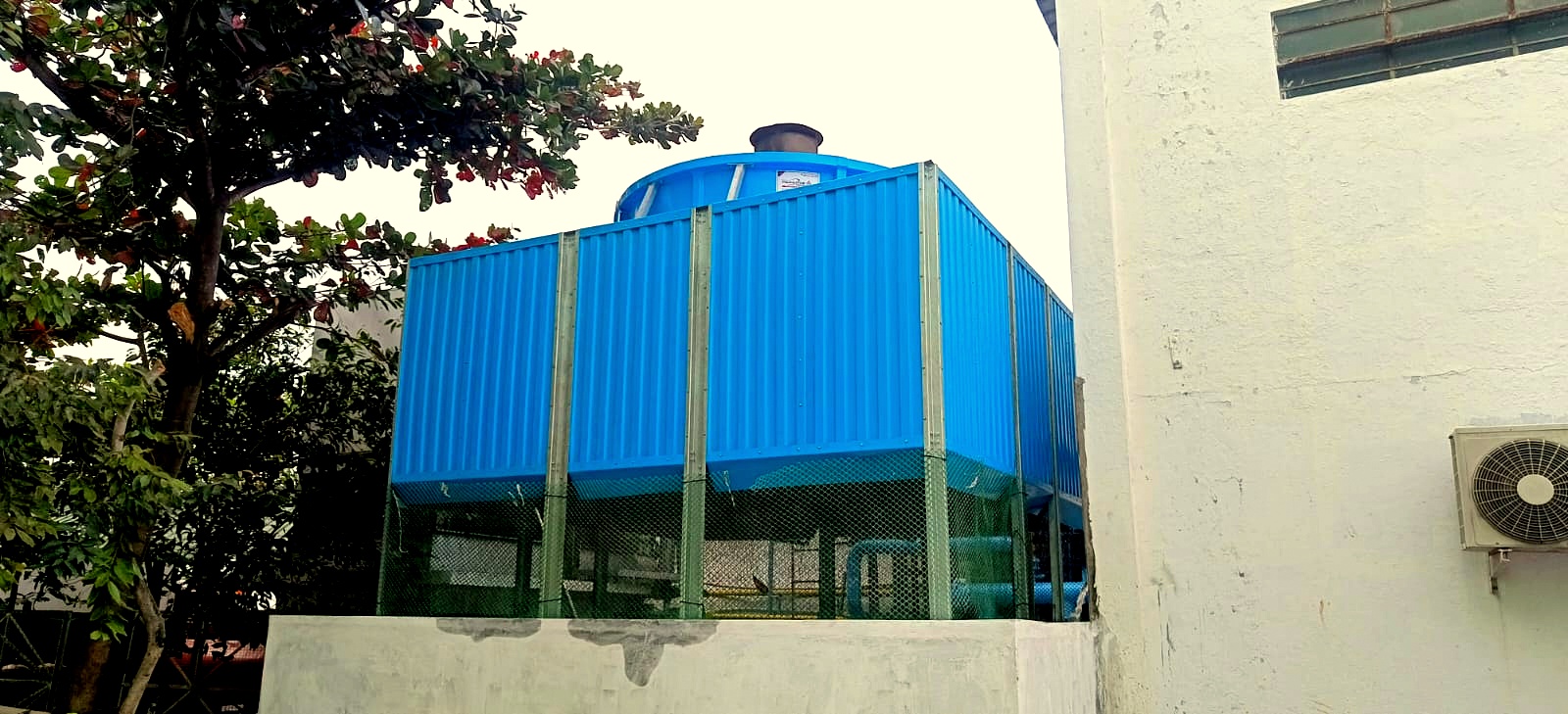
Effect of Wet Bulb Temperature in Cooling Tower
The Wet Bulb Temperature (WBT) is the most critical environmental factor governing the fundamental physics and ultimate limit of a cooling tower’s performance. It is not just an influence; it is the thermodynamic boundary.
Here’s a detailed breakdown of its effect, from core principles to practical implications.
1. The Core Principle: The Thermodynamic Limit
- WBT Definition: The lowest temperature to which air can be cooled by the evaporation of water into it at constant pressure. It is measured with a thermometer whose bulb is wrapped in a wet wick.
- The Unbreakable Rule: A cooling tower cannot cool the circulating water below the ambient Wet Bulb Temperature. This is a law of physics (psychrometrics).
Therefore, WBT sets the absolute floor for the “Cold Water Temperature” leaving the tower basin.
2. Direct Performance Metrics Affected by WBT
Tower performance is measured by two key temperatures derived from the WBT:
A. Approach (The Critical Indicator of Tower Health)
- Formula:
Approach = Cold Water Temperature (CWT) - Wet Bulb Temperature (WBT) - Effect of WBT: For a given tower operating at a constant load, if the WBT rises, the Approach narrows (even if CWT stays the same). More importantly, to maintain the same Approach, the tower must work harder as WBT rises.
- Practical Implication: A rising WBT will cause the CWT to rise unless the tower’s capacity (air/water flow) is increased. This is why towers “struggle” on hot, humid days.
B. Cooling Range
- Formula:
Range = Hot Water Temperature (HWT) - Cold Water Temperature (CWT) - Effect of WBT: While the Range is primarily determined by the heat load (process duty), the WBT dictates the starting point (CWT). A higher WBT forces a higher CWT, which can reduce the effective range if the HWT is fixed by the process.
C. Effectiveness (Efficiency)
Effectiveness = Range / (Range + Approach)or(HWT - CWT) / (HWT - WBT)- Effect of WBT: A lower WBT increases the denominator
(HWT - WBT), resulting in a lower effectiveness number for the same tower output. This seems counterintuitive but makes sense: when the WBT is low, the tower has a much greater “potential” to cool, so it operates further from its maximum capability. A high WBT forces the tower to operate closer to its limit (higher effectiveness number), but with a worse (higher) cold water temperature.
3. Practical Operational Impacts of Changing WBT
Scenario 1: HIGH Wet Bulb Temperature (Hot & Humid Day)
- Result: Higher Cold Water Temperature.
- Chain Reaction:
- Reduced temperature difference (
ΔT) between process and cooling water.
- Process Impact: Heat exchangers become less effective. Condensing pressures rise in chillers. Process output may fall, or energy consumption may increase to maintain production.
- Tower Response: To try and lower CWT, operators may increase fan speed (if VFDs are present), turning on more cells, or increasing water flow. This increases energy consumption (fan kW).
- Reduced temperature difference (
- Risk: The tower may reach its capacity limit and fail to meet the required cooling duty.
Scenario 2: LOW Wet Bulb Temperature (Cold & Dry Day)
- Result: Lower Cold Water Temperature.
- Chain Reaction:
- Increased
ΔTfor heat exchangers, improving efficiency.
- Energy Savings: Fan speeds can often be reduced, saving significant power.
- Critical Risk – FREEZING: Water in the exposed fill or distribution decks can freeze, leading to catastrophic structural damage (ice weighs down and collapses fill). Towers require winterization measures (e.g., fan cycling, basin heaters, reversing fan direction).
- Increased
4. Design and Sizing Implications
- Design WBT: Cooling towers are rated for a specific “design WBT” (e.g., 78°F / 25.6°C). This is typically based on the 1% or 2.5% annual occurrence value for a location (meaning the WBT is at or below this value for 99% or 97.5% of the year).
- The Trade-Off: Choosing a higher design WBT means a smaller, cheaper tower, but it will fail to meet cooling requirements more often. Choosing a lower design WBT means a larger, more expensive tower that provides a safety margin for extreme conditions.
- Location is Destiny: A tower designed for Phoenix (low humidity, high dry-bulb) will have a very different WBT profile than one for Miami (high humidity) or Chicago (variable).
5. The Problem of Air Recirculation
This is a self-inflicted WBT increase.
- What it is: When the hot, saturated exhaust air from the tower is sucked back into the air inlets.
- Effect: The air entering the tower now has a higher WBT than the true ambient air. This directly and negatively impacts performance as if the day were more humid.
- Cause: Poor tower siting (near walls, other towers), high wind, or improper fan operation.
Summary: The Wet Bulb Temperature as the “Gravity” of Cooling Towers
| Aspect | Effect of HIGH WBT | Effect of LOW WBT |
| Cold Water Temp (CWT) | Increases (Performance Challenge) | Decreases (Energy Opportunity) |
| Approach (CWT – WBT) | Narrows (must monitor closely) | Widens (tower has “spare” capacity) |
| Fan Energy | Increases (to fight high CWT) | Decreases (can slow fans) |
| Process Cooling | Degrades (lower ΔT) | Improves (higher ΔT) |
| Primary Risk | Loss of Production / Capacity | Ice Formation & Damage |
| Tower Sizing | Smaller tower possible, but less reliable | Larger tower needed, more capital cost |
In essence, the Wet Bulb Temperature is the relentless force against which every cooling tower works. It defines the possible, sets the efficiency curve, and dictates daily operational strategy. All cooling tower management is, fundamentally, the art of responding optimally