

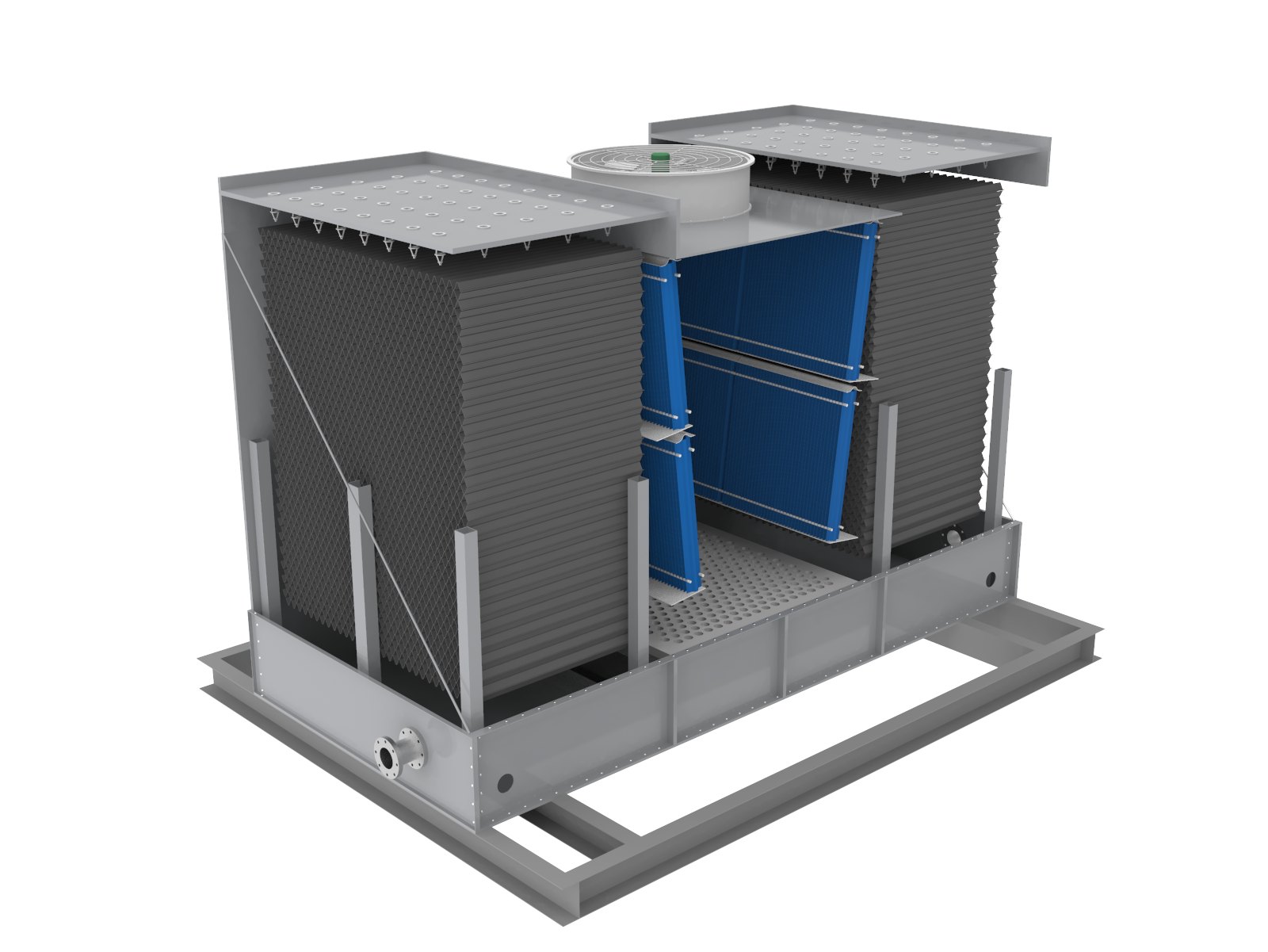
Forced Draft (V-Flow) Closed Circuit Cooling Tower
Forced Draft V-Flow Closed Circuit Cooling Tower by explaining each part of its name and how it works.
- Closed Circuit: This is the most critical part. The process fluid (the water or glycol mixture that needs to be cooled, often from a chiller condenser, industrial process, or data center) never comes into direct contact with the outside air or the cooling water. It flows inside a coil (usually copper or stainless steel). This keeps it clean and uncontaminated, which is essential for protecting expensive equipment.
- Cooling Tower: It rejects waste heat to the atmosphere through the principle of evaporative cooling.
- Forced Draft: This describes the fan and airflow arrangement. A forced draft tower has a blower (fan) located at the air inlet, pushing ambient air into the tower. This creates positive pressure inside the tower casing.
V-Flow (or Vertical Flow): This describes the path of the spray water (the separate, external water loop) and air. The spray water is pumped to the top and falls vertically down over the coil. The air, pushed by the fan, flows horizontally across the falling water and the coil. This creates a “V” or cross-flow pattern for the spray water and air relative to the coil’s surface.