

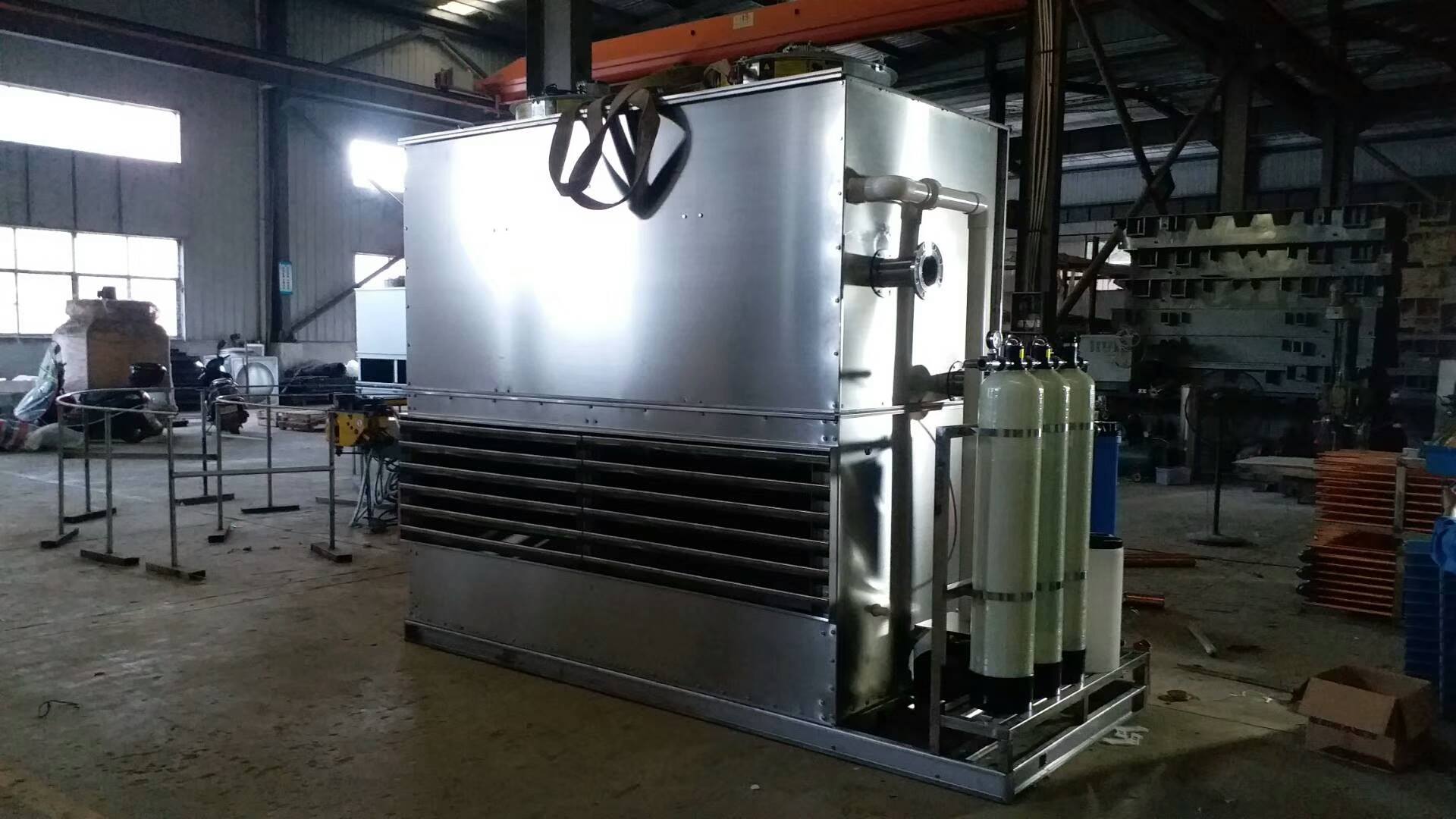
A Closed-Circuit Cooling Tower (often called a Fluid Cooler or a Closed Loop Cooling Tower) is a specialized type of heat exchanger that cools a process fluid (water or a water-glycol mixture) in a closed loop, without exposing it directly to the atmosphere or the outside environment.
Here’s a breakdown of how it works, its key components, and why it’s used.
Core Principle: Two Separate Circuits
This is the most important concept. A closed-circuit cooling tower has two completely independent fluid circuits:
- Primary (Process) Circuit (Closed Loop):
- This is the fluid you need to cool (e.g., water for a laser cutter, glycol for a plastic injection moulding machine, condenser water for a chiller).
- It circulates inside copper or stainless-steel coils and is never exposed to the air. It stays clean and at a controlled pressure and chemistry.
- Secondary (Cooling) Circuit (Open Loop):
- This is just plain water (often called “evaporative water” or “make-up water”).
- It is pumped from the tower’s basin and sprayed over the outside of the coils containing the hot process fluid. This water is open to the atmosphere, and a small portion evaporates to provide the primary cooling effect.