

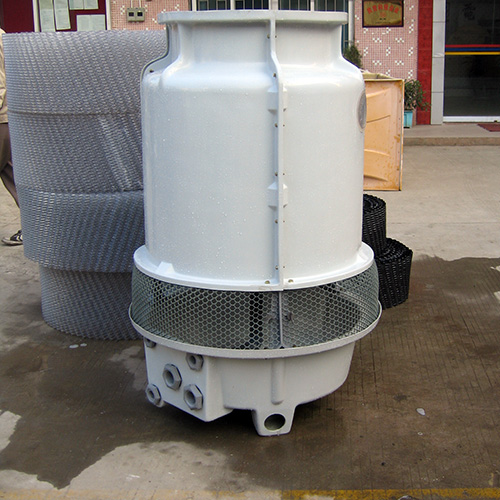
Cooling tower for Chemical & Pharmaceutical
Chemical & Pharma Manufacturing
A. Safety: Preventing Runaway Reactions
This is the most critical role in chemical plants.
- Scenario: Many chemical reactions (e.g., polymerization, nitration, hydrogenation) are highly exothermic. If the heat generated is not removed faster than it is produced, the reaction rate can accelerate uncontrollably.
- Role of Cooling Tower: Provides a guaranteed, high-capacity sink for the cooling water circulating through the reactor jacket or internal coils. A failure can lead to a thermal runaway, resulting in toxic releases, explosions, or fires.
- Requirement: Systems are designed with high redundancy (N+1 or 2N cooling towers, backup pumps, emergency water supplies) and are often tied to Safety Instrumented Systems (SIS).
B. Product Quality & Yield: Controlling Kinetics and Selectivity
Temperature dictates everything in chemistry.
- Reaction Rate: The rate of most reactions doubles with every 10°C increase (Arrhenius equation). Precise cooling allows for controlled reaction speeds.
- Selectivity: In complex reactions, one temperature favors the desired product (A), while another favors a wasteful or harmful byproduct (B). Cooling towers enable the precise isothermal control needed to maximize yield of A.
- Crystallization & Precipitation: The cooling rate directly determines crystal size, shape, and purity of Active Pharmaceutical Ingredients (APIs). This affects drug bioavailability, filtration, and drying. Cooling towers provide the stable, gradual cooling often required.
- Distillation & Fractionation: Condenses overhead vapors in distillation columns. Precise cooling water temperature control is key to maintaining column pressure and achieving sharp separation of components.
C. Condensation & Recovery of Volatile Compounds
- Solvent Recovery: After reactions, solvents (like methanol, acetone, toluene) are often evaporated and must be recovered. Cooling towers supply cold water to condensers, turning solvent vapors back to liquid for reuse, reducing cost and environmental impact.