

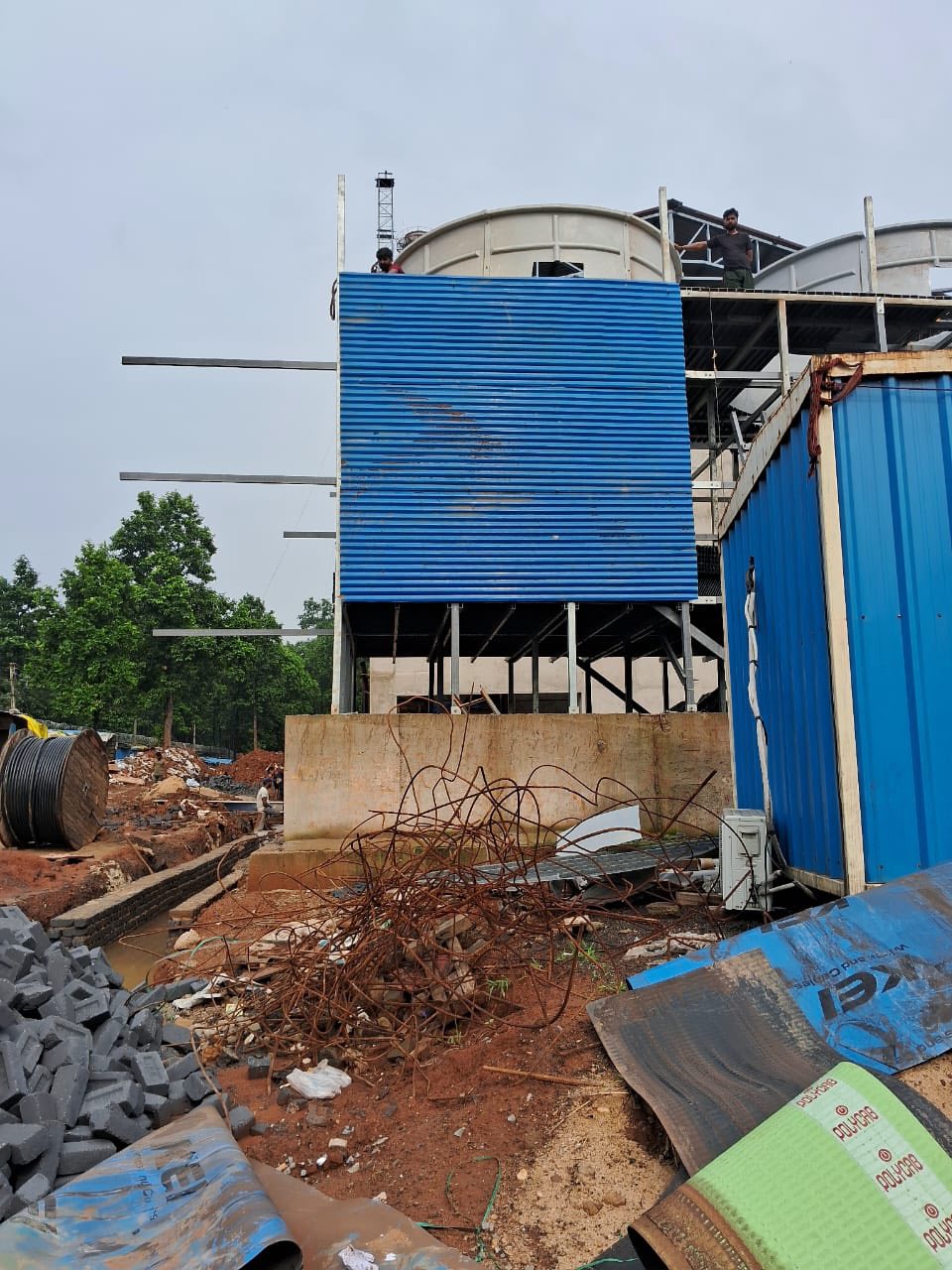
Use of cooling tower in Medium-capacity industrial cooling
Moving from commercial HVAC to medium-capacity industrial cooling shifts the focus from human comfort to process cooling, where reliability, precise temperature control, and handling unique thermal loads become paramount.
While the core thermodynamic principle (rejecting heat via evaporation) remains the same, the use, design priorities, and integration of cooling towers differ significantly in an industrial context.
Here’s a breakdown of the use of cooling towers in medium-capacity industrial cooling:
Core Industrial Use: Process Heat Rejection
The cooling tower is not for air conditioning; it’s a critical piece of process infrastructure. Its job is to maintain a stable, often specific, temperature for machinery, chemical reactions, or manufacturing steps by continuously removing waste heat.
Key Industrial Applications:
- Plastics & Injection Molding: Cools hydraulic power units and the molds themselves. Precise, consistent mold temperature is critical for product quality, cycle time, and preventing defects.
- Metal Plating & Finishing: Cools rectifiers (which convert AC to DC for electroplating) and the plating bath solutions. Overheating can ruin chemical baths and cause plating failures.
- Food & Beverage Processing:
- Brewing/Distilling: Cools wort after boiling (using a “wort chiller” often tied to tower water) and condenses spirits.
- Dairy: Cools milk rapidly after pasteurization.
- General: Cools compressors for refrigeration and freezing lines.
- Chemical & Pharmaceutical Manufacturing: Removes heat from exothermic reactions in reactors and condensers in distillation columns. Temperature control is often a direct safety and product purity issue.
- Power Generation (Small-scale/Co-gen): Provides condenser cooling for turbine exhaust steam in small turbines or backup generators.
- Laser & Welding Systems: Cools high-powered laser cutting heads and welding equipment to prevent thermal damage and maintain precision.
Die Casting & Forging: Cools the hydraulic systems that power heavy machinery
Key Differences from Commercial HVAC Use:
| Aspect | Commercial/Institutional HVAC | Medium-Capacity Industrial Cooling |
| Primary Goal | Maintain human comfort (air temperature/humidity). | Maintain process stability, product quality, and equipment protection. |
| Load Profile | Varies with occupancy and weather; more predictable diurnal cycle. | Can be constant, severe, and high-density (e.g., a 500kW laser running 24/7). Less seasonal variation. |
| Temperature Criticality | Moderate (e.g., supply chilled water at ~45°F/7°C). | Highly critical. A few degrees can ruin a batch of chemicals, plastic parts, or cause machine shutdown. |
| System Integration | Linked to a chiller to produce chilled water for air handling units. | Often linked directly to a process cooler or heat exchanger. May cool: • Hydraulic oil • Process fluids (water, glycol, oils) • Machinery (compressors, generators) • Condensers for refrigeration. |
| Water Quality Demands | Important (for Legionella prevention & scale). | Extremely Stringent. Process contamination is unacceptable. Closed-loop circuits with plate-and-frame heat exchangers are common to isolate the “dirty” tower water from the clean process water. |
| Redundancy & Reliability | Important for comfort (e.g., office building). | Critical for production. A tower failure can mean lost production, ruined product, and damaged equipment. N+1 designs (a backup tower) are common. |
| Materials of Construction | Typically galvanized steel, stainless steel, or fiberglass. | Often corrosion-resistant materials (e.g., stainless steel, special coatings) due to harsher environments (chemical vapors, salts) or the need for very pure water (e.g., in food/pharma). |
Specialized Industrial Configurations:
- Closed-Circuit Cooling Towers (Fluid Coolers): The process fluid flows through a coil, and water is sprayed over the coil. This 100% isolates the process fluid from exposure to the atmosphere, preventing contamination and minimizing water treatment needs. Very common in plastics, lasers, and food processing.
- Hybrid (Adiabatic) Towers: Combine dry air cooling with evaporative cooling. They save significant water when the ambient temperature is low—a major consideration in water-scarce areas or for sustainability goals.
Factory-Assembled vs. Field-Erected: Medium-capacity industrial needs are often met with robust, factory-assembled towers designed for heavy-duty service, as opposed to the larger, field-erected towers of heavy industry or the smaller packaged towers of some commercial buildings
Critical Industrial Considerations:
- Make-up Water & Treatment: Evaporative loss and blowdown (draining concentrated water) consume large volumes of water. Sophisticated water treatment is non-negotiable to control scale, corrosion, and biological growth (especially Legionella, a serious risk near industrial sites).
- Heat Load Stability: The tower must be sized and controlled to handle a steady, high heat load, not just a peak summer design day.
- Freeze Protection: In cold climates, industrial towers that run year-round require careful design (e.g., basin heaters, variable-speed fans, water bypass systems) to prevent ice formation.