

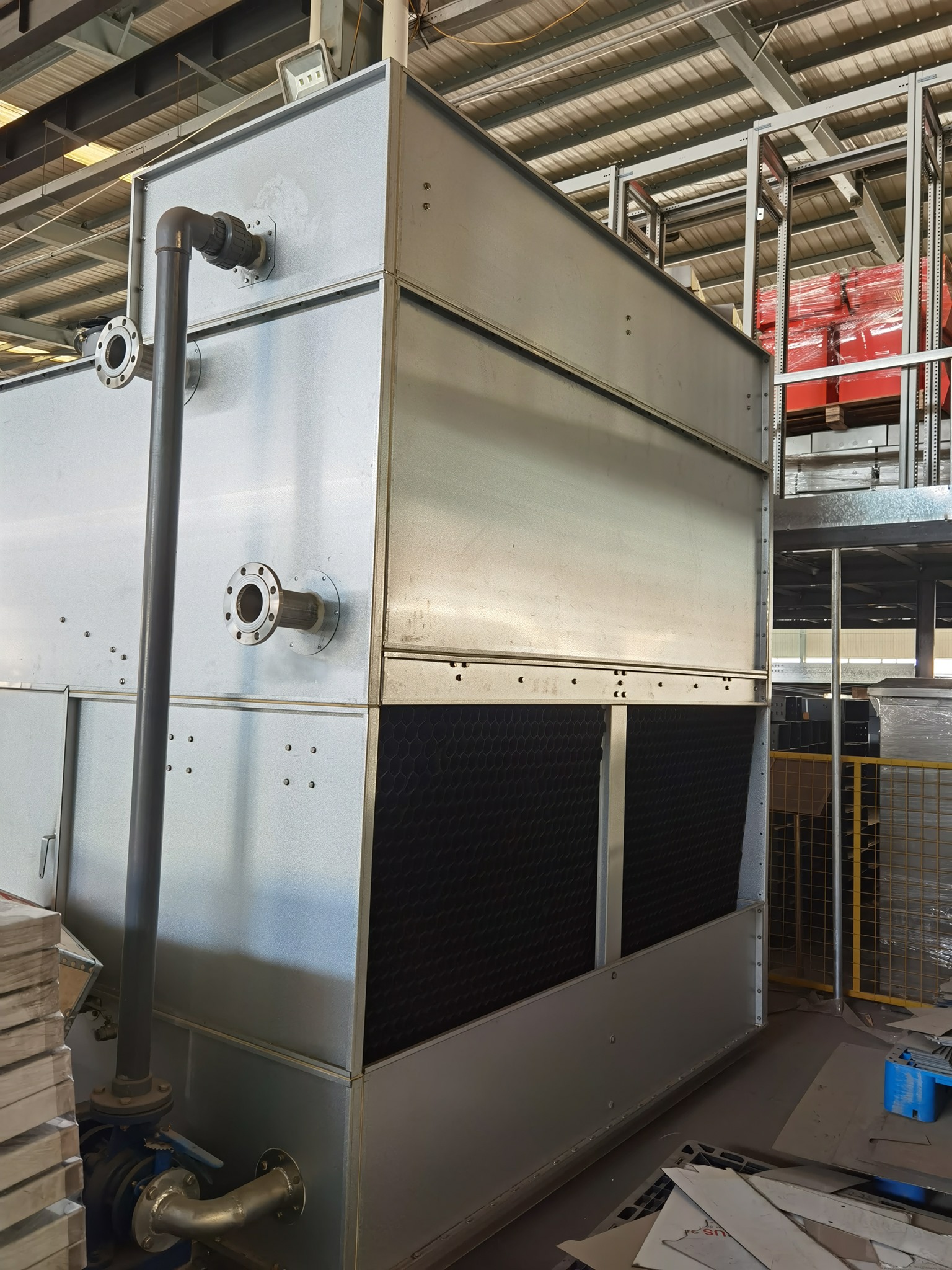
Applications of Closed-Circuit Cooling Tower
The applications of Closed Circuit Cooling Towers (CCTs) are driven by their core advantage: protecting a clean, pressurized, and precisely controlled process fluid loop. They are the preferred choice wherever cooling water contamination, scaling, or freezing would cause operational failure, high maintenance costs, or product damage.
Here is a comprehensive breakdown of their key application areas:
1. HVAC & Building Services
This is one of the largest and most common applications.
- Chiller Condenser Cooling: Cooling the condenser water loop for water-cooled chillers in office buildings, hospitals, campuses, and data centers. Protects the expensive chiller from fouling and allows for easy glycol addition in cold climates.
- Heat Pump (Water-Source) Systems: Rejecting heat from the closed water loop in geothermal or boiler-tower heat pump systems.
- District Cooling Plants: Used in large central utility plants that distribute chilled water, where system reliability and cleanliness are paramount.
2. Critical Industrial Manufacturing & Processes
Where process integrity is non-negotiable.
- Plastics & Injection Molding: Cooling the hydraulic oil and mold temperature control units (TCUs). Any scale or debris in the cooling lines can ruin expensive molds and cause defective parts.
- Laser Systems: Cooling high-power industrial lasers (CO2, fiber) used for cutting, welding, and engraving. These systems require ultra-pure, particle-free water at stable temperatures for optimal performance and longevity.
- Medical Equipment: Cooling MRI machines, CT scanners, and linear accelerators (for cancer treatment). These devices have sensitive, high-cost components that demand perfectly clean coolant.
- Food & Beverage Processing: Cooling process lines, mixing vats, compression systems, and packaging machinery. The closed loop prevents any risk of contaminating the product if a heat exchanger leaks.
- Pharmaceutical & Chemical Production: Maintaining precise temperatures in reactors, fermenters, and distillation columns without risking chemical cross-contamination or biological growth in the cooling lines.
- Die Casting & Stamping: Cooling hydraulic systems and machine tools.
3. Power Generation & Energy
- Generator & Turbine Cooling: Cooling hydrogen, lube oil, and air compressors for gas and steam turbines.
- Biomass/Biogas Plants: Cooling generator jackets and auxiliary systems.
- Solar Thermal Plants: Heat rejection in closed-loop cycles.
- Backup Diesel Generators: Cooling the jacket water for standby power generators.
4. Data Centres & Telecommunications
- Water-Side Economization: Cooling the condenser water loop for chillers in indirect evaporative cooling schemes. This allows using “free cooling” (outside air) efficiently while keeping the IT cooling loop completely sealed and clean.
- Direct Chip Cooling: In advanced liquid-cooled servers, a secondary CCT can cool the closed-loop fluid that circulates directly to server racks or heat exchangers near the IT equipment.
5. Specialized & Niche Applications
- Welding Systems: Cooling robotic welding arms and resistance welders.
- Vacuum Systems: Cooling diffusion pumps and furnaces.
- Analytical & Laboratory Equipment: Cooling MRI spectrometers, electron microscopes, and X-ray diffraction equipment.
- Ice Rinks: Cooling the brine or glycol loops that freeze the rink surface.
- Marine & Offshore: Used on ships and platforms where space is limited, air-cooling is insufficient, and seawater cannot be used directly due to corrosion and fouling.