

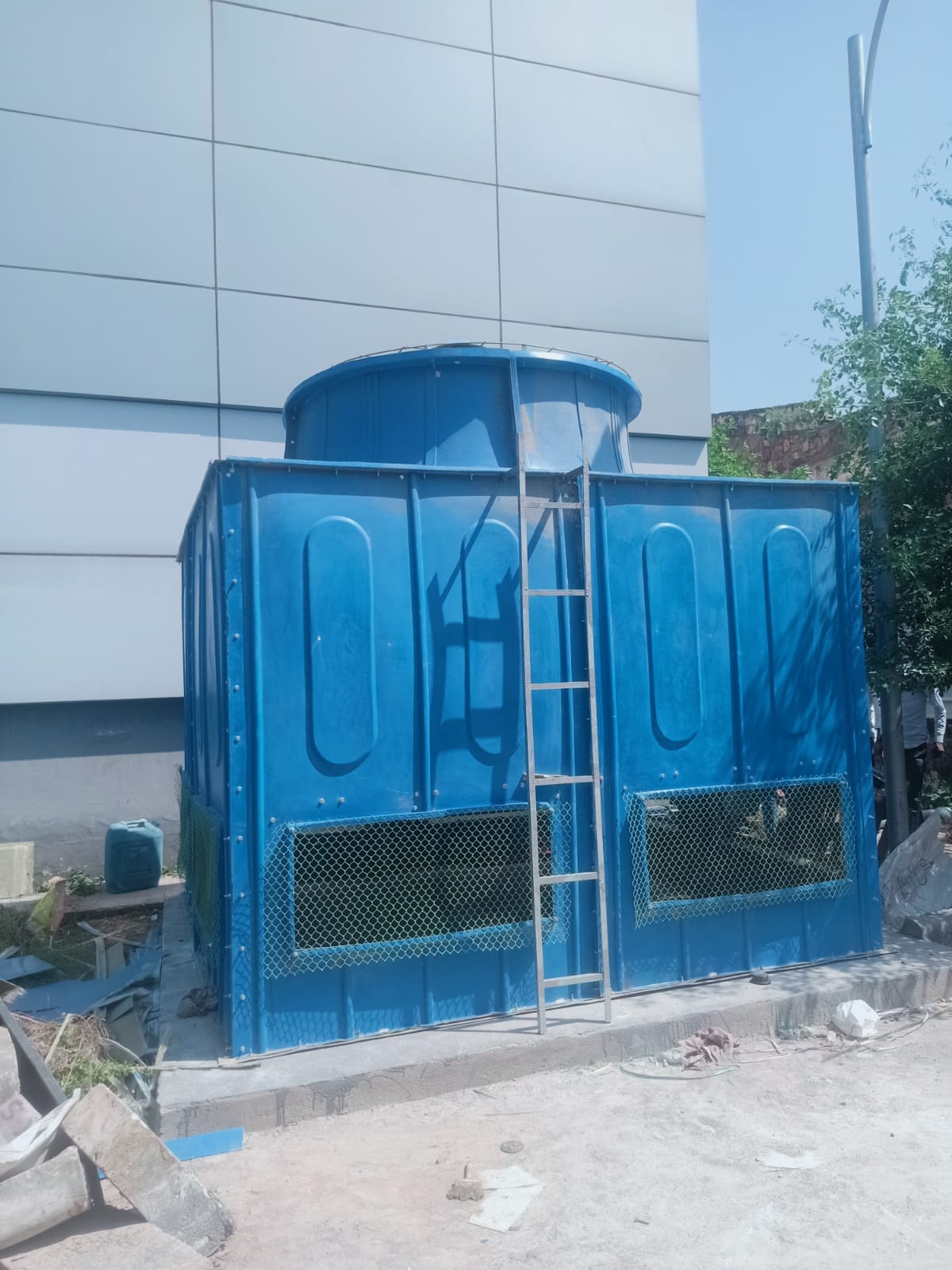
Double Cross Flow Cooling Tower
DOUBLE CROSSFLOW COOLING TOWER
Definition & Core Concept
A Double Crossflow Cooling Tower is a mechanical draft, crossflow design where air is drawn horizontally from two opposite sides of the tower, passes through two separate fill sections, and converges into a common plenum before being exhausted vertically by a centrally located fan at the top. It is essentially two single-flow crossflow towers mirrored and combined into one structure with a shared fan and basin.
Visual: Imagine a rectangular tower with air inlet louvers on both long sides, fill packs on both sides, and a single large fan on the center of the roof.
How It Works (Air & Water Path)
- Water Distribution:
- Hot water is pumped to a central, open gravity distribution basin that spans the top of the tower.
- Water flows out of orifices on both sides of this basin, cascading down vertically over two separate fill packs (one on each side).
- Air Flow (Double Inlet):
- Ambient air is pulled horizontally through inlet louvers on both sides of the tower.
- The air streams flow inward, perpendicular to the falling water in the two fill sections (this is the crossflow principle).
- Heat Transfer & Convergence:
- Evaporative cooling occurs as air contacts the water film in both fill sections.
- The two air streams converge into a common central plenum (an open space between the fills).
- Exhaust:
- A single, large induced draft fan (or multiple fans) at the top of the central plenum pulls the combined, warmed moist air upward.
- The air passes through drift eliminators and is exhausted vertically.
- Water Collection:
- Cooled water from both fill sections collects in a single, common cold water basin at the bottom for recirculation.
Key Components (Specific to Double Crossflow)
- Dual Inlet Louvers: On both long sides of the tower.
- Central Hot Water Distribution Basin: A long, open basin with water distribution on two sides.
- Two Fill Sections / Bays: Located on either side of the central plenum.
- Central Plenum: The open airway between the fill sections where air streams mix before reaching the fan.
- Induced Draft Fan(s): Centrally mounted on the fan deck over the plenum.
- Common Cold Water Basin: Serves both fill sections.
Advantages
- High Capacity in a Compact Footprint: The double-sided air inlet allows for twice the fill area and air intake compared to a single-flow tower of the same plan dimensions. This makes it ideal where length is limited but width is available.
- Balanced Airflow: Symmetrical design promotes even air distribution and water loading, improving overall thermal efficiency.
- Excellent Accessibility: The central plenum provides full, internal access to both fill banks from inside the tower for inspection and maintenance.
- Reduced Pumping Head: Like all crossflow designs, it uses gravity distribution, requiring lower pump pressure than counterflow nozzle systems.
- Common Basin & Fan: Simplifies piping, water treatment feed points, and reduces the number of fans/motors compared to two separate towers.
Good for Dirty Water: The open distribution basin and typical use of splash fill (or easy-clean film fill)
handle suspended solids better.