

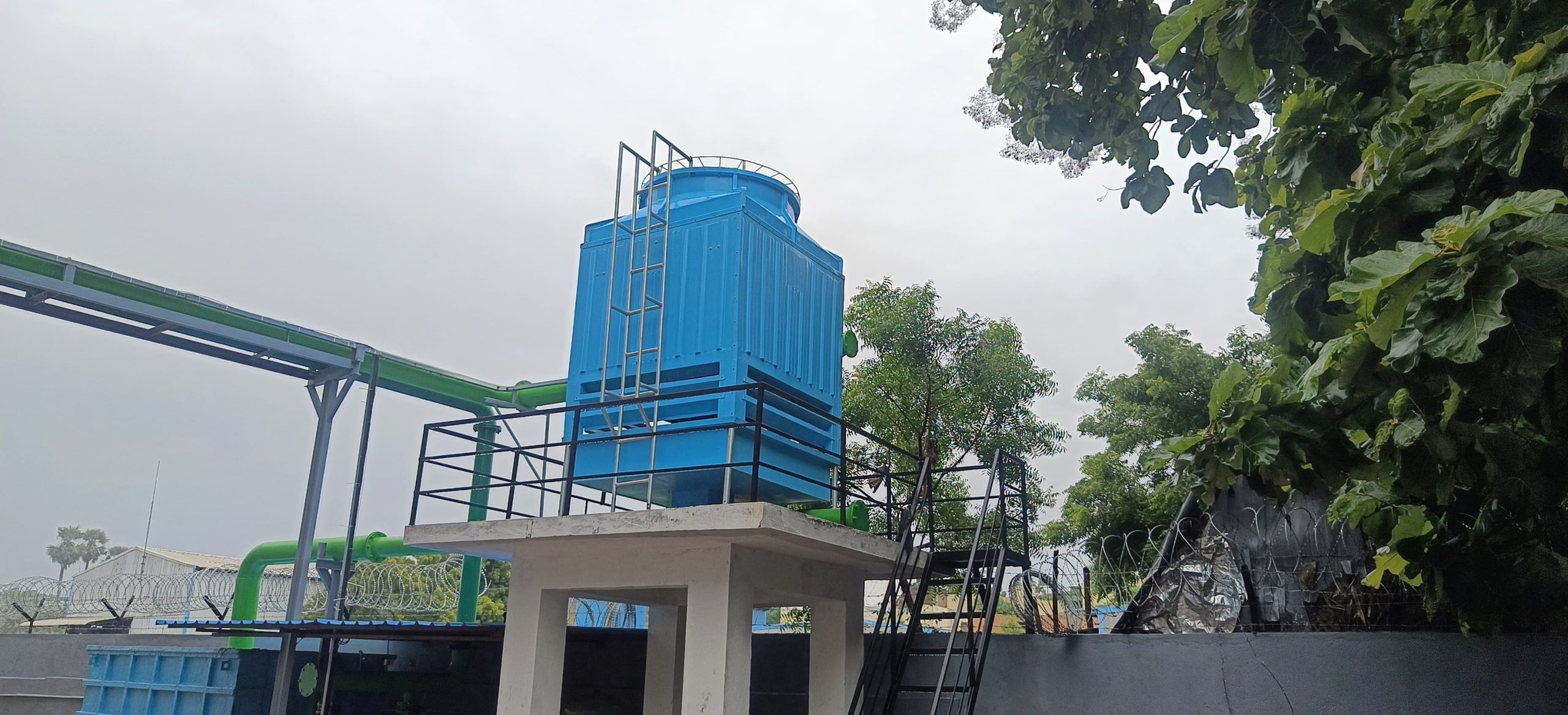
SIZING A COOLING TOWER
Core Concept
Sizing a cooling tower involves determining its required thermal capacity (heat rejection rate) and physical dimensions to meet specific process cooling needs under design ambient conditions, while balancing capital and operating costs.
1. KEY INPUTS FOR SIZING (Design Parameters)
A. Thermal Load (Heat to be Rejected)
- Primary Input. Determines the tower’s capacity.
- Sources:
- From Chiller Condenser:
Q (kW or tons) = Chiller Capacity × (1/COP + 1)(approx.)
- From Process: Direct measurement or calculation:
Q = m × Cp × ΔT
where:m= Water flow rate (kg/s or gpm)Cp= Specific heat of water (~4.18 kJ/kg·°C or 1 BTU/lb·°F)ΔT= Temperature rise in process (Range)
- From Chiller Condenser:
- Units:
- Refrigeration Tons (RT): 1 RT = 12,000 BTU/hr = 3.516 kW
- kW or MW for large industrial.
B. Water Flow Rate
- Often predetermined by process or system design.
- Typical Range: 3 gpm/ton for standard HVAC (~0.054 l/s per kW) to higher flows for industrial processes.
C. Design Wet-Bulb Temperature (Design WBT)
- The most critical environmental factor.
- Based on historical weather data for the location (e.g., 0.4%, 1%, or 2.5% annual exceedance values).
- 0.4% WBT: Temperature exceeded only 0.4% of hours in a year (35 hrs). More conservative, larger tower.
- 2.5% WBT: Exceeded 2.5% of hours (219 hrs). More common, smaller tower.
- Selection impacts cost significantly. A 1°C lower design WBT can increase tower size 10-15%.
D. Water Temperatures
- Hot Water Temperature (HWT): Temperature from process/condenser to tower inlet.
Typical HVAC: 35°C (95°F)
Industrial: Can be 45-50°C+. - Cold Water Temperature (CWT): Required temperature returning to process.
Typical HVAC: 29.4°C (85°F)
Industrial: Varies by process need.
E. Key Calculated Parameters
From above inputs:
- Range = HWT – CWT
Typical HVAC: 5.5°C (10°F)
Industrial: Can be 8-15°C. - Approach = CWT – Design WBT
Typical: 2.8-4.5°C (5-8°F). Closer approach requires larger tower.
2. SIZING METHODS & CALCULATIONS
Method 1: Using Manufacturer’s Ratings & Selection Software
- Most common method. Use published rating tables or software from vendors (BAC, SPX, Evapco, etc.).
- Process:
- Input: GPM, HWT, CWT, Design WBT.
- Output: Tower Model, Fan Motor HP, Physical Dimensions.
- Select the smallest tower that meets or exceeds required capacity at design conditions.
Method 2: Cooling Tower “Ton” Rating
- Definition: 1 Cooling Tower Ton = Rejection of 15,000 BTU/hr when cooling water from 35°C to 29.4°C (95°F to 85°F) at a Design WBT of 26.7°C (80°F).
- Sizing Formula (Approximate):
Required Tower Tons = (Actual Heat Load in BTU/hr) / 15,000- Then apply correction factors for different approach and WBT using manufacturer’s curves.
Method 3: Psychrometric & Merkel Theory (Engineering Design)
- Uses the Merkel Equation to calculate required KaV/L value (Tower Characteristic).
- KaV/L = f(Range, Approach, WBT)
- This value is used to select fill volume and tower geometry.
- Software/Tools: CTI (Cooling Tower Institute) standards, proprietary sizing programs.
. PRACTICAL SIZING STEPS
Step 1 – Define Operating Conditions:
- Determine design WBT, HWT, CWT, water flow rate (GPM), heat load.
Step 2 – Calculate Range & Approach:
- Range = HWT – CWT
- Approach = CWT – WBT
Step 3 – Preliminary Selection:
- Use manufacturer’s catalog. Find a model where at the design WBT and given GPM, the catalogued CWT is ≤ your required CWT.
- Example Selection Table Snippet (Induced Draft, Counter flow):