

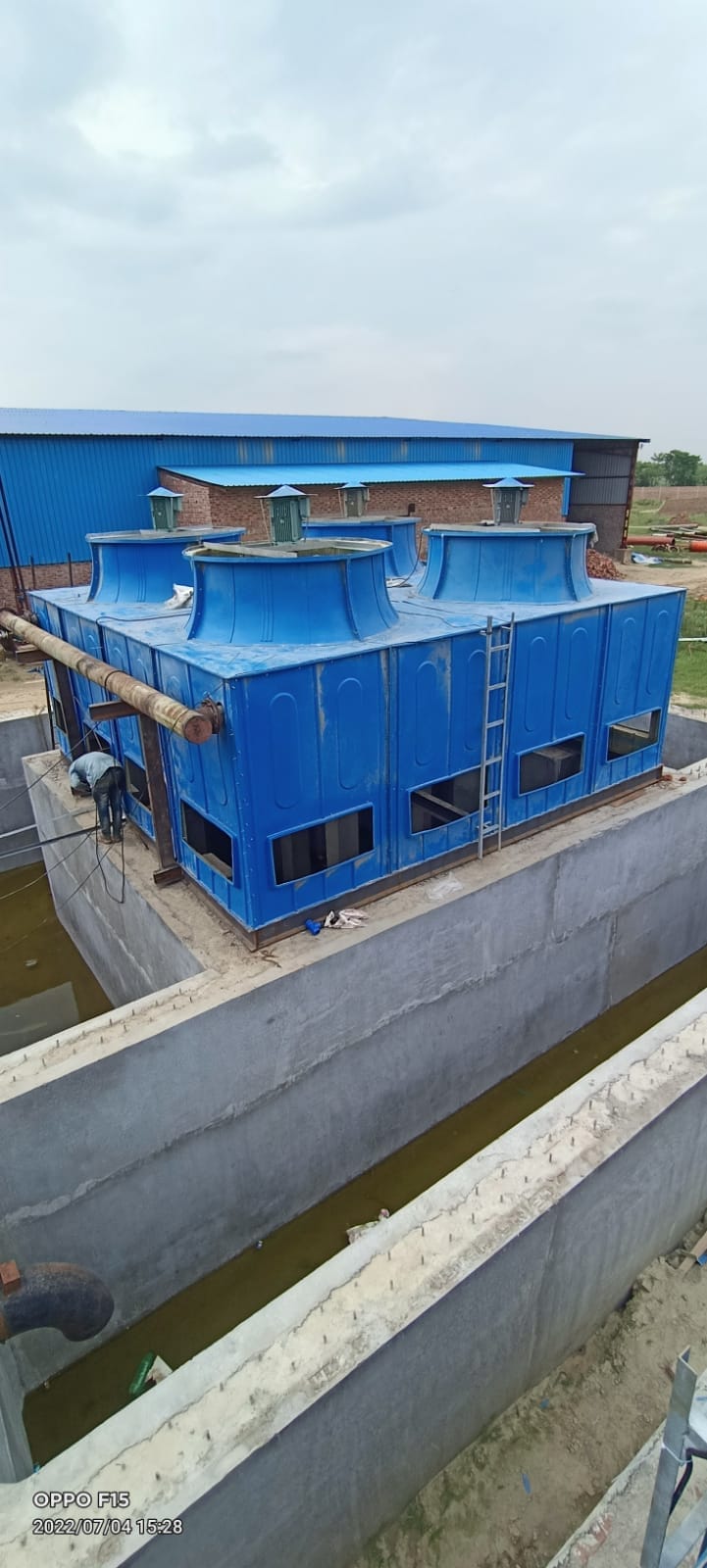
A Vertical Spray Tower (also called a Spray Pond in a Tower or No-Fill Tower) is a simplified, robust type of evaporative cooling tower that operates without traditional fill media. Instead, it relies entirely on spray nozzles to create the water-air interface for heat transfer through evaporation.
Core Design Principle
The tower eliminates the complex fill pack and uses vertical height and high-pressure
spray nozzles to:
- Break water into fine droplets
- Maximize droplet hang time (time in air)
- Create sufficient surface area for evaporation
Basic Configuration:
text
[Hot Water Inlet Header]
↓
[Multiple Spray Nozzles]
↓
┌─────────────────────────┐
│ │
│ FALLING WATER DROPLETS│ ← Evaporation occurs here
│ (Spray Zone) │
│ │
└─────────────────────────┘
↓
[Collection Basin]
↓
[Cold Water Out]
- Vertical Height: Typically 10-30 feet from nozzles to basin
- No Fill Media: Just open space for droplets to fall through
- Counter flow Air: Air flows upward against falling droplets (induced draft) or downward (forced draft)
How It Works
- Spray Generation: Hot water is pumped through a header system to high-pressure spray nozzles arranged in one or more levels.
- Droplet Formation: Nozzles atomize the water into fine droplets (typically 500-2000 microns).
- Evaporative Cooling: As droplets fall through the tower:
- Their large surface area facilitates evaporation
- Long fall time (2-5 seconds) allows extended air-water contact
- Droplets cool primarily through latent heat loss
- Air Movement: Fans induce or force air through the spray zone (usually counter flow ).
- Collection: Cooled droplets collect in the basin and return to the process.
Key Advantages
1. Fouling & Clogging Resistance
- No fill to clog with scale, silt, or biological growth
- Handles dirty water (high suspended solids, fibers, debris)
- Self-cleaning nozzles often used
- Ideal for challenging water sources: river water, wastewater, process water with particulates
2. Low Maintenance
- Simple to inspect visually
- Easy nozzle replacement/cleaning
- No fill replacement costs
- No risk of fill collapse or deterioration
3. Scale & Corrosion Tolerance
- Mineral scaling on nozzles is easier to clean than scaling in complex fill passages
- No localized “hot spots” that accelerate corrosion
- Can handle aggressive waters that would destroy conventional fill
4. High Turndown Capability
- Can operate effectively at very low flow rates (individual nozzles can be shut off)
- Good part-load performance
5. Reduced Fire Hazard
- No plastic fill media (often PVC) that can contribute to fire spread
- Preferred in certain industrial settings (paper mills, chemical plants)