

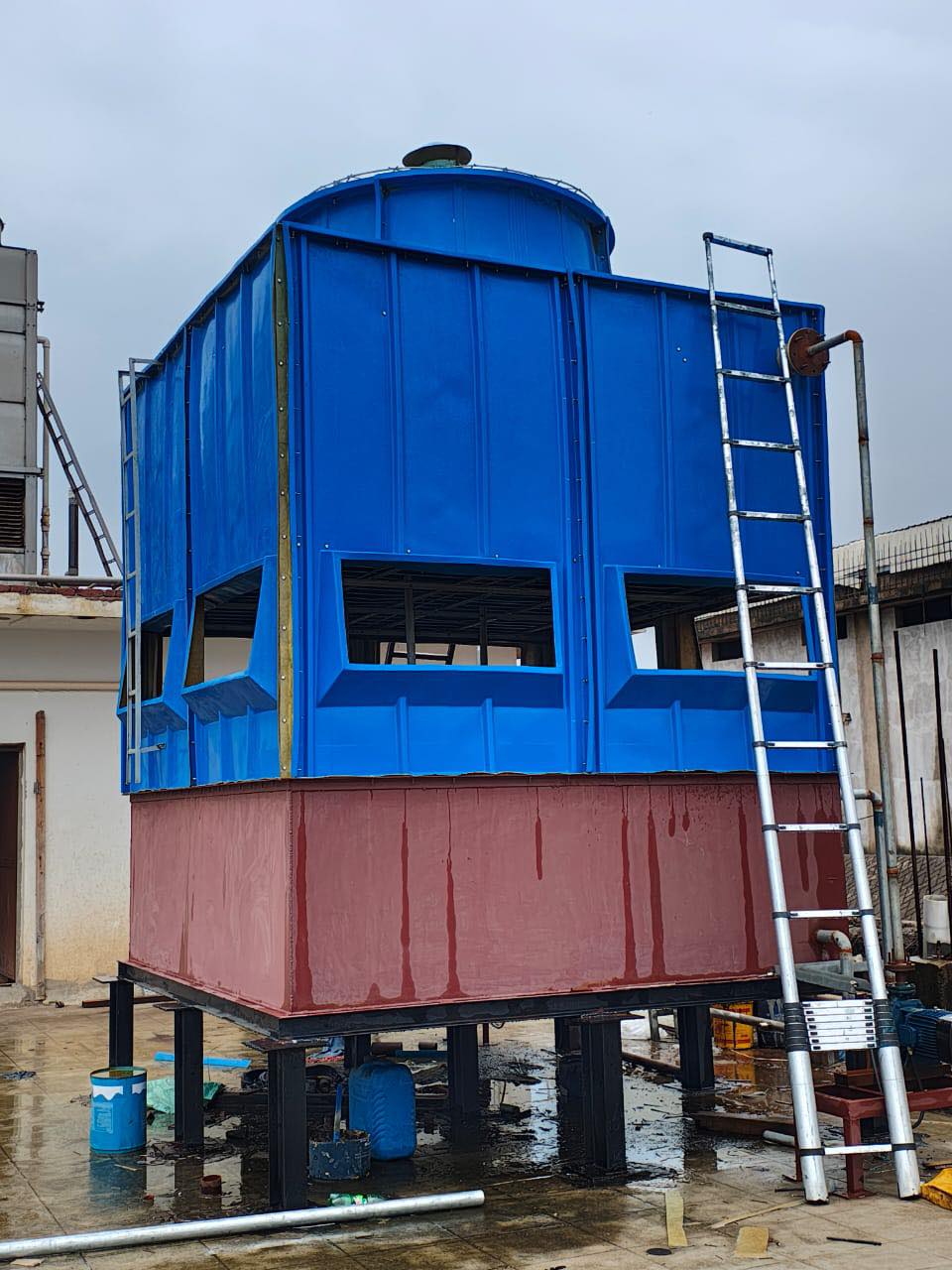
Indirect-Contact or Closed-Circuit Evaporative Cooling Tower
An Indirect-Contact or Closed-Circuit Cooling Tower is a hybrid system that combines the efficiency of evaporative cooling with the cleanliness of a closed-loop process. It physically separates the process fluid from the atmospheric air and spray water, while still using evaporation for heat rejection
Core Principle: Two Separate Loops
The “closed-circuit” name comes from the primary process loop being completely sealed (closed). Heat is transferred from this closed loop to an open evaporative loop through a heat exchanger.
Two Independent Fluid Circuits:
- Primary (Process) Loop – CLOSED:
- Contains clean process fluid (water, glycol mix, or other coolant).
- Circulates inside tubes or coils.
- Never exposed to atmosphere – no evaporation, contamination, or concentration.
- Goes directly to sensitive equipment (lasers, servers, PLCs, medical devices).
- Secondary (Evaporative) Loop – OPEN:
- Contains spray/makeup water (often called “sump water”).
- Circulates outside the coils and is exposed to air.
- Operates like a small open cooling tower, with evaporation, Blow down, and drift.
How It Works: The Indirect Contact Process
- Hot Process Fluid Entry: Hot fluid from the process enters the coil bundle at the top.
- Internal Flow: It travels through the sealed coils, releasing heat through the tube walls.
- External Evaporative Cooling:
- Recirculated spray water is pumped from the basin and sprayed/n distributed over the exterior of the coil bundle.
- Simultaneously, air is drawn vertically through the coil and spray water by a fan.
- A small portion of the spray water evaporates on the coil surface, absorbing latent heat and cooling the coil.
- Indirect Heat Transfer: Heat moves from the hot internal fluid, through the coil wall, to the evaporating external water film.
- Cooled Fluid Return: The now-cooled process fluid exits the coil bundle and returns to the process.
- Air/Water Exhaust: Warm, humid air is discharged, and excess spray water falls back to the basin.
Key Advantages
- Process Fluid Protection: The primary loop stays clean and uncontaminated—no exposure to air, dust, minerals, or biological growth. Ideal for critical processes.
- Freeze Protection: Easy to add glycol to the sealed primary loop for winter operation without affecting evaporative performance.
- Reduced Water Treatment: Only the secondary open loop (spray water) requires treatment, which is typically less critical.
- Lower Pumping Power: The primary loop often operates at lower pressure drops than open tower systems with heat exchangers.
- Year-Round Operation: Can operate in dry mode (as an air-cooled coil) in freezing conditions by shutting off the spray pump.
- No Cross-Contamination Risk: Eliminates risk of process fluid contaminating the tower water or vice-versa.