

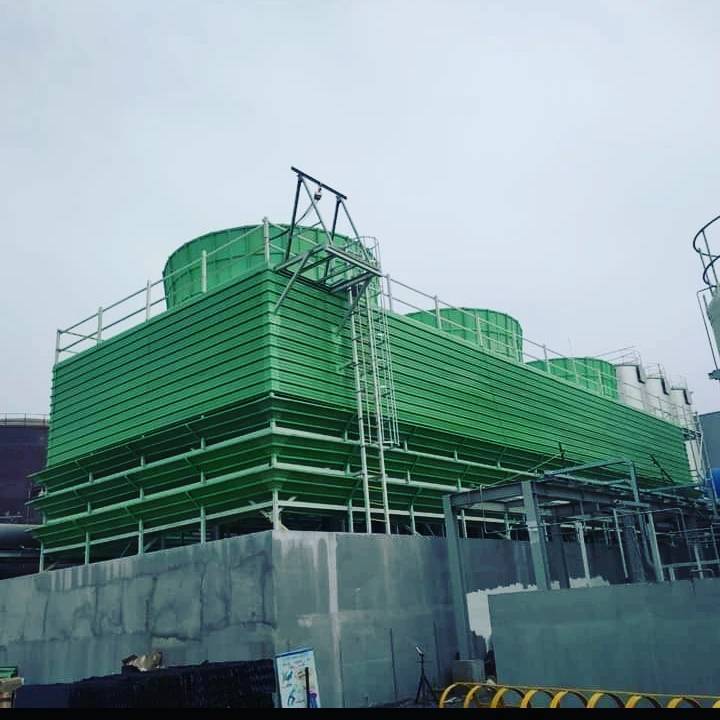
Cooling Tower Applications by Industry & Sector
1. Power Generation (The Largest Application)
- Function: Condense exhaust steam from turbines back into water, creating a vacuum that dramatically improves the plant’s thermodynamic efficiency.
- Types of Plants:
- Thermal Power Plants: Coal, natural gas, oil.
- Nuclear Power Plants: Especially pressurized water reactors (PWRs).
- Geothermal Power Plants: Cool geothermal brine after heat extraction.
- Biomass & Waste-to-Energy Plants.
- Types of Plants:
2. Heating, Ventilation, and Air Conditioning (HVAC)
- Function: Reject heat from building cooling systems by cooling the condenser water loop of water-cooled chillers.
- Typical Installations:
- Large office towers, hotels, and hospitals.
- University campuses and school districts.
- Shopping malls and convention centers.
- Airports and large transportation hubs.
- District Cooling Plants: Central plants that provide chilled water to multiple buildings in a city or development.
- Typical Installations:
3. Oil Refining & Petrochemical
- Function: Cool process streams, condense hydrocarbons, and control temperatures in reactors and distillation columns—critical for safety, product quality, and catalyst life.
- Specific Processes:
- Catalytic cracking and reforming units.
- Crude oil distillation (atmospheric and vacuum).
- Hydrotreaters and hydrocrackers.
- Steam methane reformers for hydrogen production.
- Ethylene and propylene production (olefin plants).
- Specific Processes:
4. Chemical & Pharmaceutical Manufacturing
- Function: Provide precise, reliable cooling for exothermic reactions, solvent recovery, crystallization, and equipment cooling.
- Examples:
- Fertilizer production (ammonia, urea).
- Plastic and synthetic fiber production (PVC, nylon, polyester).
- Examples:
- Pharmaceutical synthesis and fermentation processes.
- Specialty chemical batch reactors.
5. Heavy Industry & Manufacturing
- Function: Cool machinery, process fluids, and products to ensure continuous operation and product quality.
- Industries:
- Steel & Metal Production: Blast furnaces, basic oxygen furnaces, rolling mills, continuous casters.
- Automotive: Paint booth temperature control, welding equipment, hydraulic systems, engine test cells.
- Plastics: Injection molding machines, extruders, blow molders.
- Paper & Pulp: Process cooling, heat recovery, and paper machine rolls.
- Food & Beverage: Milk pasteurization, brewing fermentation, bakery ovens, refrigeration plant condensers.
- Textiles: Temperature and humidity control in spinning and dyeing processes.
- Cement: Cool clinker from the kiln.
- Industries:
6. Data Centers & Telecommunications
- Function: Reject the immense heat generated by servers, routers, and switching equipment. Often used in conjunction with chillers in high-density facilities.
- Key Consideration: Reliability is paramount. Systems often have N+1 redundancy.
7. Miscellaneous & Specialized Applications
- Ice Rinks: Maintain the temperature of the ice sheet and dehumidify the arena air.
- Lasers & High-Power Electronics: Cool laser cavities and power supplies.
- Die Casting & Forging: Cool dies and hydraulic systems.