

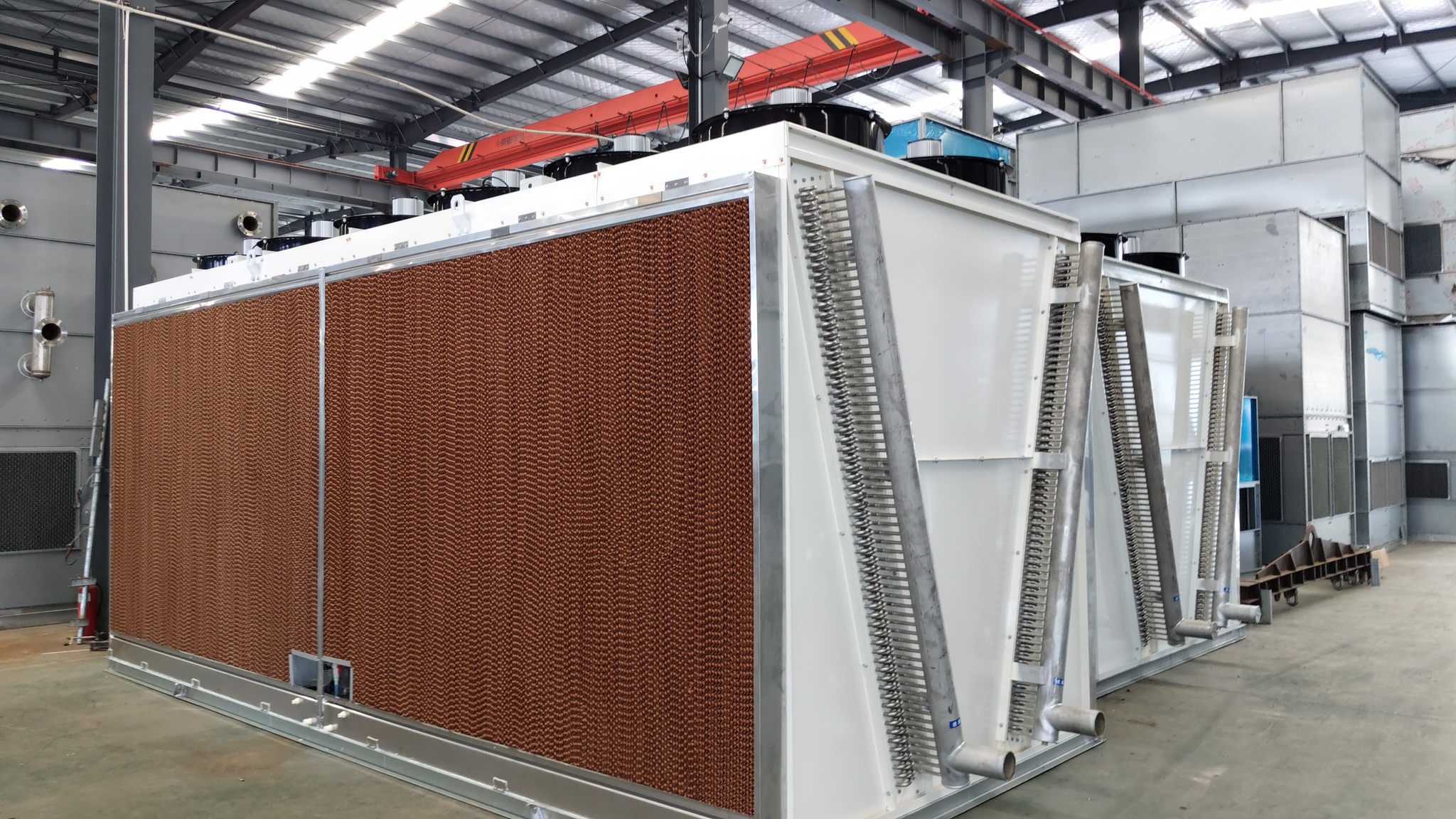
Dry cooling tower with Adiabatic fluid cooler
A Dry Cooling Tower with an Adiabatic Fluid Cooler (often called an Adiabatic Hybrid Cooler) is a system that combines the water-saving benefits of a dry cooler with the high efficiency of evaporative cooling, but only when needed.
It’s designed to get the “best of both worlds,” mitigating the key weakness of a standard dry cooler: reduced performance on hot days.
How It Works: The Two Modes of Operation
This hybrid system intelligently switches between two modes depending on the ambient temperature and cooling demand.
Mode 1: Dry Operation (Most of the Year)
- When: When the ambient air temperature is low enough to meet the cooling demand (e.g., at night, and during spring, fall, and winter).
- How: The system operates exactly like a standard dry cooling tower.
- The adiabatic section is OFF. No water is sprayed.
- The process fluid flows through the coil.
- Fans draw ambient air across the dry coil, rejecting heat through sensible heat transfer only.
- Benefit: Zero water consumption during this mode.
Mode 2: Adiabatic Pre-Cooling Operation (On Hot Days)
- When: When the ambient air temperature rises to a point where the dry cooler alone cannot achieve the desired fluid temperature (e.g., on a hot summer afternoon).
- How: The adiabatic system activates.
- A fine mist of water is sprayed into the incoming air before it hits the main heat exchanger coil. Alternatively, the air is drawn through a saturated evaporative pad.
- The water evaporates, cooling the air through latent heat of vaporization. This is an adiabatic process (the total heat energy stays the same, but sensible heat is converted to latent heat, lowering the air’s dry-bulb temperature).
- This pre-cooled, humidified air is now much cooler than the outside ambient air. It then passes over the finned coil.
- Because the air entering the coil is now cooler, the heat transfer is dramatically improved, allowing the system to maintain the required cool fluid temperature.
- Benefit: High efficiency when it’s needed most, with minimal water consumption compared to a full evaporative tower, as water is only used during the hottest hours.