

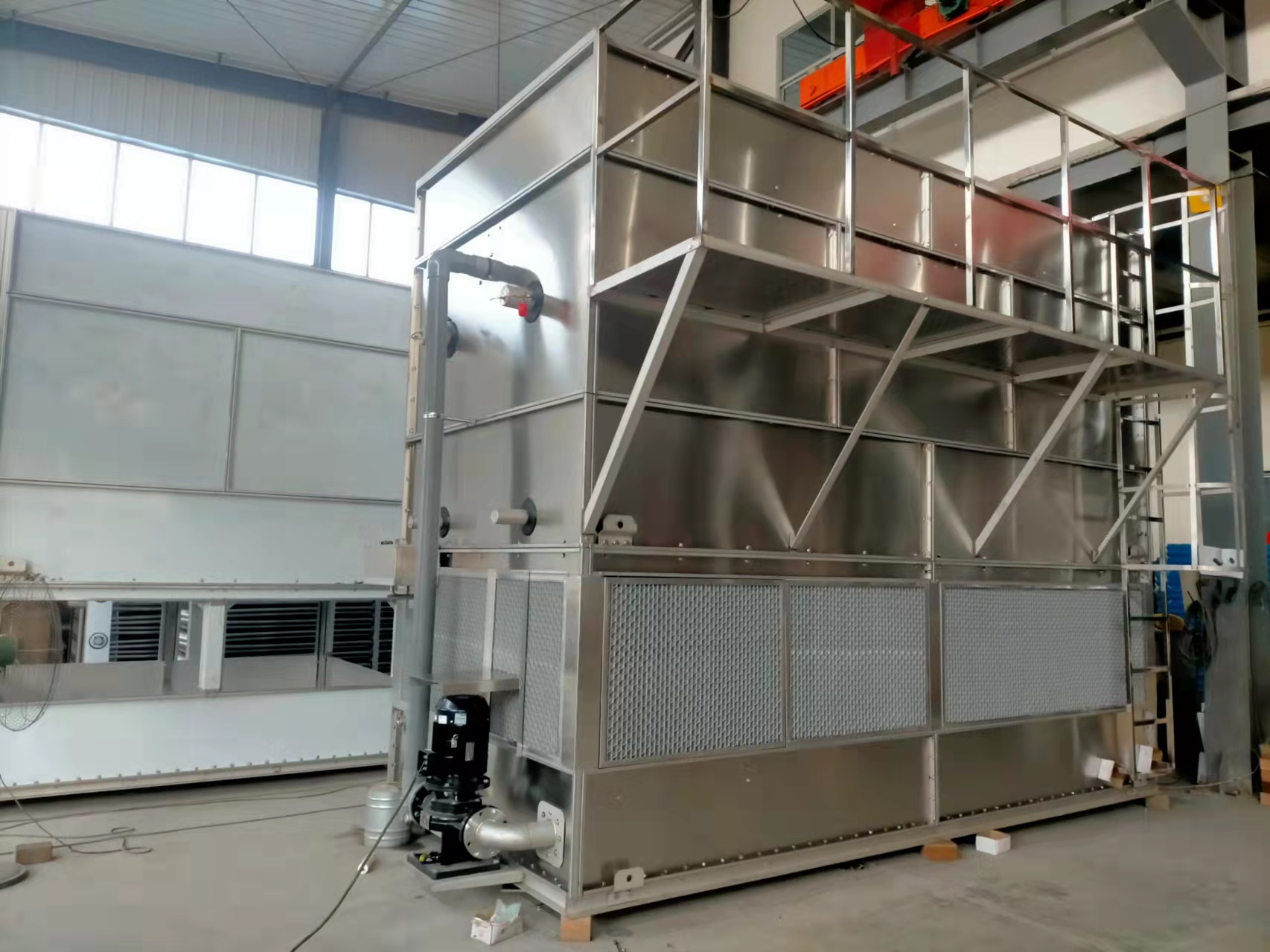
Role of Closed-Circuit Cooling Tower in Glass industry
In the glass industry, a closed-circuit cooling tower provides critical, high-purity cooling for melting furnaces and forming equipment, protecting the system from scaling and contamination that can cause production stoppages or damage.
The Core Role: Protecting Glass Melting Furnaces
The most critical application is cooling the glass melting furnace and its auxiliary equipment. This process generates immense heat, and a sudden failure in the cooling system can lead to a catastrophic meltdown or damage to the furnace itself, which is a major safety and financial risk. Closed-circuit towers cool vital components like electrode holders, the glass level measuring system, and other equipment close to the furnace.
Why the Glass Industry Chooses Closed-Circuit Systems
Several unique benefits make closed-circuit cooling towers the preferred choice over traditional open towers:
- Preventing Catastrophic Scaling: In a glass plant, an open cooling tower exposes water to airborne dust and impurities. When this contaminated water flows through cooling tubes, it leaves scale deposits that can insulate the tubes and cause overheating. This scaling can damage expensive melting furnaces and create safety hazards. A closed system uses treated, de-mineralized water inside a sealed loop, virtually eliminating this scaling risk.
- Zero Process Contamination: The process cooling water never comes into contact with the outside air. This prevents airborne particles, chemical fumes, and industrial smoke from contaminating the fluid, which is essential for maintaining consistent cooling and product quality.
- Enabling Precision for High-Value Products: The stability of a closed-loop system is essential for manufacturing high-value glass products. For example, it is used to ensure the stability and efficiency of equipment that produces high-quality sapphire lenses, where even slight temperature variations can ruin a batch.
Enhanced Durability: Given the harsh environment of a glass factory, these towers are often built with robust materials. Many use corrosion-resistant stainless steel (like 316L or 304 SS) for the cooling coils and shell to ensure a long service life. Some specialized designs even
- use a glass lining on the finned tubes inside the tower to prevent corrosion and extend the service life of the equipment itself.
A Strategic Tool for Efficiency and Space Savings
Beyond protection, these towers offer significant operational advantages:
- Water and Energy Savings: By using a closed loop, the process fluid is never lost to evaporation or bleed-off. Furthermore, systems can be equipped with automatic temperature controls that adjust the operation of fans and spray pumps based on the actual cooling demand, reducing both water and energy consumption.
- Space Saving: A closed-circuit tower combines the functions of a heat exchanger, pump, and cooling tower into a single unit. This can reduce the equipment footprint to 1/4 or 1/5 the size of a comparable open system, freeing up valuable factory floor space.
damaging scaling and overheating, while also saving space and resources.