

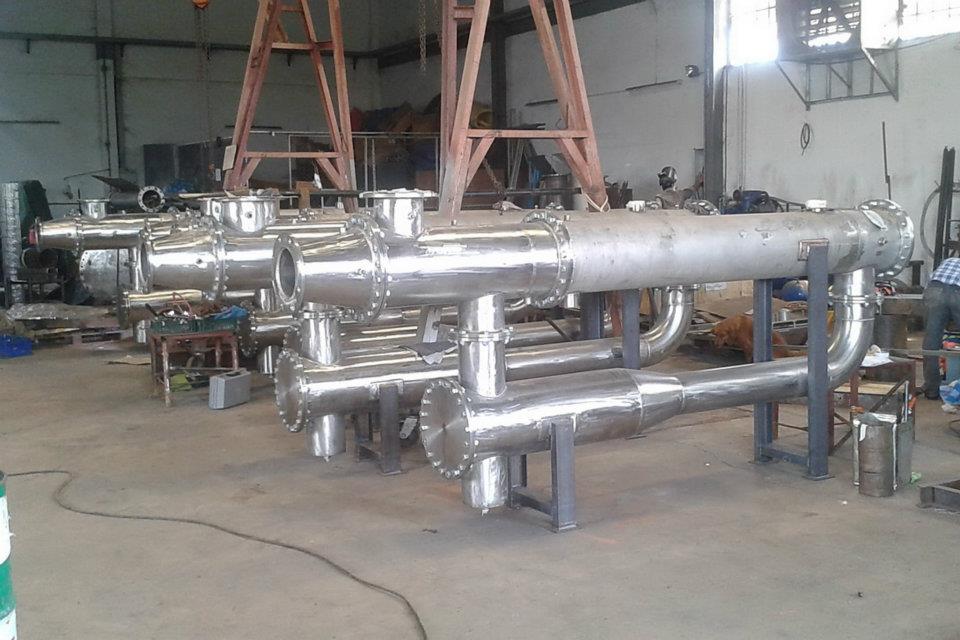
In the food and beverage industry, heat exchangers are essential for ensuring product safety, quality, and process efficiency. Their primary function is to apply precise thermal treatments—like pasteurization, sterilization, heating, and cooling—to a vast range of products while maintaining hygiene and protecting the product’s integrity.
Core Applications
The most critical applications are centered on food safety and preservation:
- Pasteurization and Sterilization: This is the most common use. Heat exchangers rapidly heat products like milk, juice, and eggs to specific temperatures for a set time to kill pathogens and spoilage organisms, then quickly cool them to protect flavor and nutritional value. Common methods include High-Temperature Short-Time (HTST) processing.
- Heating and Cooling: They are used for a variety of duties, such as warming ingredients before mixing, cooling products after cooking, and in heat recovery systems where the heat from a hot product is used to pre-heat an incoming cold product, saving significant energy.
Key Heat Exchanger Types and Their Roles
Different products require different technologies. The selection heavily depends on the product’s viscosity and whether it contains particles.
| Heat Exchanger Type | Best For | Key Advantages | Common Examples |
| Plate Heat Exchanger (PHE) | Low-viscosity, clean fluids like milk, beer, and clear juices. | Highly efficient, compact, easy to clean (CIP), and offers excellent heat recovery. | Standard dairy pasteurization, beverage processing. |
| Tubular Heat Exchanger | Medium to high-viscosity products or those with small particles. | More robust than plates, gentler on the product, and can handle higher pressures. Corrugated tubes enhance heat transfer and reduce fouling. | Dairy products (cream, yogurt), sauces, and fruit purees. |
| Scraped Surface Heat Exchanger | Very thick, viscous, or sticky products that would foul other exchangers. | Uses rotating or reciprocating blades to constantly scrape the heat transfer surface, preventing fouling and ensuring even heating/cooling. | Ice cream, peanut butter, chocolate, processed cheese, and meat slurries. |
| Wide-Gap Plate Heat Exchanger | Products containing long fibers or large particles, such as pulpy juices and crushed tomatoes. | Special design with wider channels to prevent clogging. Offers the thermal efficiency of a plate exchanger with the particle-handling capability of a tube. | Plant-based beverages, fruit pulps, dressings, and purees. |
Key Selection Factors
Choosing the correct heat exchanger is critical for both product quality and operational cost. According to industry experts, the primary considerations are:
- Product Viscosity: The thicker the product, the more robust the heat exchanger design required.
- Particulate Content: Products with solids or fibers require specially designed units to avoid clogging.
- Hygiene and Cleanability: All equipment must meet strict sanitation standards. The ease of cleaning (Clean-in-Place or CIP) is a vital factor to minimize downtime.
- Safeguarding Product Quality: The equipment must heat and cool gently and evenly to avoid changing the product’s texture, viscosity, or flavor. For example, pumping a sauce through the wrong type of unit can permanently make it too thin.
- Energy Efficiency: Modern heat exchangers are increasingly designed for superior heat recovery, helping producers significantly cut energy consumption and reduce their environmental footprint.