

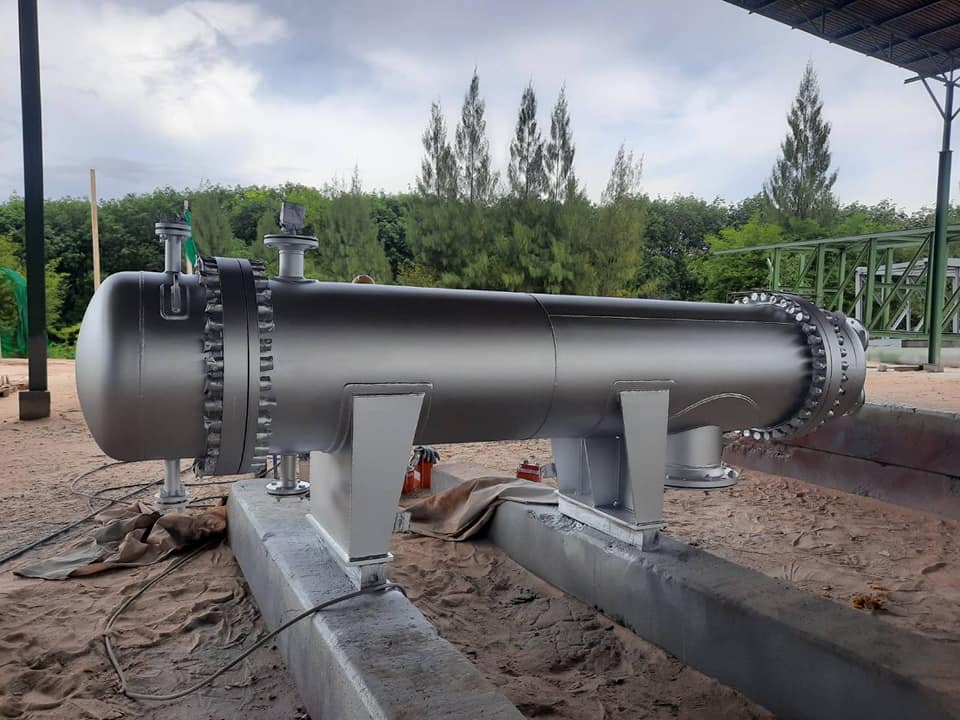
n the oil and gas industry, heat exchangers are fundamental to almost every stage of the value chain. They are critical for maintaining process efficiency, ensuring safety, and reducing operational costs by managing the immense amounts of thermal energy involved in processing hydrocarbons .
Primary Applications Across the Value Chain
Heat exchangers are used throughout the upstream (production), midstream (transport and storage), and downstream (refining and petrochemical) sectors .
| Sector | Specific Application | Role of the Heat Exchanger |
| Upstream (Production) | Separation and Stabilization | Heating crude oil before it enters a separator to make it easier to separate into gas, oil, and water. This improves efficiency and reduces the need for chemicals . |
| Gas Processing | Cooling and condensing hydrocarbon gases in recovery systems to capture valuable natural gas liquids (NGLs) and meet pipeline specifications . | |
| Dehydration and Treating | Used in units like glycol dehydration systems to remove water vapor from natural gas. | |
| Midstream (Transport) | Pipeline Heating | Maintaining the temperature and viscosity of crude oil in pipelines to ensure it flows freely. |
| Compressor/Pump Cooling | Cooling the gas or the compressor/pump itself at compressor stations along pipelines . | |
| Downstream (Refining & Petrochemicals) | Crude Preheat Trains | Recovering heat from hot process streams to preheat crude oil before it enters the main distillation column, significantly reducing energy consumption . |
| Condensers and Reboilers | Condensers cool and liquefy vapors at the top of distillation columns; Reboilers provide heat at the bottom to generate the rising vapor needed for separation . | |
| Reaction Temperature Control | Maintaining precise temperatures in reactors (e.g., hydrotreaters, reformers) to ensure optimal chemical reactions and product yields . |
The Workhorse: Shell-and-Tube
The shell-and-tube heat exchanger is by far the most common type in the oil and gas industry, accounting for roughly 60-70% of all exchangers in refineries and petrochemical plants . Its popularity stems from:
- Robustness: It can handle the widest range of operating temperatures (from cryogenic to over 600°C) and extremely high pressures (over 300 bar) .
- Durability: It is well-suited for dealing with fouling fluids, multiphase flows, and high-viscosity fluids commonly found in the industry .
- Standardization: Its design is well-established under TEMA (Tubular Exchanger Manufacturers Association) and ASME (American Society of Mechanical Engineers) standards, providing a reliable and proven solution .
Other Key Types and Their Roles
While shell-and-tube is dominant, other types are chosen for specific applications:
- Air-Cooled Heat Exchangers (Fin-Fan Coolers): These use ambient air forced by fans over finned tubes to cool process fluids. They are critical in remote or arid regions where cooling water is scarce or expensive .
- Plate Heat Exchangers: These are highly efficient and compact, with a much smaller footprint than shell-and-tube units for equivalent duty. They are often used in clean-fluid services where space is at a premium . However, their pressure and temperature limits are lower.
- Double-Pipe (Hairpin) Heat Exchangers: A simple and robust design ideal for small duties, high pressures, and true counter-current flow, which yields maximum thermal efficiency .
Challenges and Advanced Solutions
The extreme conditions in oil and gas processing create significant challenges:
- Corrosion: Process fluids often contain H₂S, CO₂, and other corrosive agents that can attack metals .
- Fouling: Deposits of wax, scale, coke, or salts on heat transfer surfaces reduce efficiency and increase operational costs .
- Thermal Stress: Frequent startups and shutdowns cause thermal cycling, which can lead to fatigue and failure .
To combat these issues, the industry increasingly uses advanced materials and designs:
- Corrosion-Resistant Alloys: Materials like duplex stainless steel, nickel alloys, and titanium are used for corrosive services .
- Specialized Designs: For extreme fouling, spiral heat exchangers are used for their self-cleaning properties . For ultra-high pressures and temperatures, printed circuit heat exchangers (PCHEs) are chosen for their compact, weldless construction .
Waste Heat Recovery: A major driver is recovering and reusing waste heat from process streams to preheat other fluids, improving overall energy efficiency and lowering emissions