

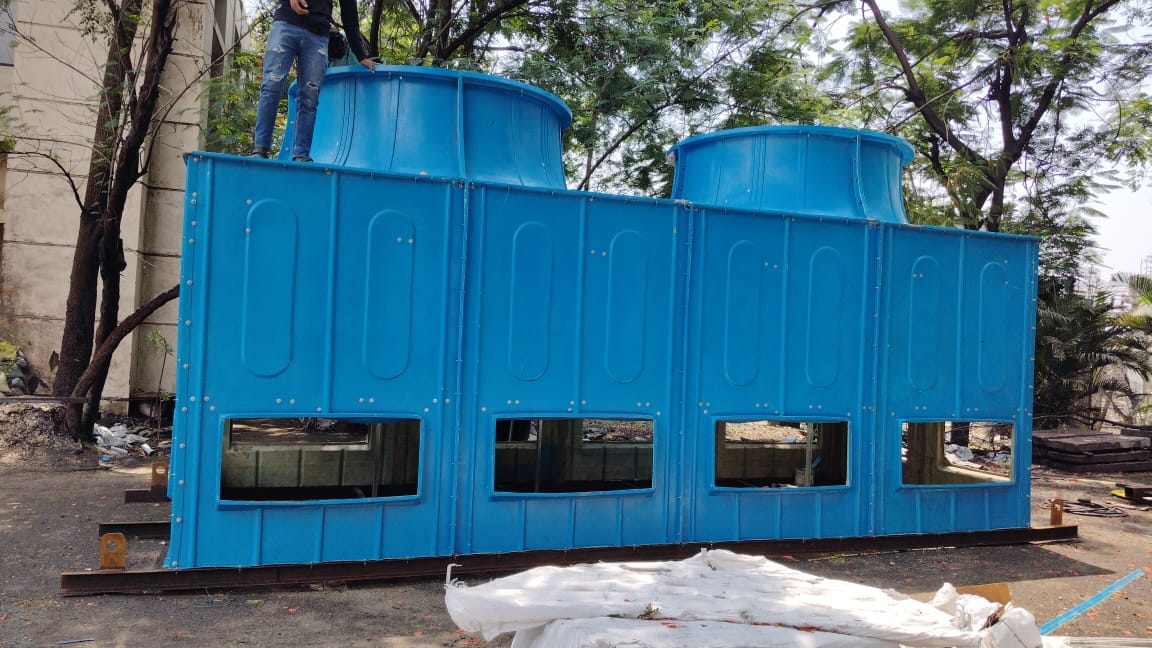
By AIR-WATER FLOW DIRECTION (within Mechanical Draft Towers)
| Type | Airflow vs. Water Flow | Characteristics |
| Counter flow | Air flows upward, opposite to falling water. | – Higher thermal efficiency – Smaller footprint – Higher pumping head (pressure) – More prone to fouling |
| Cross flow | Air flows horizontally, water falls vertically. | – Lower air-side pressure drop – Gravity water distribution (low pressure) – Larger footprint – Easier maintenance access |
5. Specialized & Closed-Circuit Systems
A. Closed-Circuit Cooling Towers (Fluid Coolers)
- Principle: Process fluid flows through a coil; water is sprayed over the coil and cooled by evaporation outside the coil.
- Key: Process fluid stays clean and contained (no exposure to atmosphere).
- Pros: Protects expensive process fluids, reduces scaling/fouling in main loop.
- Cons: Lower efficiency than open wet towers, higher cost.
Applications: Cooling of refrigerant, lubricants, engine jackets, sensitive instrumentation.
B. Spray (Atmospheric) Cooling Towers
- No fans; rely on natural wind and spray nozzles to create droplets.
- Very low efficiency, large area.
- Rarely used today except in some small agricultural/industrial applications.
- Water Conservation: Recycles >95% of cooling water, unlike “once-through” systems.
- Energy Efficiency: More efficient than air-cooled systems for large heat loads, especially in humid climates.
- Cost-Effective Scaling: Lower capital and operating cost per ton of cooling at large scales compared to air-cooled systems.
- Space Efficiency: Smaller footprint than an equivalent air-cooled heat exchanger bank.
- Environmental Compliance: Avoids thermal pollution and large water withdrawals from natural sources, which are often regulated.