

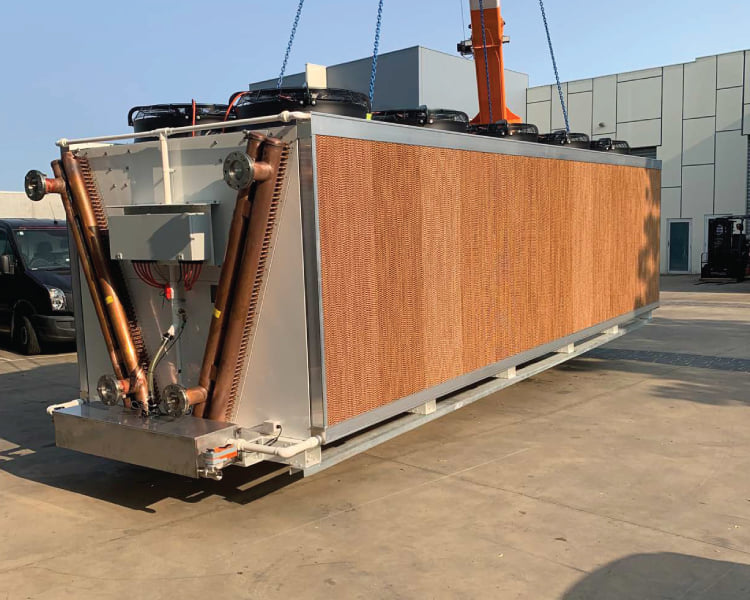
Effect of Wet bulb temperature in Dry cooling tower performance
The direct effect of Wet Bulb Temperature on a pure Dry Cooling Tower is essentially ZERO.
However, it has a major indirect effect that becomes critical for system design and comparison. Let’s break this down.
The Direct Effect: Why It Doesn’t Matter
A pure dry cooling tower operates solely on the principle of sensible heat transfer. The cooling process depends only on the Dry Bulb Temperature, which is the actual temperature of the air.
- Driving Force (ΔT) = Process Fluid Temperature – Ambient Dry Bulb Temperature
The wet bulb temperature, which is the lowest temperature to which air can be cooled by the evaporation of water, is irrelevant to the heat transfer physics of a dry coil. The air passing over the fins remains dry, and no evaporation occurs on the coil surface
In a 100% dry system, if you have two days with the same dry bulb temperature but different wet bulb temperatures, the cooling tower performance will be identical.
The Critical Indirect Effect: The Performance Benchmark
While the wet bulb temperature doesn’t affect the dry cooler’s operation, it is the gold standard for judging the dry cooler’s inefficiency and for comparing it to other cooling technologies.
1. The “Inefficiency Gap” or “Performance Penalty”
The wet bulb temperature is the thermodynamic limit for a wet or evaporative cooling tower. A dry cooler’s limit is the dry bulb temperature. Since the wet bulb is always lower than or equal to the dry bulb, a dry cooler is always at a disadvantage.
2. Dictating the Viability of Hybrid (Adiabatic) Operation
This is the most important practical effect. Many modern “dry” coolers are equipped with adiabatic pre-coolers (pads or misters) that are activated only when needed.
- When is it needed? On hot, dry days.
- What defines a “dry day”? A large difference between the Dry Bulb and Wet Bulb temperatures, known as the Wet Bulb Depression (WBD).
- Wet Bulb Depression (WBD) = Dry Bulb Temp – Wet Bulb Temp
A high Wet Bulb Depression means adiabatic pre-cooling is highly effective. On a day with 40°C DB and 20°C WB (a 20°C WBD), pre-cooling can lower the air temperature significantly before it hits the coil.
A low Wet Bulb Depression means adiabatic pre-cooling is ineffective. On a day with 35°C DB and 30°C WB (a 5°C WBD), there is very little water evaporation possible, so pre-cooling provides almost no benefit.
Therefore, the Wet Bulb Temperature (and the resulting WBD) is the control signal that determines if and when the adiabatic system should turn on and how much water it will use.
The Real-World Implications
| Scenario | Dry Bulb Temp | Wet Bulb Temp | Effect on Pure Dry Cooler | Effect on Hybrid Dry Cooler |
| Hot & Dry Day | High | Low | Poor Performance | Adiabatic system highly effective. Can pre-cool air close to the low WB, restoring performance. |
| Hot & Humid Day | High | High | Poor Performance | Adiabatic system ineffective. Little WB Depression to exploit. Performance remains poor. |
| Cool & Dry Day | Low | Lower | Excellent Performance | Adiabatic system stays off. Excellent dry performance. |
| Cool & Humid Day | Low | ~Same as DB | Excellent Performance | Adiabatic system stays off. Excellent dry performance. |