

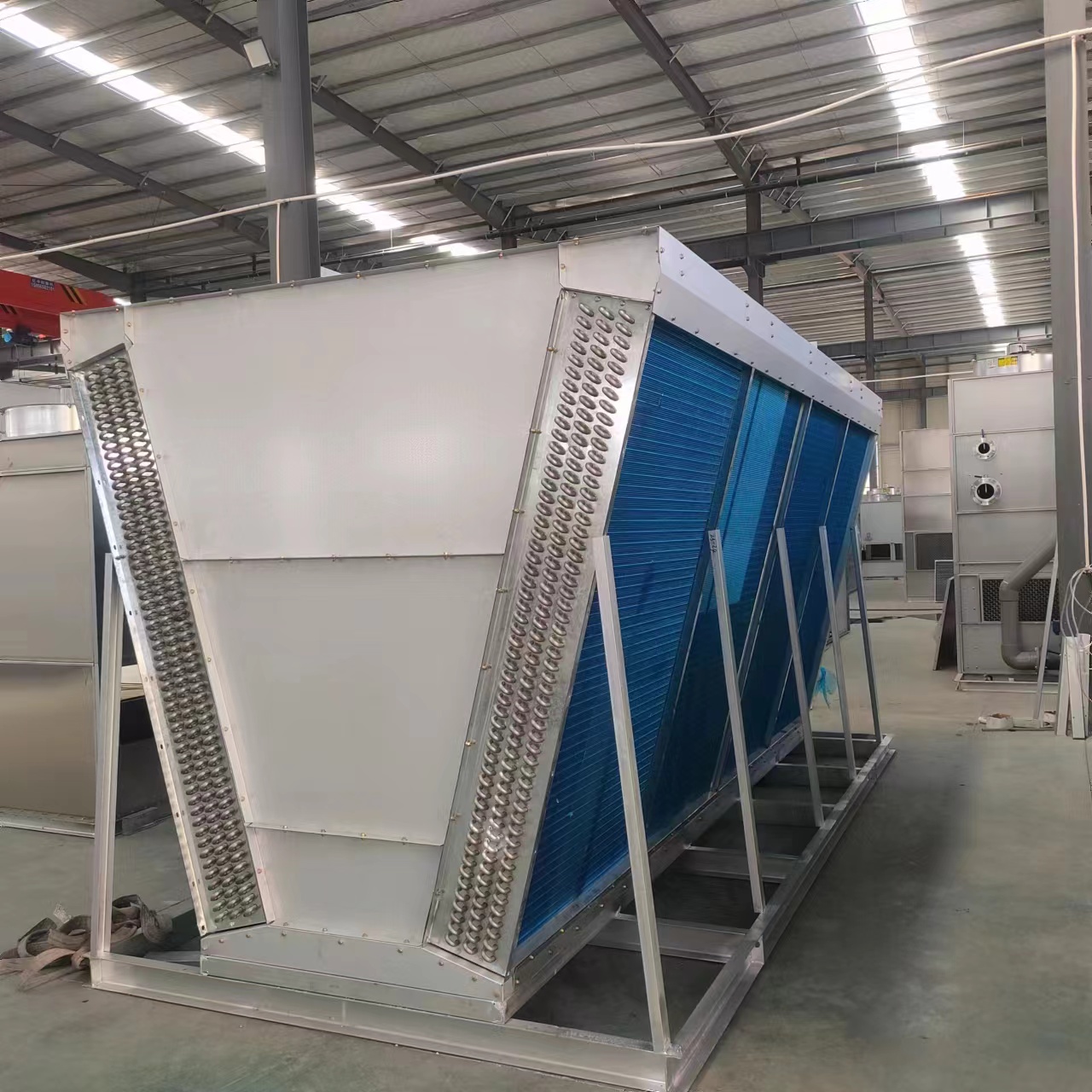
Effect of Dry bulb temperature in Dry cooling tower performance
The Dry Bulb Temperature is the single most critical environmental factor affecting the performance of a dry cooling tower.
In simple terms: As the Dry Bulb Temperature increases, the performance and efficiency of a dry cooling tower decrease significantly.
Let’s break down exactly why and how.
The Core Principle: The Temperature Difference Driver
A dry cooling tower works entirely on the principle of sensible heat transfer. Heat moves from the hot process fluid inside the tubes to the cooler ambient air flowing over the fins. The rate of this heat transfer is directly proportional to the temperature difference (ΔT) between the two.
- Driving Force (ΔT) = Process Fluid Temperature – Ambient Dry Bulb Temperature
The larger this difference, the faster and more efficiently heat can be rejected.
How Increasing Dry Bulb Temperature Affects Performance
As the dry bulb temperature rises, the story unfolds as follows:
1. Reduced Temperature Difference (ΔT):
This is the most direct effect. If your process fluid needs to be cooled to 40°C (104°F):
- On a cool day (20°C / 68°F DB): ΔT = 40 – 20 = 20°C of driving force.
- On a hot day (35°C / 95°F DB): ΔT = 40 – 35 = Only 5°C of driving force.
With a smaller ΔT, the heat transfer rate slows down dramatically.
2. Increased Outlet Fluid Temperature:
To reject the same amount of heat with a reduced ΔT, the system must operate at a higher temperature. The tower can no longer cool the fluid to its design temperature.
- Result: The outlet temperature of the cooled fluid rises.
3. Loss of Cooling Capacity:
If the process requires a specific fluid temperature, the only way to achieve it with a higher ΔT is to reduce the thermal load.
- Result: The tower’s effective cooling capacity drops. A tower rated for 1000 kW at 35°C DB might only be able to handle 700 kW at 40°C DB. This often forces a power plant to derate (reduce its electrical output) on hot days.
4. Increased Energy Consumption:
To compensate for the reduced performance, the control system will ramp up the fan speed to move more air across the coil. Since fan power consumption is proportional to the cube of the speed, a small increase in speed leads to a large increase in energy use.
- Result: Higher operating costs and a much lower system COP (Coefficient of Performance).
The Limiting Factor: The “Approach”
A key term in cooling tower performance is Approach.
- Approach = Process Fluid Outlet Temperature – Ambient Wet Bulb Temperature (for a wet tower)
- Approach = Process Fluid Outlet Temperature – Ambient Dry Bulb Temperature (for a dry tower)
For a dry cooler, the approach is physically and thermodynamically limited. A dry cooling tower can NEVER cool the process fluid below the ambient dry bulb temperature. In reality, a practical approach for a dry tower is typically 8°C to 20°C (15°F to 35°F) above the dry bulb temperature.
As the dry bulb temperature climbs, the minimum possible outlet temperature also climbs, creating an inescapable performance barrier.
Comparison with Wet Cooling Towers
This is where the fundamental weakness of dry coolers is exposed:
- Dry Cooler: Limited by the Dry Bulb Temperature.
- Wet Cooler: Limited by the Wet Bulb Temperature, which is always lower than the dry bulb temperature except at 100% relative humidity.
On a typical hot day (35°C DB, 40% RH), the wet bulb temperature might be only 24°C. This gives a wet tower a massive inherent advantage in driving force.
Practical Consequences and Mitigation
- Power Plant De-rating: This is the most significant economic impact. Gas and thermal solar power plants with dry cooling can lose 5-15% of their generating capacity on hot days.
- Process Inefficiency: Industrial processes that rely on cool water for cooling become less efficient, potentially affecting product quality or production rate.
- Mitigation Strategies:
- Oversizing the Tower: Designing it for the highest expected dry bulb temperature, which is very expensive.
- Hybrid/Adiabatic Systems: Adding an adiabatic pre-cooling (mist or pad) system to lower the effective dry bulb temperature of the air entering the coil, as discussed in your previous question.
- Supplemental Cooling: Using a secondary cooling system (like a chilled water system) during peak temperature hours.