

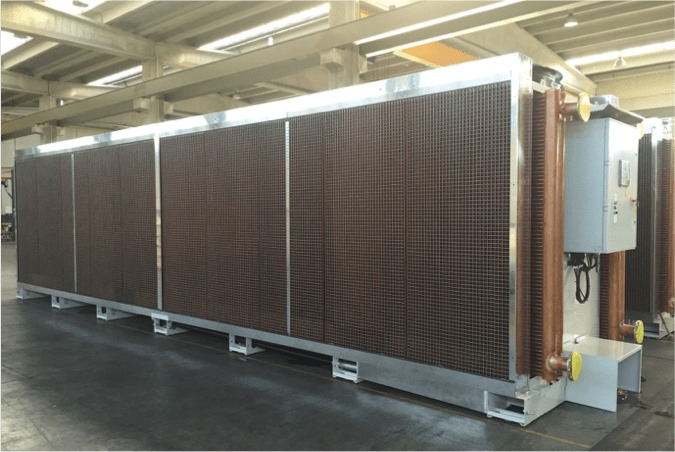
Detailed Functions and Design Characteristics:
1. Creates a Sealed, Closed Loop:
- The coil is a continuous, sealed circuit of piping. This ensures that the process water or water-glycol mixture remains completely isolated from the outside environment. This is crucial for preventing contamination, corrosion, and most importantly, water loss.
2. Provides Maximum Surface Area for Heat Transfer:
- A plain pipe has a limited surface area. The coil is not a simple pipe; it’s a system of tubes with fins attached to them.
- Tubes: Carry the hot fluid.
- Fins: Thin sheets of metal (usually aluminum) attached to the tubes. They act as “extensions” that dramatically increase the surface area exposed to the cooling air.
- Analogy: This is exactly like a car radiator. The fins allow a much larger volume of air to “grab” the heat from the tubes.
3. Acts as the Physical Barrier:
- The tube wall is the physical barrier that separates the process fluid from the ambient air. Heat must conduct through this metal wall, moving from the hotter fluid inside to the cooler fins on the outside, where the air carries it away.
4. Dictates the Tower’s Efficiency and Capacity:
- The design of the coil directly determines the cooling capacity of the entire tower. Key factors include:
- Fin Density: The number of fins per inch. Higher density means more surface area and better heat transfer, but it also requires more fan power to push air through it.
- Tube Material and Thickness: Affects how well heat conducts from the fluid to the fins.
- Overall Size and Circuitry: The total length and arrangement of the finned tubes determine how much heat can be rejected.