

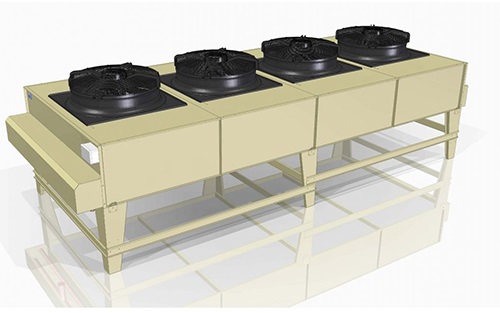
The decision to use a dry cooling tower is often a trade-off, heavily influenced by environmental and economic factors.
Advantages (The “Why”)
- Zero Water Consumption: This is the single biggest advantage. It is ideal for:
- Arid and desert regions.
- Remote sites where water is expensive or unavailable.
- Areas with strict water usage regulations.
- Low Operational Cost (Water & Chemicals): Eliminates the cost of makeup water, water treatment chemicals, and the system required to handle blowdown (concentrated wastewater from wet towers).
- Environmental Compliance: No vapor plume (fog) and no risk of chemical discharge or Legionella bacteria growth, which is a concern with wet towers.
- Minimal Maintenance: The closed loop prevents scale, corrosion, and algae buildup inside the system. Maintenance primarily involves keeping the fins clean and ensuring the fans work.
- Ideal for Backup/Standby Gensets: Avoids the problem of stagnant water freezing, evaporating, or fostering biological growth during long periods of inactivity.
Disadvantages (The “Trade-Offs”)
- Higher Initial Capital Cost: Dry cooling systems are typically more expensive to purchase and install than equivalently sized wet cooling systems.
- Lower Cooling Efficiency in Hot Weather: Its cooling capacity is limited by the ambient dry-bulb temperature. On a very hot day, it can only cool the fluid to a temperature close to the hot air temperature. This can lead to…
- Genset Derating: In high ambient temperatures, the cooler may not be able to reject enough heat, forcing the genset to operate at a reduced power output to prevent overheating.
- Larger Physical Footprint: For the same cooling capacity, a dry cooler requires a larger surface area and is physically bigger than a wet cooling tower.
- Higher Fan Power Consumption: The fans need to move a large volume of air, which can consume more electrical energy than the pumps of a wet system.