

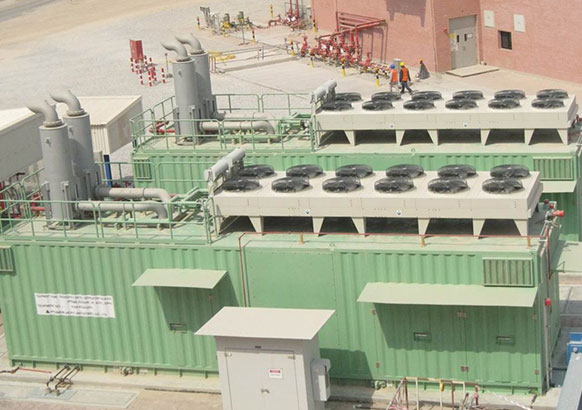
Material of Construction of Remote Radiator
The Material of Construction (MOC) for a remote radiator is critical for its longevity, performance, and compatibility with the environment and coolant. The choice is a balance between thermal conductivity, corrosion resistance, strength, and cost.
Here’s a detailed breakdown of the materials used for the key components of a remote radiator (which, as we’ve established, is typically a Remote Dry Cooler or Remote Fluid Cooler).
Core Components and Their Materials
1. Heat Transfer Core (Finned Tubes)
This is the heart of the radiator where heat exchange occurs. The standard construction is an Aluminum Fin / Copper Tube combination, but other configurations exist.
| Material Combination | Advantages | Disadvantages | Typical Use Case |
| Aluminum Fins / Copper Tubes | Excellent balance. High thermal conductivity of both metals. Copper is strong and corrosion-resistant internally; aluminum provides a cost-effective, high-surface-area fin. | Risk of galvanic corrosion between dissimilar metals if not protected. Requires a clean, controlled environment. | Most common for standard industrial applications with clean air and proper coolant treatment. |
| Aluminum Fins / Aluminum Tubes | Eliminates galvanic corrosion. Lighter weight. Generally lower material cost. Good corrosion resistance in many atmospheres. | Lower mechanical strength than copper. More susceptible to certain forms of pitting corrosion. Can be harder to mechanically repair. | Very common, especially in HVAC and lighter industrial duty. Becoming more prevalent. |
| Copper Fins / Copper Tubes | Maximum thermal performance. Eliminates galvanic corrosion. Excellent durability and strength. Easier to solder/repair. | Very high cost. Heavy. Often overkill for most applications. | Severe environments where maximum heat transfer is critical and cost is secondary (e.g., some marine or chemical processing applications). |
| Stainless Steel Tubes (with Al or Cu fins) | Superior internal and external corrosion resistance. High strength. | High cost. Lower thermal conductivity than copper. | Highly corrosive environments: coastal areas (salt air), chemical plants, or with specialized coolants. |
2. Headers and Tanks
Headers are the manifolds that distribute the coolant from the inlet/outlet pipes to the many tubes of the core.
- Carbon Steel: Common, strong, and low-cost. Must be coated internally (e.g., epoxy lining) and often externally to prevent rust from the coolant and atmosphere.
- Copper or Brass: Excellent corrosion resistance but more expensive. Often used in smaller units or where water quality is a concern.
- Stainless Steel: Used in highly corrosive environments or for long-life, maintenance-free requirements. Highest cost.
3. Casing/Frame and Structural Support
This is the chassis that holds the core, fans, and motors.
- Galvanized Steel (Galvannealed): The industry standard. Steel is strong and cheap, and the zinc coating provides excellent corrosion resistance for most outdoor environments. It may be painted for additional protection and aesthetics.
- Aluminum: Lightweight and highly corrosion-resistant. Used in more premium units or in extremely corrosive environments (e.g., coastal, chemical plants) where even galvanized steel might degrade.
- Stainless Steel: Used for the most aggressive environments or where hygiene is a concern (e.g., food and pharmaceutical industry). It is the most expensive option.
4. Fans
- Blades: Typically glass-filled polypropylene (GFP) or aluminum. GFP is corrosion-proof, quiet, and lightweight. Aluminum is more durable and can be used in high-temperature applications.
- Hub/Housing: Typically cast aluminum or galvanized steel.
5. Fin Coatings
The fins are the most exposed part to the environment. Coatings are often applied to protect them.
- Uncoated (Bare Aluminum or Copper): For clean, indoor, or non-corrosive environments.
- Epoxy Coatings: A thin, protective layer that resists corrosion from salt, chemicals, and industrial pollutants. Very common for units installed in moderate marine or industrial areas.
- Hot-Dip Galvanizing: (For steel fins, which are rare). Extreme corrosion protection.
- Hydrophilic Coatings: A specialized coating that causes water to form a sheet rather than droplets. This improves heat transfer efficiency and reduces water spotting and scaling, especially in evaporative fluid coolers.
Material Selection Based on Environment
The choice of material is heavily driven by the installation environment:
- Standard Inland / Industrial Environment:
- Core: Aluminum Fins / Copper Tubes.
- Casing: Galvanized Steel.
- Headers: Coated Carbon Steel.
- Marine / Coastal Environment (Salt Air):
- Core: Epoxy-coated Aluminum Fins / Copper Tubes or Aluminum Fins / Aluminum Tubes. For severe cases, stainless steel tubes.
- Casing: Heavily coated Galvanized Steel, Aluminum, or Stainless Steel.
- Headers: Stainless Steel or heavily coated carbon steel.
- Fasteners: Must be stainless steel.
- Chemical Plant / Heavy Industrial (Chemical Pollutants):
- Core: Epoxy-coated fins are essential. Stainless steel tubes may be required.
- Casing: Aluminum or Stainless Steel.
- Headers: Stainless Steel.
- Food & Beverage / Pharmaceutical (Hygienic Requirements):
- Core: Often Stainless Steel tubes with coated or stainless fins.
- Casing: Stainless Steel (304 or 316) for easy cleaning and corrosion resistance.