

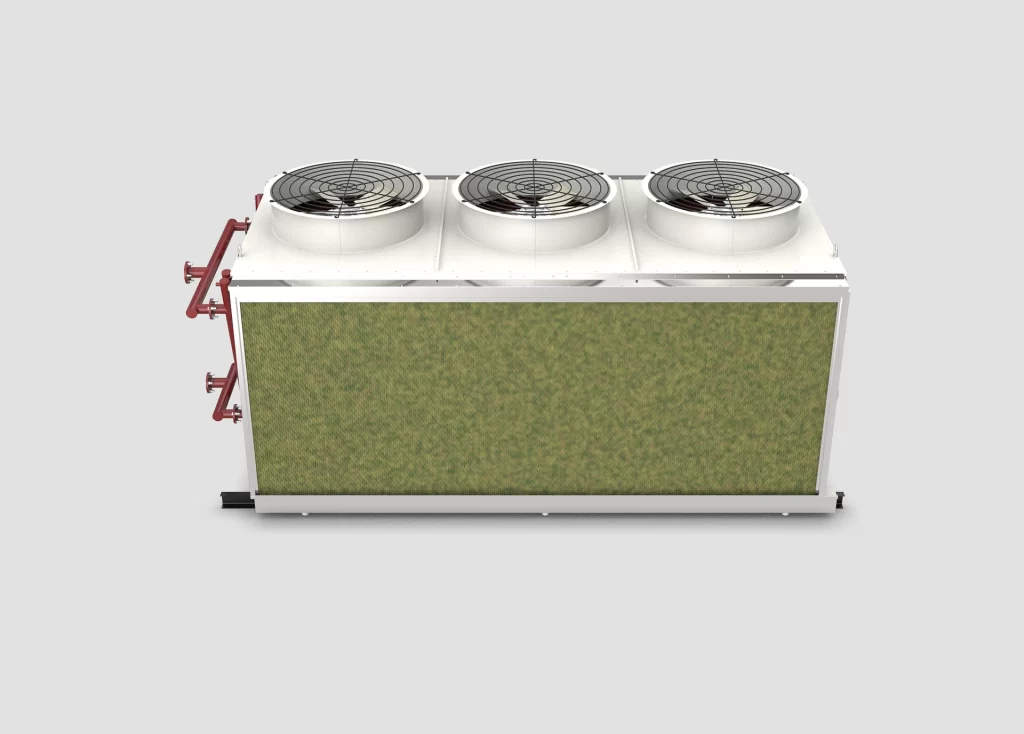
Specialized Coatings best of dry cooling tower that used in Sea Shore Area?
For a dry cooling tower in a seashore area, specialized coatings are not just an add-on; they are a critical component of the system’s defense, working in tandem with material selection to maximize service life.
The goal of these coatings is to form a continuous, impermeable barrier that shields the underlying metal (typically steel or aluminum) from the corrosive triad of salt, moisture, and oxygen.
The “Best” Coating System: A Multi-Layer Approach
The most effective strategy is a multi-coat system where each layer has a specific function. The classic and most robust system is a three-coat scheme.
The Gold Standard: 3-Coat Epoxy/Polyurethane System
This is the industry benchmark for severe environments like offshore platforms, ships, and coastal industrial facilities.
| Layer | Primary Function | Typical Coats & Dry Film Thickness (DFT) | Key Characteristics |
| 1. Primer (Zinc-Rich Epoxy) | Cathodic Protection | 1-2 coats (60-80 µm / 2.5-3 mils) | Contains zinc dust. The zinc particles sacrificially corrode to protect the underlying steel, similar to galvanizing. It is the foundational corrosion inhibitor. |
| 2. Mid-Coat (High-Build Epoxy) | Barrier Protection & Build | 1-2 coats (150-200 µm / 6-8 mils) | Creates a thick, tough, and chemically resistant barrier. It blocks moisture and chlorides from reaching the primer and substrate. Often called a “barrier coat.” |
| 3. Topcoat (Polyurethane) | Weathering & UV Resistance | 1-2 coats (50-75 µm / 2-3 mils) | Provides excellent resistance to UV degradation, which breaks down epoxy. It also provides a hard, glossy, and durable finish that is easy to clean and has good color and gloss retention. |
Why this system is best for a seashore:
Synergistic Defense: The zinc primer actively fights corrosion, the epoxy mid-coat is a formidable physical barrier, and the polyurethane topcoat shields the system from the sun and weather.
- Proven Performance: This system has a long track record of success in the harshest marine environments.
Alternative & Specialized Coating Types
Depending on the specific component and requirements, other coatings may be used.
1. For the Structure & Casing (Steel Substrate)
- Thermoset Spray-Applied Coatings: The 3-coat system above is the prime example.
- Thermoplastic Coatings (Nylon, Polyolefin): Applied as a powder coating, these are extremely tough, chemically resistant, and have excellent impact resistance. They can be a good option for louvers, guards, and other components.
- Zinc Silicate Primers: An alternative to epoxy zinc-rich primers. They offer excellent corrosion resistance and very high heat resistance but can be more difficult to apply correctly.
2. For the Heat Exchanger Fins & Tubes (Aluminum or Copper-Nickel Substrate)
Coating the fins themselves is a highly specialized process and is often the difference between a long and short life.
- Hydrophobic Coatings: These are “water-hating” coatings that cause water to bead up and roll off. This helps to rinse away salt and contaminants, keeping the fins cleaner.
- Anti-Corrosive Fin Coatings:
Chromate Conversion Coatings: Historically common, they provide a good, self-healing layer of protection. However, environmental regulations are limiting the use of hexavalent chromium
- Non-Chromate Organic Coatings: These are the modern alternative. They are typically thin-film, spray-applied coatings specifically formulated for aluminum fins (e.g., coatings based on acrylics, polyurethanes, or silanes). They must be very thin to not significantly impair heat transfer.
- E-Coating (Electrocoating): This is an excellent method for finned coils. The entire coil is immersed in a paint bath, and an electric current is applied, causing the paint to form a uniform, continuous film over every surface, even deep within the fin pack. This eliminates bare edges and provides outstanding coverage.
Key Properties to Specify for a Seashore Coating
When evaluating or specifying a coating system, ensure it has these properties:
- High Chloride Resistance: The coating must be impermeable to chloride ions.
- Excellent Adhesion: It must stick to the substrate tenaciously, even under thermal cycling and mechanical stress. Surface preparation is key to this.
- UV Stability: The topcoat must resist chalking and degradation from sunlight.
- Flexibility: It should be able to expand and contract with the metal substrate without cracking.
- Abrasion Resistance: To withstand wind-blown sand and grit.
- Chemical Resistance: To resist not just salt, but also potential spillage of oils or other chemicals.
The Critical Step: Surface Preparation
The best coating in the world will fail if the surface is not prepared properly. This is arguably more important than the coating selection itself.
- For New Steel: The standard is Abrasive Blast Cleaning to Sa 2½ (Near-White Metal).
- What it means: All mill scale, rust, and foreign matter are removed, and the surface is left with a uniform, clean, metallic grey appearance with a defined anchor profile (roughness for the paint to grip onto).
- For Aluminum: Requires a thorough chemical cleaning and etching to remove oxides and ensure adhesion.
Summary: Best Practice Recommendation
For a dry cooling tower on a seashore, the best coating strategy is:
- Substrate: Hot-Dip Galvanized (HDG) or stainless steel structure.
- Surface Prep: Abrasive blast clean to Sa 2½.
- Coating System: Apply a 3-Coat System:
- Primer: Zinc-Rich Epoxy.
- Mid-Coat: High-Build Epoxy.
- Topcoat: Aliphatic Polyurethane (for best UV resistance).
- Total Dry Film Thickness (DFT): Ensure a minimum of 250-300 microns (10-12 mils) for the entire system.
- For Finned Coils: Specify that the aluminum fins are protected with a factory-applied, non-chromate, organic coating or e-coat to ensure complete coverage.