

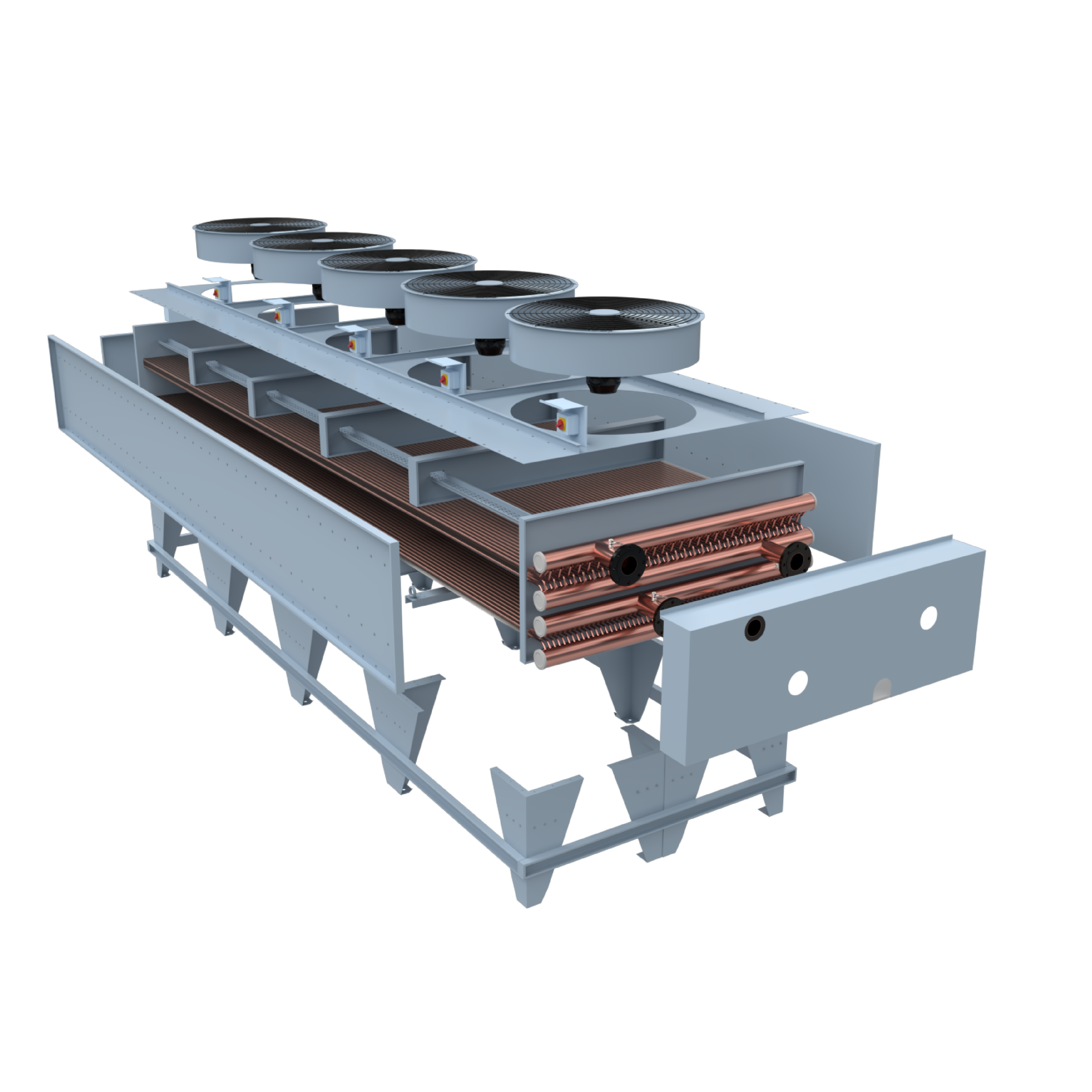
Design and Selection Considerations for Genset Cooler
When engineers design or select a Genset with an ACHE, they must consider
- Maximum Ambient Temperature: The system must be sized to reject the full engine heat load at the site’s highest expected temperature.
- Altitude: Air is thinner at higher altitudes, reducing its ability to carry away heat. Gensets often require derating for altitude.
- Airflow Restriction: The design of the enclosure and any inlet/outlet louvres must allow for sufficient airflow with minimal static pressure drop.
- Application: Is it for prime power (running continuously) or standby (running only during outages)? Standby units can often be more compact as they are designed for shorter, intermittent run times.
- Fouling Factor: The design must account for a certain level of core fouling over time, building in extra capacity.
Comparison with Alternative: Radiator with Remote Dry Cooler
For large, stationary installations, an alternative is a “pump-around” system where a shell-and-tube heat exchanger on the engine is coupled with a remote Dry Cooler (which is essentially a large, external ACHE). This keeps the engine’s cooling loop small and separates the noisy fan from the Genset, but it is more complex and expensive to install