

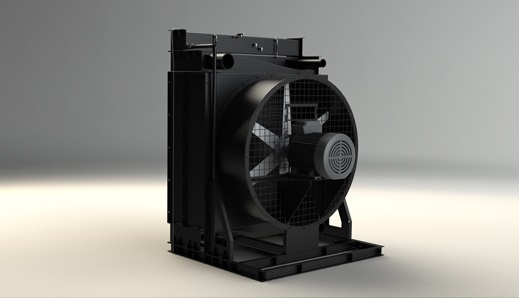
Air Cooled Heat Exchanger in Genset engine cooling
Why Cooling is Necessary
A diesel or gas Genset engine converts fuel into mechanical energy, but a significant portion of that energy (around 30-35%) is wasted as heat. Without an effective cooling system, this heat would cause:
- Engine Overheating: Leading to seizure of pistons, damage to cylinder heads, and catastrophic engine failure.
- Oil Degradation: Engine oil would break down, losing its lubricating properties and leading to increased wear.
- Reduced Efficiency: The engine would run less efficiently and produce less power.
The cooling system’s job is to reject this waste heat to the atmosphere and maintain the engine within its optimal operating temperature range
How an Air Cooled Heat Exchanger Works in a Genset
In simple terms, the ACHE works like a car’s radiator, but it uses air instead of water as the final cooling medium.
- Heat Absorption: A coolant mixture (typically a water-glycol blend) is circulated by a pump through the engine block and cylinder head. It absorbs heat from these critical components.
- Heat Transfer: The now-hot coolant is pumped into the ACHE, which is a network of fins and tubes. The core is usually made of aluminum for its excellent thermal conductivity.
- Heat Rejection: A powerful fan, driven by the engine itself or an electric motor, forces ambient air across the finned tubes. The air absorbs the heat from the coolant and is expelled out of the Genset enclosure.
- Coolant Recirculation: The cooled-down coolant then returns to the engine to repeat the cycle.
This creates a closed-loop system, protecting the engine from external contaminants.
Key Components of the ACHE System
- Core / Fin-and-Tube Bundle: The heart of the exchanger. Fins are attached to the tubes to dramatically increase the surface area for heat transfer to the air.
- Fan and Drive System:
- Fan: A high-flow, axial fan (sometimes centrifugal for specific pressure requirements). It’s the primary consumer of auxiliary power on the Genset.
- Drive: Can be a direct V-belt drive from the engine (most common), a hydraulic drive, or an independent electric motor drive for more precise control.
- Coolant Pump (Circulating Pump): Driven by the engine, it maintains the flow of coolant through the engine block and ACHE.
- Shrouds and Ducting: These components guide the airflow efficiently through the core, preventing air from taking “shortcuts” and ensuring maximum heat transfer.
Thermostat: A crucial valve that regulates coolant temperature. It bypasses the ACHE when the engine is cold to allow for rapid warm-up and opens to direct flow through the ACHE once the optimal operating temperature is reached.