

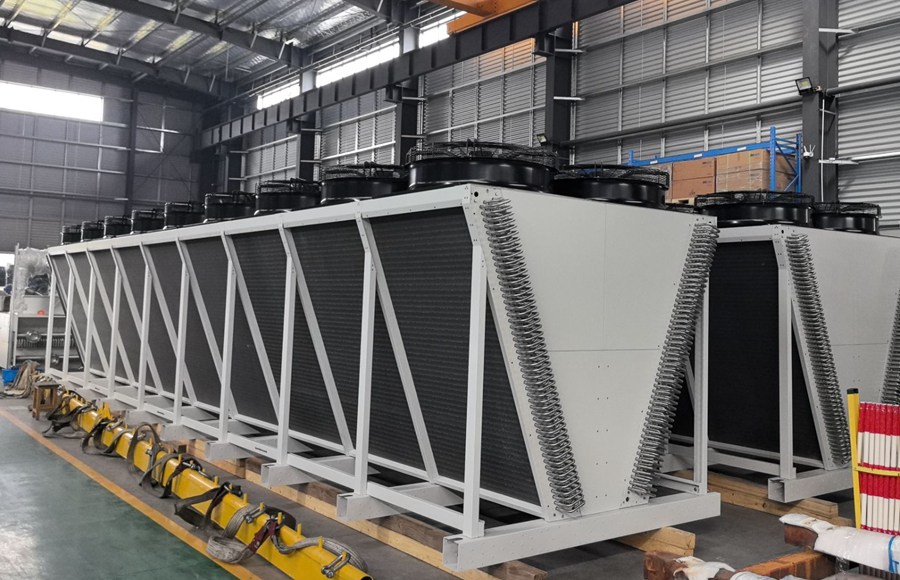
Role and Suitability for Gensets
Dry cooling towers are not a one-size-fits-all solution for gensets. Their use is dictated by specific site conditions and priorities.
Ideal Scenarios for a Dry Cooling Tower on a Genset:
- Water Scarcity: This is the primary reason for choosing a dry cooler. In arid and semi-arid regions (e.g., deserts, remote mining sites) or on islands where fresh water is precious and expensive, the zero water consumption is a massive advantage.
- Environmental Regulations: In areas with strict regulations on water usage or where chemical discharge from wet tower “blowdown” is prohibited.
- Backup/Standby Gensets: For gensets that run infrequently, a dry cooler avoids the maintenance headaches of stagnant water in a wet tower, which can lead to Legionella bacteria growth, scaling, and corrosion.
- Avoiding Plume & Fogging: In sensitive locations (e.g., near airports, highways, or in dense urban areas), the visible vapor plume from a wet tower can be a nuisance or a safety hazard. Dry coolers produce no plume.
Less Suitable Scenarios:
- High Ambient Temperatures: In very hot climates, the cooling capacity of a dry cooler drops significantly because it can only cool the fluid to a temperature approaching the ambient dry-bulb temperature. This can lead to the genset derating (reducing its power output) to prevent overheating.
- Space Constraints: Due to their larger physical size for the same cooling capacity, they might not be suitable for sites with limited space.
- Where Maximum Efficiency is Critical: If the goal is to have the genset run at its full, nameplate power rating in a hot climate, a wet cooling tower is often necessary to achieve the lower coolant temperatures required.
4. Key Considerations for Installation and Maintenance
- Sizing: Must be carefully sized based on the genset’s heat rejection requirement and the site’s design dry-bulb temperature (the high percentile ambient temperature, e.g., 95%).
- Airflow: Location is critical. The unit must have ample access to a free flow of cool, ambient air. It should not be placed where it will recirculate its own hot exhaust air or be near other heat sources.
- Fouling: The finned tubes are susceptible to getting clogged with dust, pollen, leaves, and insects. Regular cleaning (e.g., with compressed air or water spray) is essential to maintain efficiency.
- Fan Noise: The large fans required can be noisy, which may require acoustic attenuation measures in noise-sensitive areas.