

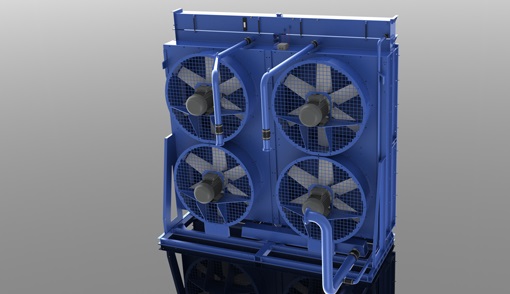
Remote Radiator. It’s a cooling system where the radiator is physically separated from the heat source and the device it’s cooling, connected only by tubes or hoses that carry a coolant liquid.
How Does It Work?
A remote radiator system operates on the same basic principles as a standard liquid cooling loop, just with more distance between the components.
- Heat Absorption: A liquid coolant absorbs heat from a component (like a CPU or GPU in a computer, or a powerful motor in an industrial machine). This happens at a “water block” or “heat exchanger” attached directly to the hot component.
- Pumping: A pump pushes the now-hot liquid through a tube (the “outlet” or “flow” hose) to the remote radiator.
- Heat Dissipation: The remote radiator, which has a large surface area made of fins and tubes, dissipates the heat into the surrounding air. This is usually assisted by fans blowing air through the radiator fins.
- Return: The cooled liquid then travels back through another tube (the “inlet” or “return” hose) to the heat source to repeat the cycle.
This creates a continuous loop: Heat Source -> Pump -> Remote Radiator -> Back to Heat Source.