

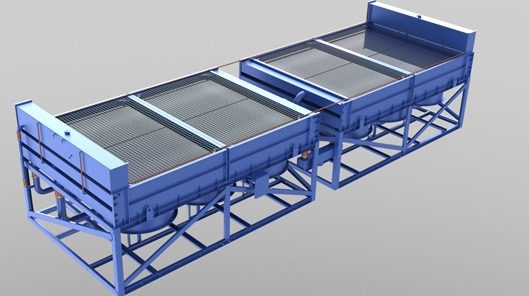
Remote Radiator” is a common term, but in industrial cooling, it’s more accurately broken down into specific types of systems. When people refer to a “remote radiator” for a genset, they are typically talking about moving the heat rejection component away from the engine itself.
Here are the primary types of remote radiator systems used with gensets and other industrial equipment.
Overview: The Core Principle
In a remote system, the genset has a heat exchanger (usually a plate or shell-and-tube type) on its engine. This heat exchanger transfers the engine’s heat to a separate, intermediate fluid loop. This separate loop is then pumped to a remote unit located outside the engine room, where the heat is finally rejected to the atmosphere.
The main advantages of this setup are:
- Frees up space in the engine room.
- Allows for much larger, more effective heat rejection.
- Isolates fan noise from the genset.
- Provides more flexibility in system design.
1. Remote Dry Cooler (or Remote Air-Cooled Heat Exchanger)
This is the most direct equivalent to a “remote radiator.”
- Working Principle: It’s a large, standalone Air Cooled Heat Exchanger (ACHE). A mixture of water and glycol is circulated through a finned-tube core, and one or more fans blow ambient air across it to remove heat. It is a closed-loop, dry system.
- Key Components:
- Finned-tube coil (core).
- Axial or centrifugal fans (often multiple).
- Pump skid for the secondary coolant loop.
- Support structure and guards.
- Best For:
- Applications where water is scarce or expensive.
- Locations with moderate ambient temperatures.
- Situations where low maintenance is a priority.
- Advantages:
- Zero water consumption.
- Lower maintenance than evaporative systems (no water treatment, no risk of legionella).
- Simple and reliable.
- Disadvantages:
- Performance is limited by the ambient dry-bulb temperature.
- Larger and more expensive than an evaporative cooler of similar capacity.
- Higher fan power consumption compared to a cooling tower.
2. Remote Fluid Cooler (Evaporative Closed-Circuit Cooler)
This is a hybrid system that combines the benefits of a dry cooler and a cooling tower.
- Working Principle: It looks similar to a dry cooler, but the core is continuously wetted by a recirculating water spray system. As air is drawn through the moistened coil, the water evaporates, providing highly efficient evaporative cooling to the fluid inside the closed-loop coils.
- Key Components:
- Finned-tube coil (the process fluid is sealed inside).
- Water distribution system (spray nozzles).
- Recirculating pump and basin.
- Fan(s) and drift eliminators.
- Best For:
- Applications requiring high cooling capacity in a hot, dry climate.
- Cooling high-temperature fluids.
- When the process fluid must be kept clean and in a closed loop.
- Advantages:
- Much higher efficiency than a dry cooler; performance is based on the ambient wet-bulb temperature.
- Keeps the process coolant (water-glycol) clean and sealed.
- More compact than a dry cooler for the same capacity.
- Disadvantages:
- Consumes water (through evaporation and blowdown).
- Requires water treatment to prevent scale and biological growth.
- Higher maintenance than a dry cooler due to the water system.
3. Cooling Tower with Heat Exchanger
This is a classic two-loop system, as described in the previous conversation.
- Working Principle: The genset’s heat is transferred via a heat exchanger to a separate, open loop of water. This warm water is then pumped to a cooling tower, where it is directly exposed to air and cooled primarily by evaporation.
- Key Components:
- Cooling Tower (open, with fill media).
- Plate Heat Exchanger or Shell & Tube Heat Exchanger.
- Pumps for both loops.
- Water treatment system.
- Best For:
- Large, permanent installations with high heat loads.
- Locations with a good water supply.
- Prime power applications where efficiency is critical.
- Advantages:
- Highest efficiency and lowest operating cost (in terms of energy).
- Most compact heat rejection unit for a given capacity.
- Can cool the fluid to a temperature close to the ambient wet-bulb.
- Disadvantages:
- Highest maintenance due to the open water system (scaling, corrosion, biological growth, legionella risk).
- Highest water consumption.
- Requires more system components (heat exchanger, extra pumps).