

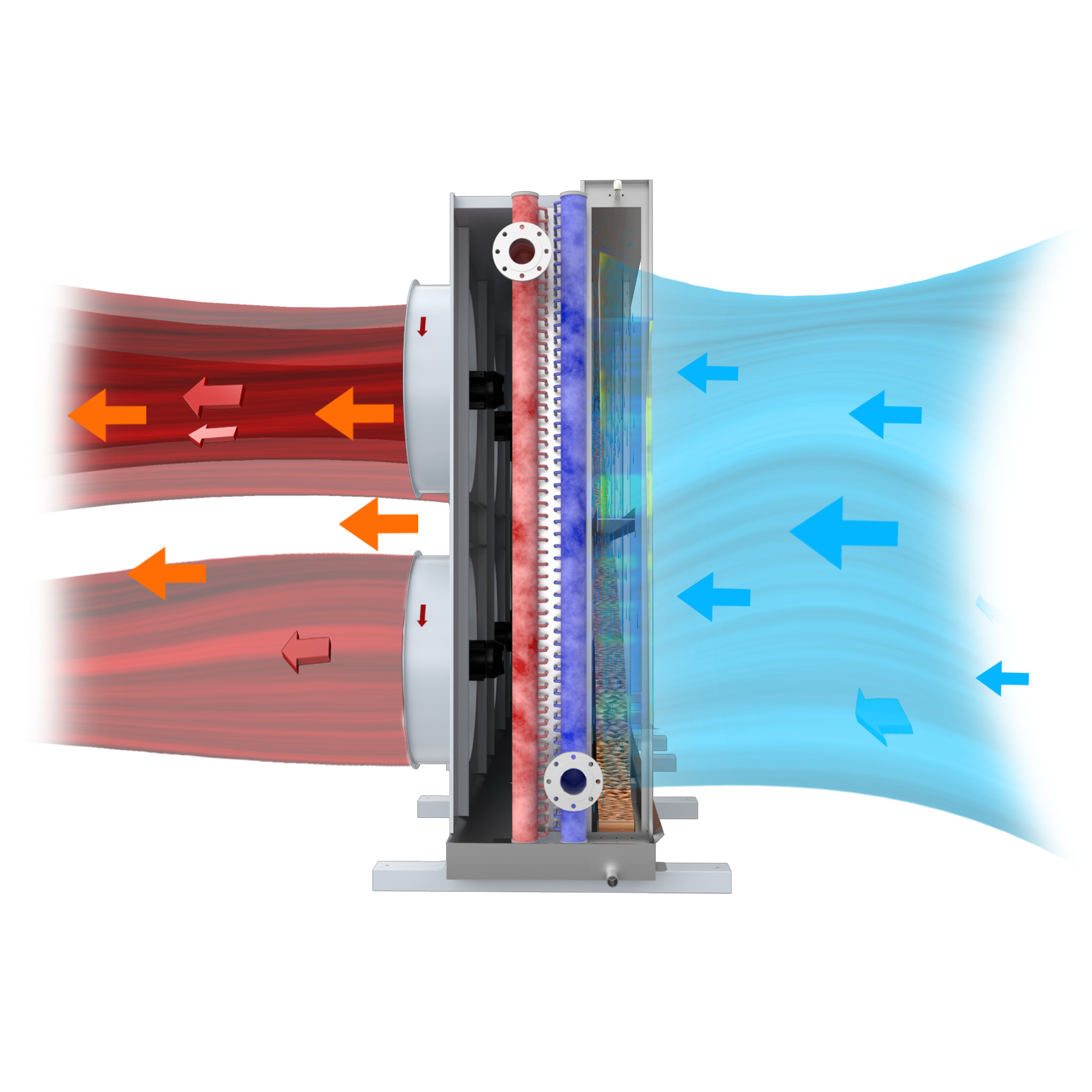
While a Water-Cooling Tower is not typically used directly with a Genset engine, it is a critical component in large, stationary power generation facilities for rejecting the massive amounts of waste heat from the engine’s cooling system.
It represents a different philosophy compared to the self-contained Air-Cooled Heat Exchanger (ACHE).
The Core Concept: Rejecting Heat with Evaporation
A cooling tower’s primary mechanism is evaporative cooling. By evaporating a small portion of the water, it rejects large quantities of heat very efficiently. This makes it much more effective than a dry, air-cooled system, especially in high-heat-load applications.
How a Cooling Tower Integrates with a Genset
A Genset itself cannot use a cooling tower directly because the engine’s jacket cooling system is a closed, pressurized loop containing treated water and glycol. The cooling tower is part of a separate, open loop. The connection is made through a Heat Exchanger.
Here is the typical two-loop system:
1. Engine Jacket Cooling Loop (Primary/Closed Loop)
- Coolant: Treated water and glycol mixture.
- Function: Circulates through the engine block and cylinder heads, absorbing engine heat.
- Path: Engine -> Pump -> Heat Exchanger -> Engine.
2. Cooling Tower Loop (Secondary/Open Loop)
- Coolant: Raw water or treated raw water (this is the water that gets evaporated).
- Function:
- Absorbs heat from the primary loop via the Heat Exchanger.
- Transports this heat to the Cooling Tower where it is rejected to the atmosphere.
- Path: Heat Exchanger -> Pump -> Cooling Tower -> Back to Heat Exchanger.
The Critical Link: The Heat Exchanger
This is usually a Plate Heat Exchanger or a Shell and Tube Heat Exchanger. It transfers heat from the hot engine coolant (primary loop) to the cooler tower water (secondary loop) without the two fluids mixing.