

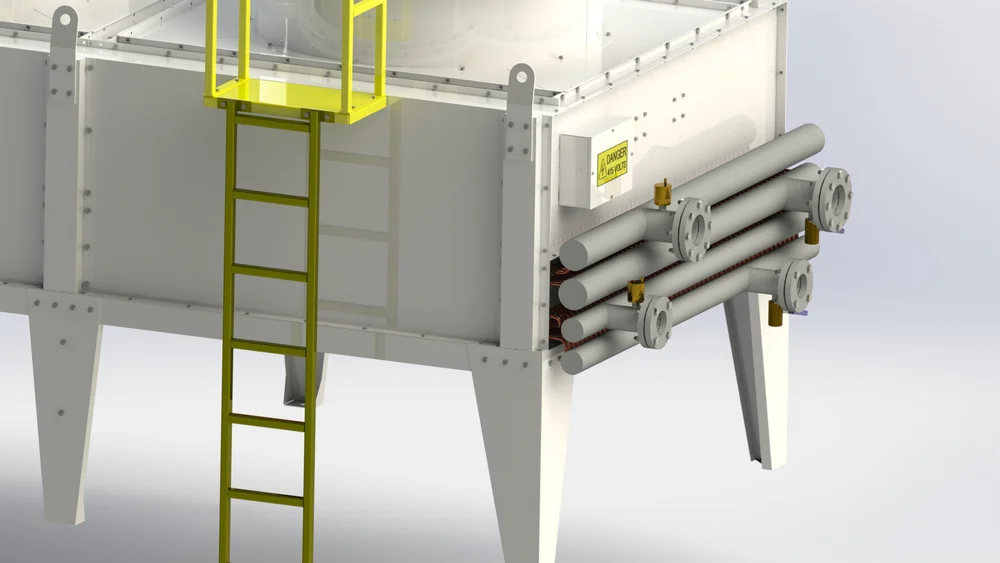
The advantages of a remote radiator stem from its core design principle: physically separating the heat dissipation unit (the radiator) from the heat source and the primary device. This fundamental choice unlocks a cascade of benefits.
Here is a detailed breakdown of the key advantages:
1. Superior Cooling Performance and Efficiency
This is often the primary reason for choosing a remote radiator.Access to Cooler Air: A radiator placed inside a computer case or machinery cabinet is trying to cool with air that is already heated by other components. A remote radiator can be placed in a location with access to
- fresh, ambient-temperature air. Since heat transfer is more efficient with a larger temperature difference between the coolant and the air, this leads to significantly lower coolant and component temperatures.
- Ability to Use Larger Radiators: There is no physical constraint imposed by the original chassis. You are free to use a radiator that is vastly larger and has more surface area (e.g., a massive 1080mm or even custom-sized radiator) than anything that could fit internally. More surface area directly translates to more heat dissipation.
- Unrestricted Airflow: A remote radiator isn’t crammed into a tight space. It can be positioned for optimal airflow, often allowing for slower, quieter fan speeds while still achieving better cooling than a choked internal radiator with loud, high-speed fans.
2. Unmatched Design Flexibility and Space Saving
This advantage is critical in both compact builds and industrial design.
- Enables Smaller Enclosures: You can build an incredibly powerful system inside a very small case (like a Mini-ITX PC) because all the bulky cooling hardware is relocated externally. This is the ultimate solution for maximizing power in a minimal footprint.
- Freedom of Placement: The radiator can be mounted on a wall, under a desk, in a different part of a room, or even in an adjacent utility space. This frees engineers and enthusiasts from the constraints of traditional chassis design.
3. Drastically Reduced Noise Levels
This is a huge quality-of-life improvement, especially for workstations, home theaters, and recording studios.
- Distance is Key: The noisiest components in a liquid cooling loop are the fans and, to a lesser extent, the pump. By moving the radiator (and its fans) away from the user, the perceived noise drops dramatically.
- Potential for Passive Cooling: In some low-power scenarios, a large enough remote radiator can dissipate heat effectively through natural convection alone, allowing for a completely silent, fanless cooling system.
4. Improved Maintenance and Serviceability
This is a significant operational advantage.
- Easier Cleaning: Radiators act as dust filters. Having the radiator in an accessible location, rather than buried deep inside a complex machine, makes it much easier to clean without disassembling the entire system.
- Simplified Access: Servicing or upgrading other components inside the main chassis becomes easier because the large radiator and its fan assembly are not in the way.
5. Enhanced Thermal Stability and System Longevity
This benefit is crucial for both high-performance computing and industrial applications.
- Consistent Cooling Performance: Because the remote radiator is not affected by the internal heat buildup of the main system, it provides more consistent and stable cooling. This prevents thermal throttling and is essential for processes requiring precise temperature control (e.g., scientific instruments, high-precision manufacturing).
- Reduced Heat Soak: The main chassis and its sensitive components (like RAM, storage drives, and power supplies) are exposed to far less residual heat. A cooler internal environment generally contributes to better stability and longer lifespan for all electronics.
6. Specialized and Extreme Environment Suitability
This makes remote radiators indispensable in harsh conditions.
- Operation in Dirty/Dusty Environments: In industrial settings (mining, woodworking, construction), a remote radiator can be placed in a clean air plenum or a separate room, protecting its fins from clogging with debris, which would cripple its performance and cause overheating.
- Military and Rugged Applications: The radiator can be mounted in a protected location on a vehicle, safe from bullets, shrapnel, or environmental damage, while the engine or electronics are housed in a armored compartment.
Summary Table of Advantages
| Advantage | Core Reason | Ideal For |
| Superior Cooling | Access to cool air & larger radiator size | Overclockers, high-performance workstations, servers |
| Design Flexibility | Separation from main chassis | Small Form Factor (SFF) PCs, custom builds, tight engine bays |
| Reduced Noise | Distance from user & slower fan speeds | Recording studios, home theaters, quiet offices |
| Easier Maintenance | Accessible location | All users, especially in dusty industrial environments |