

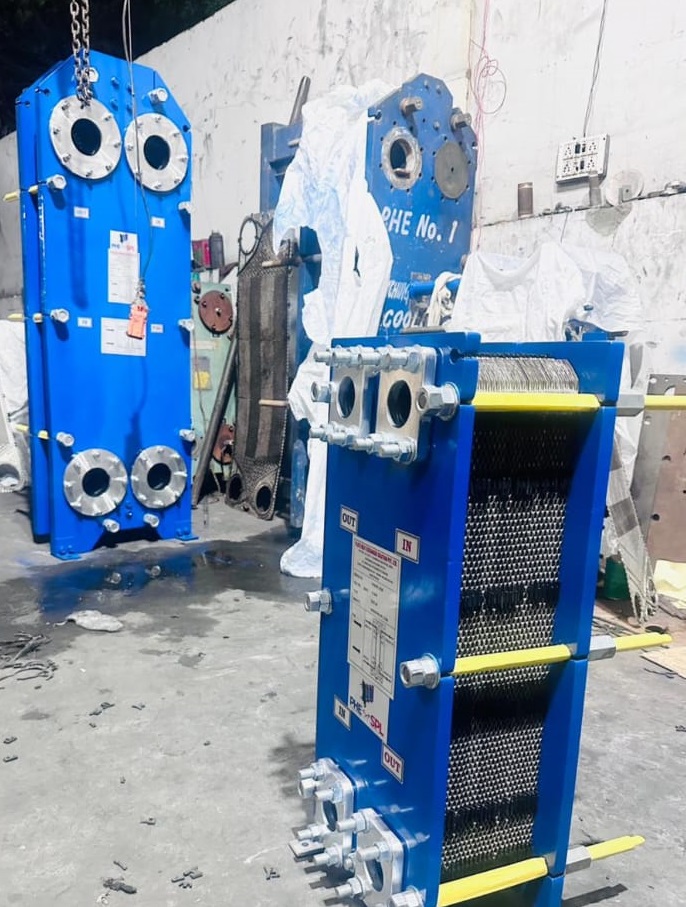
Gasket Plate Heat Exchanger Vs Brazed plate heat exchanger
Gasketed Plate Heat Exchangers (GPHE) vs. Brazed Plate Heat Exchangers (BPHE).
The core difference lies in the sealing method, which drives all other differences in application, maintenance, and capability.
Head-to-Head Comparison Table
| Feature | Gasketed Plate Heat Exchanger (GPHE) | Brazed Plate Heat Exchanger (BPHE) |
| Construction & Sealing | Plates sealed with elastomeric gaskets, held in a steel frame. | Plates permanently brazed together (copper or nickel) into a solid block. |
| Serviceability & Maintenance | Excellent. Can be fully opened for inspection, mechanical cleaning, and plate addition/removal. | None. It is a sealed unit. Cannot be opened. Only chemical cleaning is possible. |
| Initial Cost | Higher initial cost. | Lower initial cost for the same capacity. |
| Pressure Capability | Medium (Typically up to 25-30 bar / 360-430 psi). | High (Typically up to 30-45 bar / 430-650 psi, some higher). |
| Temperature Capability | Medium (Limited by gasket material, typically -50°C to 200°C). | High (Limited by braze material, typically -195°C to 225°C with copper, up to 400°C with nickel). |
| Risk of Leakage | External Leak Risk. Gaskets can fail, causing leaks to the atmosphere. Fluids do not mix. | Internal Leak Risk. If a plate corrodes or fails, fluids can mix internally, requiring full unit replacement. |
| Fouling Tolerance | Good. Can handle moderately fouling fluids because it can be opened and cleaned. | Poor. Narrow channels are prone to clogging with dirty or particulate-laden fluids. |
| Flexibility | High. Capacity can be easily modified by adding or removing plates. | Fixed. Capacity is set at manufacture. |
| Size & Footprint | Larger and heavier due to the frame. | Extremely compact and lightweight for its capacity. |
| Typical Applications | Services requiring maintenance: HVAC, food & beverage (milk pasteurization), marine, process industries with fouling. | Clean, sealed systems: Refrigeration, heat pumps, combi-boilers, hydraulic/power pack cooling. |