

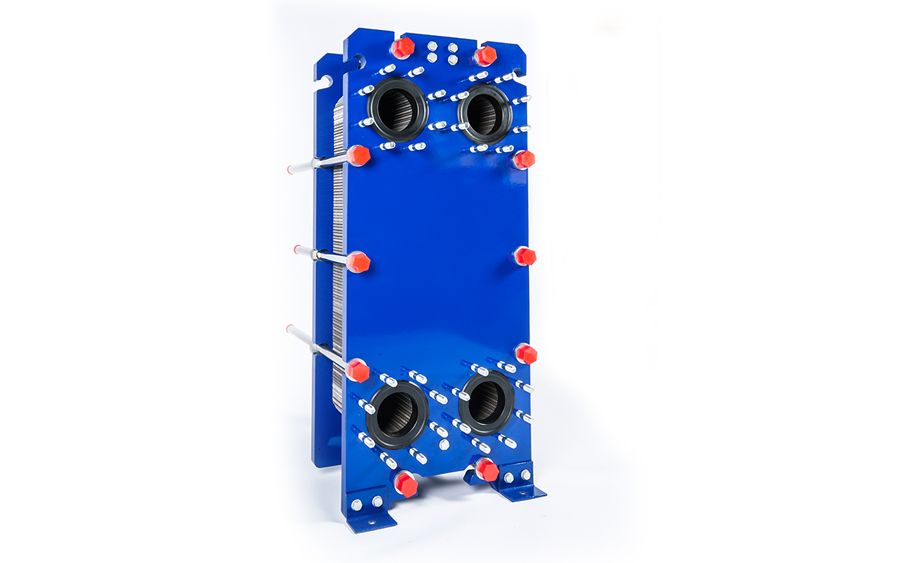
When to Choose Fully welded Plate heat exchanger
The decision to use a Fully Welded Plate Heat Exchanger is driven by the need for a robust, maintenance-free, and highly reliable heat transfer solution for demanding service conditions where other types of heat exchangers would fail.
The Primary Rule of Thumb
Choose a Fully Welded Plate Heat Exchanger when your application involves high pressures, high temperatures, aggressive fluids, or a combination of these factors, and when mechanical cleaning is not a requirement.
It is the go-to choice for the most severe operating conditions in industrial processing.
Specific Criteria for Selection
You should strongly consider a Fully Welded Plate Heat Exchanger in the following scenarios:
1. When Handling Highly Corrosive or Aggressive Fluids
- Why: Fully welded units have no elastomeric gaskets that can be degraded by chemicals. The entire unit is made of a weldable, corrosion-resistant alloy (like 316L stainless steel, Hastelloy, Titanium, or SMO 254).
- Examples:
- Concentrated acids (sulfuric, hydrochloric) and alkalis.
- Strong solvents and chlorinated hydrocarbons.
- Aggressive chemical process streams in petrochemical and pharmaceutical plants.
2. When Operating at Very High Pressures and/or Temperatures
- Why: The all-welded construction forms a rigid, strong block that can withstand much higher mechanical stress than gasketed or brazed designs.
- Typical Range: They are regularly used for pressures above 25 bar (360 psi) and can be designed for pressures over 80 bar (1160 psi). Temperature ratings can exceed 350°C (660°F).
- Examples:
- Gas compression cooling in oil and gas production.
- High-pressure synthesis loops in chemical plants.
- Heat recovery from high-pressure process streams.
. When the Fluid is Toxic, Hazardous, or Expensive
- Why: The integrity of a permanent weld is far superior to a gasket. It minimizes the risk of any leakage to the atmosphere, protecting personnel, the environment, and valuable process fluids.
- Examples:
- Toxic chemicals like phosgene or chlorine.
- Expensive catalysts or specialty chemicals.
- Systems where even a minor external leak would be a major safety or environmental incident.
4. When the Process Requires Absolute Purity or is Sanitary
- Why: Without gaskets, there are no crevices where bacteria can grow or product can be trapped. This makes them suitable for ultra-pure or sterile applications, provided the materials of construction are compatible.
- Examples:
- Ultra-pure water systems in the semiconductor industry.
- Certain sanitary processes in pharmaceutical and fine chemical production (though gasketed is more common for clean-in-place needs).
5. When You Want to Eliminate Maintenance and Gasket Replacement Costs
- Why: There are no gaskets to inspect, tighten, or replace. This eliminates associated downtime and maintenance labor costs, leading to a lower total cost of ownership over the long term in suitable applications.
- Examples:
- A heat exchanger in a remote, inaccessible location.
- A critical process unit where unplanned shutdowns are extremely costly.
Critical Considerations and Warnings
Before selecting a Fully Welded Plate Heat Exchanger, you must be certain of the following:
- The Fluids Must Be CLEAN and Non-Fouling: This is the most important limitation. You cannot mechanically clean a fully welded unit. If the fluids contain solids, polymers, or tend to form scale, the narrow plate channels will eventually clog permanently. Only chemical cleaning is possible, which may not be effective for severe fouling.
- The Duty is Fixed: You cannot add or remove plates to adjust the heat transfer area. The capacity is fixed at the factory, so your process requirements must be well-defined and stable.
- Repair is Impossible: If a plate corrodes through or a weld fails, the entire heat exchanger block is typically scrapped and must be replaced. They are not repairable in the field.
Decision Checklist
Choose a Fully Welded Plate Heat Exchanger if you answer “YES” to one or more of the following questions, AND you can answer “YES” to the final, critical question:
YES to any of these:
- Are the operating pressures above 25 bar (360 psi)?
- Are the operating temperatures above 200°C (400°F)?
- Are one or both of the fluids highly corrosive to elastomeric gaskets?
- Is one of the fluids toxic, hazardous, or very expensive, making leakage unacceptable?
- Is eliminating gasket-related maintenance a high priority?
AND the critical question:
Are both fluids clean and non-fouling, making mechanical cleaning unnecessary?
If you meet these criteria, a Fully Welded Plate Heat Exchanger is likely the most robust, reliable, and cost-effective long-term solution for your demanding application. If you have a fouling fluid, a Semi-Welded or robust Shell and Tube heat exchanger would be a better choice.