

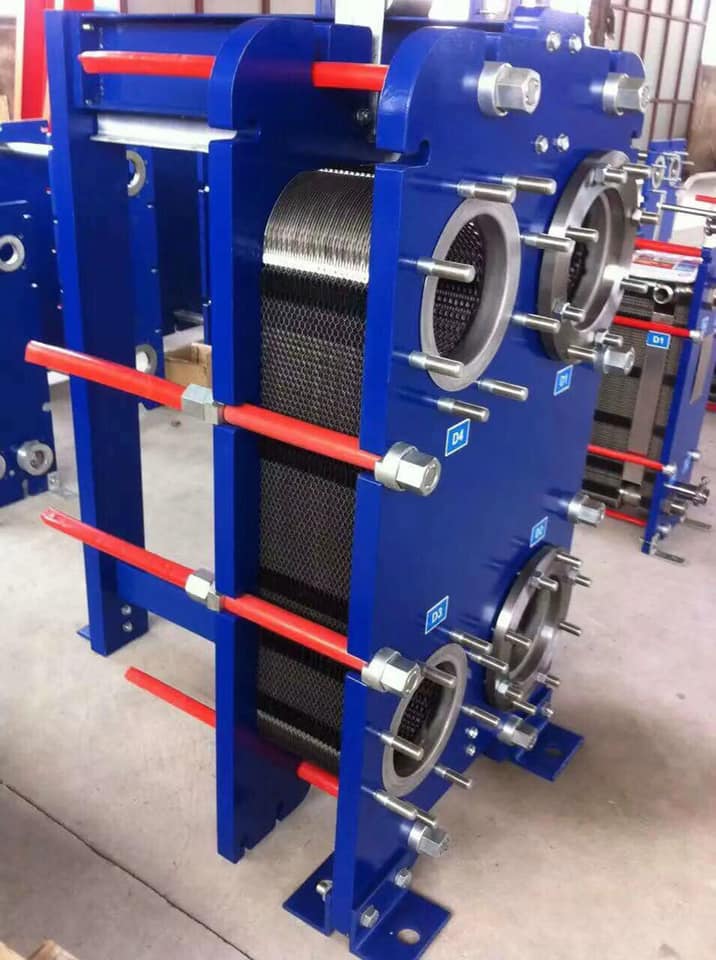
Material of Construction of Plate heat exchanger?
The Materials of Construction (MOC) for a plate heat exchanger are critical to its performance, longevity, and cost. The selection is primarily driven by the need to resist corrosion from the process fluids, while also considering pressure, temperature, and hygiene requirements.
The main components and their common materials are:
- Plates: The primary heat transfer surface.
- Gaskets: The sealing elements (for gasketed types).
- Frame: The structural component (for gasketed types).
1. Plate Materials
The plates are the most important component, and their material must be compatible with both fluids on either side.
Most Common Plate Materials:
- AISI 304 / 304L Stainless Steel
- Properties: Good general corrosion resistance, formable, cost-effective.
- Typical Applications: Water (municipal, cooling tower), oils, mild chemicals, dairy, food, and beverage. Not suitable for chlorides.
- AISI 316 / 316L Stainless Steel
- Properties: The industry standard for a wide range of applications. Contains 2-3% Molybdenum, which significantly improves resistance to pitting and crevice corrosion, especially from chlorides.
- Typical Applications: Sea water, brackish water, cooling water with chlorides, many chemical process streams, food processing. This is the most common choice for industrial duties.
Advanced / Alloy Plate Materials (for Corrosive Fluids):
- 254 SMO® (UNS S31254)
- Properties: A “super-austenitic” stainless steel with high Molybdenum (~6%) and Nitrogen content. Excellent resistance to pitting and crevice corrosion.
- Applications: A step up from 316L for very aggressive chloride environments, strong oxidizers, and sulfuric acid.
- Titanium (Gr. 1 or Gr. 2)
- Properties: Excellent resistance to chlorides, sea water, and hypochlorites. Very good for oxidizing environments.
- Applications: Standard for sea water and brine cooling. Also used in swimming pool heating (chlorine resistance) and the chemical industry.
- Hastelloy® (C-276, C-22)
- Properties: Nickel-based alloys with exceptional resistance to a wide range of severe corrosives, including strong acids (hydrochloric, sulfuric) and wet chlorine gas.
- Applications: Highly corrosive chemical processes, pollution control (FGD – Flue Gas Desulphurization), and pharmaceutical industries.
- Nickel (Alloy 200/201)
- Properties: Good resistance to caustic solutions and high temperatures.
- Applications: Caustic evaporation, high-temperature organic acids.
- Inconel® (Alloy 625)
- Properties: Similar to Hastelloy, with high strength and excellent corrosion resistance in a wide range of severe environments.
- Applications: Offshore oil & gas, chemical processing with high chloride and acid concentrations.
- AISI 904L (UNS N08904)
- Properties: A super-austenitic stainless steel with high resistance to sulfuric acid and other non-oxidizing acids.
- Applications: Sulfuric acid production, phosphate fertilizer industry.
Gasket Materials
Gasket material must be compatible with the fluid, temperature, and sometimes cleaning chemicals. The gasket is often the temperature and pressure-limiting component.
Most Common Gasket Materials:
- Nitrile Butadiene Rubber (NBR)
- Properties: Good resistance to oils, fats, aliphatic hydrocarbons, and water up to ~100-110°C.
- Applications: The most common standard gasket for water, oils, and many coolants. Used in HVAC and general industry.
- Ethylene Propylene Diene Monomer (EPDM)
- Properties: Excellent resistance to hot water, steam, alkalis, and acids. Poor resistance to oils and hydrocarbons.
- Applications: Standard for hot water and heating systems, cooling tower water, and mild chemicals. Very common in HVAC.
- Fluoroelastomer (FKM/Viton®)
- Properties: Excellent resistance to high temperatures (~180°C), oils, fuels, aliphatic and aromatic hydrocarbons, and many acids.
- Applications: Chemical processing, refineries, high-temperature oils, and aggressive fluids.
- Compressed Asbestos-Free (CAF) / Graphite
- Properties: Excellent resistance to extreme temperatures (from cryogenic to ~400°C) and a very wide range of chemicals. Less flexible than elastomers.
- Applications: High-temperature thermal oil, steam, and highly corrosive chemicals where elastomers fail.
. Frame Materials (for Gasketed PHEs)
The frame is typically less critical as it is not in direct contact with the process fluids, but it must be structurally sound and resist the external environment.
- Carbon Steel: Most common, often painted or coated for corrosion protection.
- Stainless Steel (304 or 316): Used in hygienic applications (food, pharmaceutical) or corrosive environments (e.g., marine, coastal areas).
Material Selection Guide Table
| Fluid / Application | Recommended Plate Material | Recommended Gasket Material |
| Cooling Tower Water | 316L Stainless Steel | EPDM or NBR |
| Sea Water / Brine | Titanium (or 254 SMO for less chlorides) | EPDM |
| Domestic Hot Water | 304 or 316L Stainless Steel | EPDM |
| Mineral Oils / Hydraulic Oil | 304 or 316L Stainless Steel | NBR |
| Steam Heating | 304 or 316L Stainless Steel | EPDM (for low pressure) or Graphite (for high temp) |
| Food, Dairy, Beverage | 304 or 316L Stainless Steel | EPDM (for hot water/CIP) or NBR (for fatty products) |
| Concentrated Sulfuric Acid | Hastelloy®, 904L | FKM/Viton® or PTFE |
| Caustic Soda | Nickel, 316L Stainless Steel | EPDM |
| Refrigerants (e.g., Ammonia) | 316L Stainless Steel (Semi-Welded) | NBR (for non-welded side) |
| Chlorinated Solvents | Hastelloy® | FKM/Viton® |
Key Takeaway
The material selection is a balance between corrosion resistance, temperature/pressure capability, and cost.
- Start with 316L Stainless Steel and EPDM/NBR gaskets as a baseline for most industrial water and mild chemical applications.
- Move to more exotic alloys like Titanium for chlorides or Hastelloy for strong acids when corrosion data or experience dictates.
- Always consult with the heat exchanger manufacturer and consider a corrosion test if the fluid is non-standard or the stakes are high.