

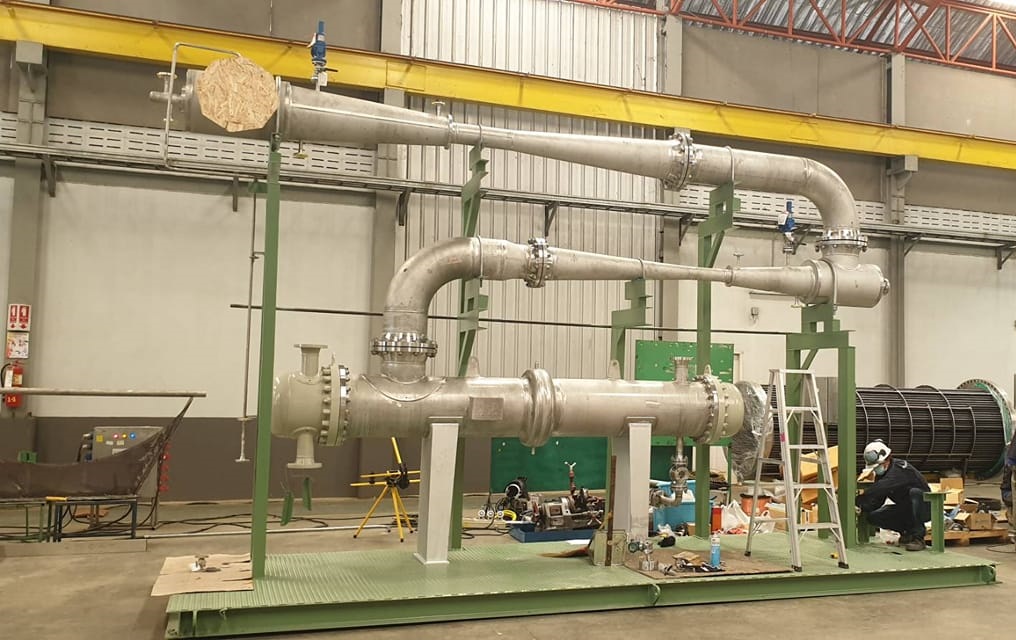
How To Select a Heat Exchanger for High pressure Application?
Selecting a heat exchanger for high-pressure service is a critical engineering task that goes far beyond simply choosing the most robust-looking design. The decision is a balancing act between mechanical integrity, thermal performance, cost, and long-term operational reliability.
The key is understanding the pressure rating, the application’s specific needs, and the strengths and limitations of each technology. Here is a step-by-step guide to making that choice.
1. The First Decision: Shell-and-Tube vs. High-Pressure Plates
For most conventional high-pressure applications (e.g., up to 1,500 psi), the primary choice has traditionally been between Shell-and-Tube and Plate-and-Frame heat exchangers.
Shell-and-Tube: The Traditional Heavyweight
- Pressure Capability: This is the classic choice for a reason. Standard shell-and-tube designs can typically handle pressures up to 1,500 psi or more, and specialized designs can go far higher . They are the “workhorse” for high-pressure and high-temperature applications in power, chemical, and refining industries .
- Pros: Very robust, well-understood, and conforms to established safety and manufacturing codes (like ASME) . Material choices (like 316 stainless steel) can be selected for high corrosion resistance .
- Cons: They are large, heavy, and require significant floor space. Maintenance, particularly cleaning the tube bundle, is difficult and time-consuming, often requiring specialized equipment and cranes . They are generally less thermally efficient than plate designs for a given duty .
Plate-and-Frame (Gasketed): The Efficient Alternative
- Pressure Capability: Modern gasketed plate-and-frame exchangers can handle pressures up to 450 psi in many configurations .
- Pros: Highly efficient, compact (up to five times smaller than a shell-and-tube for the same duty), and much easier to maintain and clean. The design is modular, allowing for easy capacity expansion by adding plates .
- Cons: Do not use this type for applications exceeding its pressure rating. The gaskets are a limiting factor for high pressures and temperatures. As one industry expert puts it, “if your pressure demands sit in that mid-range, don’t default to shell and tube. A plate and frame system might check every box” .
2. For Ultra-High Pressures: Specialized Solutions
When your application demands pressures that push beyond the limits of standard shell-and-tube or gasketed plate designs, you need to look at specialized technologies.
Printed Circuit Heat Exchangers (PCHEs)
This is the leading technology for extreme pressures.
- Pressure Capability: PCHEs can handle design pressures up to an astonishing 650 barG (approximately 9,430 psiG) .
- How it Works: They are manufactured by chemically etching flow channels onto flat metal plates and then diffusion-bonding them into a solid block. This creates a compact, weldless, and incredibly strong core .
- Pros: They are up to 85% smaller and lighter than a shell-and-tube exchanger for the same duty, which is invaluable for offshore and aerospace applications . They are also very safe, as the pressurized fluid is contained within a much smaller volume and diameter, reducing the potential energy release in a failure .
- Cons: They are expensive to manufacture, and the diffusion bonding process limits the maximum size of a single block . They are typically used for clean fluids, as they cannot be disassembled for cleaning .
Advanced Compact Header Shell-and-Tube
Some manufacturers have developed innovative shell-and-tube designs specifically to overcome traditional pressure limitations.
- Pressure Capability: Patented designs, like the “Compact Header,” can be applied for pressures up to an extreme 1000 bar (14,500 PSI) .
- Key Advancements: These designs minimize the number of critical welds, reducing potential failure points and allowing for 100% inspection of the remaining welds. By using a weldless forged header construction, they also offer greater material integrity, less risk of cracking, and can be up to 40% lighter than conventional shell-and-tube designs .
3. Emerging Technologies: Additive Manufacturing
The future of high-pressure heat exchangers lies in additive manufacturing (3D printing). This technology allows for the creation of complex geometries that are impossible to machine or weld.
- Pressure Capability: Research is pushing the boundaries. For example, Triply Periodic Minimal Surface (TPMS) based heat exchangers, 3D-printed from high-temperature alloys, have been developed for applications up to 900°C and 25 MPa (approx. 3,625 psi) .
- Advantage: These designs can pack an immense amount of heat transfer area into an incredibly small volume, potentially achieving a 10 times increase in volumetric power density compared to conventional designs . This is a game-changer for high-performance aviation and power generation.