

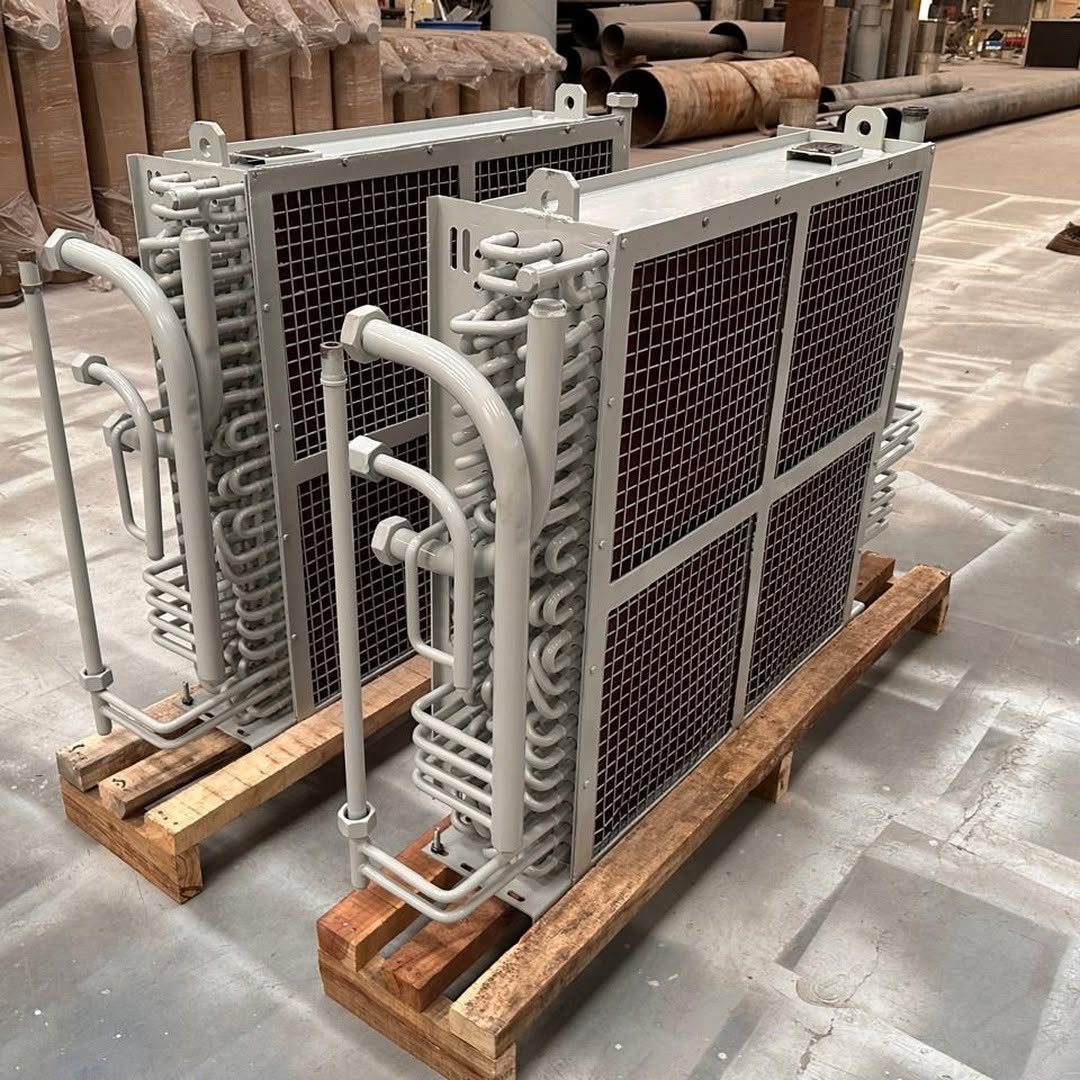
Selection Factors for Fin Material.
When selecting a fin material, engineers consider:
- Thermal Conductivity: How well the material transfer’s heat.
- Corrosion Resistance: How well it resists the surrounding environment.
- Formability & Cost: How easily it can be manufactured into fins and the overall expense.
- Compatibility with Tube Material: To avoid galvanic corrosion.
- Operating Temperature: The material must retain its strength.
Common Fin Materials
1. Aluminum (and its Alloys)
The most widely used fin material by far.
- Advantages:
- Excellent Thermal Conductivity: (~237 W/m·K). Very efficient at transferring heat from the tube to the fin surface.
- Lightweight: Low density reduces the overall weight of the heat exchanger.
- High Formability: Easily rolled, stamped, or extruded into various fin shapes (plain, louvered, wavy).
- Good Corrosion Resistance: Forms a protective oxide layer that resists atmospheric corrosion.
- Cost-Effective: Abundant and relatively inexpensive compared to copper and stainless steel.
- Ideal for Extruded Fins: The softness of aluminum makes it the exclusive choice for the bimetal extrusion process onto steel or copper tubes.
- Primary Applications: HVAC systems, automotive radiators, air conditioners, charge air coolers, and many industrial air-cooled exchangers in non-corrosive environments.
2. Copper (and its Alloys)
The classic choice for maximum thermal performance.
- Advantages:
- Superior Thermal Conductivity: (~400 W/m·K). The best among common engineering metals.
- Excellent Corrosion Resistance: Particularly good in marine and fresh water atmospheres. Develops a protective patina.
- Natural Biocidal Properties: Copper surfaces inhibit the growth of microbes, algae, and fungi, which is a key advantage for hygiene and reducing bio-fouling.
- Ease of Soldering and Brazing: Allows for robust joining methods.
- Primary Applications: Where ultimate heat transfer is critical; marine and coastal applications; industrial processes where water is the external fluid; applications requiring hygienic surfaces (e.g., pharmaceutical, food & beverage).
3. Carbon Steel / Corten Steel
Used for high-temperature and specific corrosive environments.
- Advantages:
- High Temperature Resistance: Can withstand temperatures well above the limits of aluminum and copper (up to 450-500°C / 840-930°F).
- High Strength & Durability: Fins are very robust and resistant to mechanical damage.
- Cost-Effective for High Temp: Cheaper than stainless steel for high-temperature service.
- Weldable: Easily welded to carbon steel tubes, creating a very strong, integral unit.
- Corten Steel: A specific alloy that forms a stable, protective rust layer, making it highly resistant to atmospheric corrosion. Often used in air-cooled condensers.
- Primary Applications: High-temperature gas-to-gas heat recovery, economizers, fired heater convection sections, and applications where strength at high temperature is more important than peak efficiency.
4. Stainless Steel (e.g., 304, 316, 409)
The choice for severe corrosion resistance and high temperatures.
- Advantages:
- Excellent Corrosion Resistance: Highly resistant to oxidation, chemicals, and moisture. Grade 316 offers superior resistance to chlorides (salt).
- High Temperature Strength: Maintains strength at high temperatures (up to ~800°C / 1470°F for some grades).
- Hygienic and Easy to Clean: The smooth, non-porous surface is ideal for sanitary applications.
- Durable and Strong: Resists abrasion and physical damage.
- Primary Applications: Highly corrosive environments (chemical processing, marine, coastal), food and pharmaceutical processing, exhaust gas heat recovery, and applications where product purity is critical.