

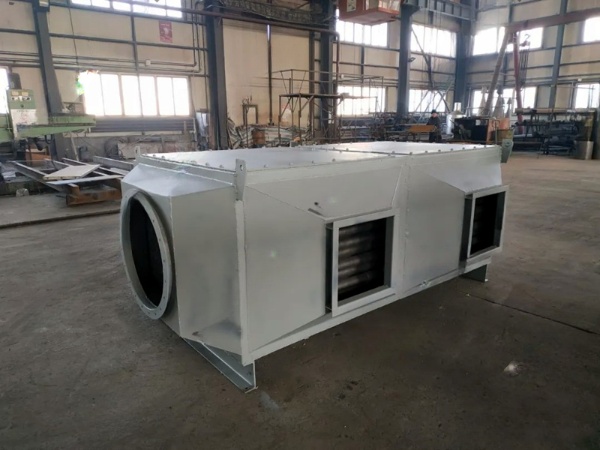
. Key Components
- Tubes: The primary conduit through which one fluid flows (typically a liquid like water, oil, refrigerant, or steam). This fluid is often called the “tube-side” fluid.
- Fins: The most distinctive feature. These are thin, projecting metal plates or spines attached to the outside of the tubes. They are made from a highly conductive material like aluminum or copper.
- Headers/Manifolds: These are chambers at the ends of the heat exchanger that distribute the tube-side fluid into the multiple tubes and collect it again.
- Frame/Casing: The structure that holds all the tubes and fins together and directs the external fluid (air or gas) over the finned tube bundle.
2. How It Works: The Principle
The core principle is enhancing surface area.
- Gases and air are poor conductors of heat compared to liquids. If you had a bare tube with hot water inside and cool air outside, the air would act as an “insulating layer,” limiting the rate of heat transfer.
- By adding fins to the outside of the tube, you create a much larger surface area for that cool air to contact.
- Heat from the hot liquid inside the tube conducts through the tube wall and into the fins. The large surface area of the fins then transfers this heat efficiently to the air passing over them.
Analogy: Think of a car radiator. The engine coolant (hot liquid) flows through the tubes. The fins on the outside give the air from the fan and the car’s movement a huge surface to blow against, effectively cooling the coolant.
3. Common Types of Fin Tube Construction
There are several ways to attach the fins to the tubes, each with its own advantages:
- Extruded / Integral Fins: The fin is formed from the tube wall itself by pushing the tube through a die. This creates a very strong, monolithic bond with excellent heat transfer. Common in high-pressure or corrosive environments.
- Wrapped / Helical Fins: A long strip of fin material is wound helically around the tube and secured at the base (often by a tight mechanical fit, welding, or adhesives). This is a very common and cost-effective method.
- Plate Fins: Flat, plate-like fins are stacked with spacers, and the tubes are inserted through holes in the fins. This is typical in compact heat exchangers like a car radiator or an HVAC coil.