

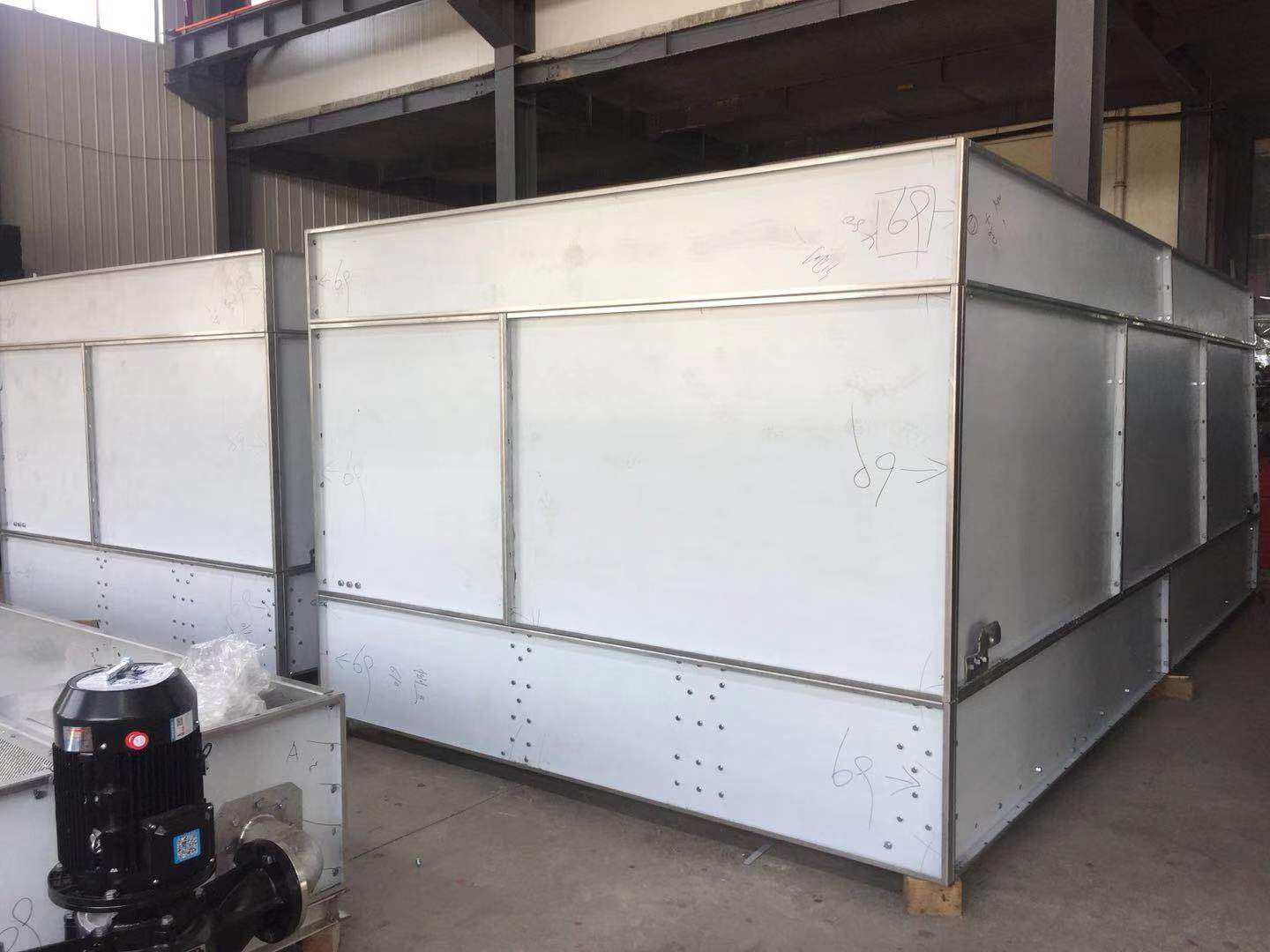
What is Evaporative cooling tower?
Based on standard industry definitions, an evaporative cooling tower is an open, water-recirculating device that cools water by bringing it into direct contact with air, causing a small portion to evaporate and remove heat . It is the most common and energy-efficient method for rejecting heat in large industrial and HVAC systems .
How It Works: The Science of Evaporative Cooling
The principle behind an evaporative cooling tower is simple and natural: evaporation consumes heat . It’s the same process that cools your body when you sweat.
- Warm Water Enters the Tower: Water heated by an industrial process or an HVAC system’s condenser is pumped to the top of the tower .
- Water is Distributed: This warm water is sprayed through nozzles onto a heat transfer medium called “fill.” The fill is designed to create a large surface area, breaking the water into smaller droplets and slowing its descent to maximize contact with air .
- Air and Water Meet: A fan pulls or pushes air through the tower, past the wetted fill .
- Evaporation Cools the Water: As the air passes over the water, a small portion of the water evaporates. This process absorbs a significant amount of latent heat from the remaining water, cooling it. This cooling is highly efficient and can lower the water’s temperature to nearly the ambient wet-bulb temperature, which is lower than the ambient dry-bulb temperature .
- Cooled Water is Recirculated: The cooled water collects in a basin at the bottom of the tower and is pumped back to the process or condenser to absorb more heat, continuing the cycle .
The Key Feature: An Open Loop
The defining characteristic of an evaporative cooling tower is that its cooling water circuit is open to the atmosphere . The water is directly exposed to the air, meaning it can absorb contaminants like dust, pollen, and dirt . While this makes cooling very efficient, it also means the water requires regular treatment to prevent scale, corrosion, and biological growth .
Comparison with a Closed Circuit Cooling Tower
The “open loop” nature of an evaporative cooling tower is the key difference between it and the “closed circuit” towers we discussed earlier. Here’s a quick summary of the distinction :
- Evaporative Cooling Tower (Open Loop): The process water is directly exposed to the air. Heat is removed primarily through evaporation on a fill surface. This is the most common type of tower.
- Closed Circuit Cooling Tower (Fluid Cooler): The process fluid is contained within a sealed coil. A separate spray water system evaporates on the outside of the coil to remove heat from the fluid inside, keeping the process fluid isolated from the atmosphere.
Because of their simplicity and high efficiency, open evaporative cooling towers are widely used in power generation, chemical plants, and large commercial HVAC systems where high volumes of water need to be cooled cost-effectively