

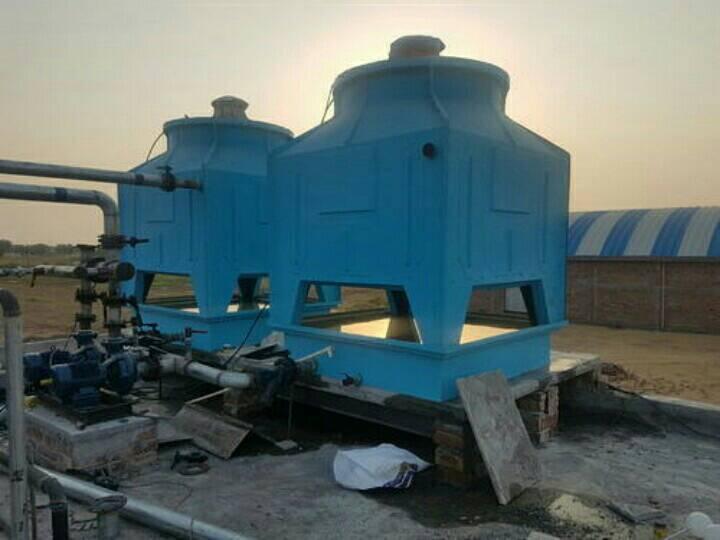
A cooling tower is not a heat exchanger.
While both move heat, they work in fundamentally different ways.
- A heat exchanger transfers heat between two fluids through a solid metal wall (the fluids never touch).
- A cooling tower transfers heat by bringing hot water into direct contact with air, allowing a small portion of the water to evaporate. This evaporation removes massive amounts of heat from the remaining water.
Here is the engineering breakdown of what a cooling tower is, how it works, and why it is absolutely vital to industry.
The Simple Definition
A cooling tower is a specialized, open-air device that removes waste heat from a building or industrial process by spraying hot water into the air. It uses the natural principle of evaporative cooling (the same reason you feel cold when stepping out of a pool on a windy day) to reject heat into the atmosphere.
How It Actually Works (The Mechanics)
Think of it as a giant, highly controlled shower:
- Hot water enters: Hot water (from a power plant condenser, an HVAC chiller, or an industrial reactor) is pumped to the top of the tower and sprayed through large nozzles over a “fill” (a dense, honeycomb-like plastic mesh).
- Maximizing contact: The fill breaks the water into millions of tiny droplets, vastly increasing the surface area of the water exposed to air.
Airflow: Massive fans draw or push large volumes of ambient air through the falling water (or in some designs, natural wind drafts
- pull air through).
- Evaporation (The Magic): As the air and water mix, a small portion of the water molecules absorb enough heat to change from a liquid into a vapor. This process of evaporation pulls latent heat directly from the bulk of the water.
- Cooling: The remaining water loses that heat and drops in temperature. It collects in a cold-water basin at the bottom and is pumped back into the industrial process.
- Losses: The water vapor (visible as the white plume you see leaving the top) is literally lost to the atmosphere, along with any water that gets carried off as mist (drift). To maintain water levels, fresh “makeup” water is continuously added.