

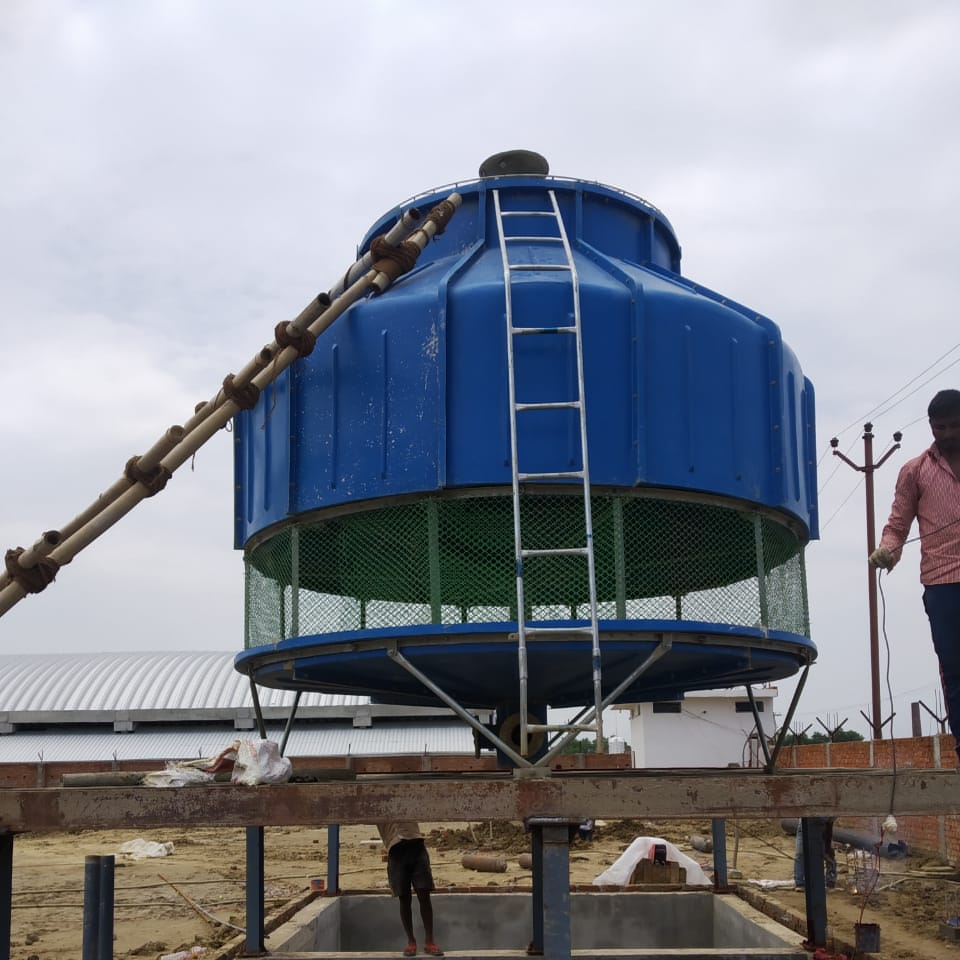
Major Industrial Roles (Where are they used?)
Cooling towers are the “radiators” of heavy industry. They are used wherever a process generates more heat than can be dissipated locally:
- Power Plants (The Biggest User): As we discussed, the main condenser needs thousands of gallons of cooling water per second. A cooling tower takes that heated water and cools it down so it can be sent back to the condenser to condense more steam. They allow power plants to be built far away from rivers or lakes.
- HVAC for Large Buildings: Skyscrapers, hospitals, and data centers don’t use outside air to cool their chillers. They use cooling towers on the roof to reject the heat absorbed from inside the building.
- Oil Refineries & Chemical Plants: Used to cool hot process streams, condense overhead vapors from distillation columns, and cool reciprocating compressors.
- Manufacturing: Plastic injection molding, metal heat-treating, and food processing all generate immense friction heat that must be removed.
The “Water Problem”: Concentration Cycles & Blowdown
Here is the biggest engineering challenge with cooling towers: They are a “concentrator.”When water evaporates, it leaves behind all the dissolved minerals (calcium, magnesium, silica) in the remaining water. If you just keep adding fresh water, those minerals concentrate until they precipitate out as hard scale (limescale) inside your pipes and heat exchangers,
destroying efficiency and ruining equipment.
To fix this, operators run “cycles of concentration.” They intentionally drain a portion of the highly concentrated water (this is called blowdown or bleed-off) and replace it with fresh water to dilute the mineral content. Managing blowdown is a constant balancing act between saving water (by running high cycles) and preventing scaling (by keeping cycles low).