

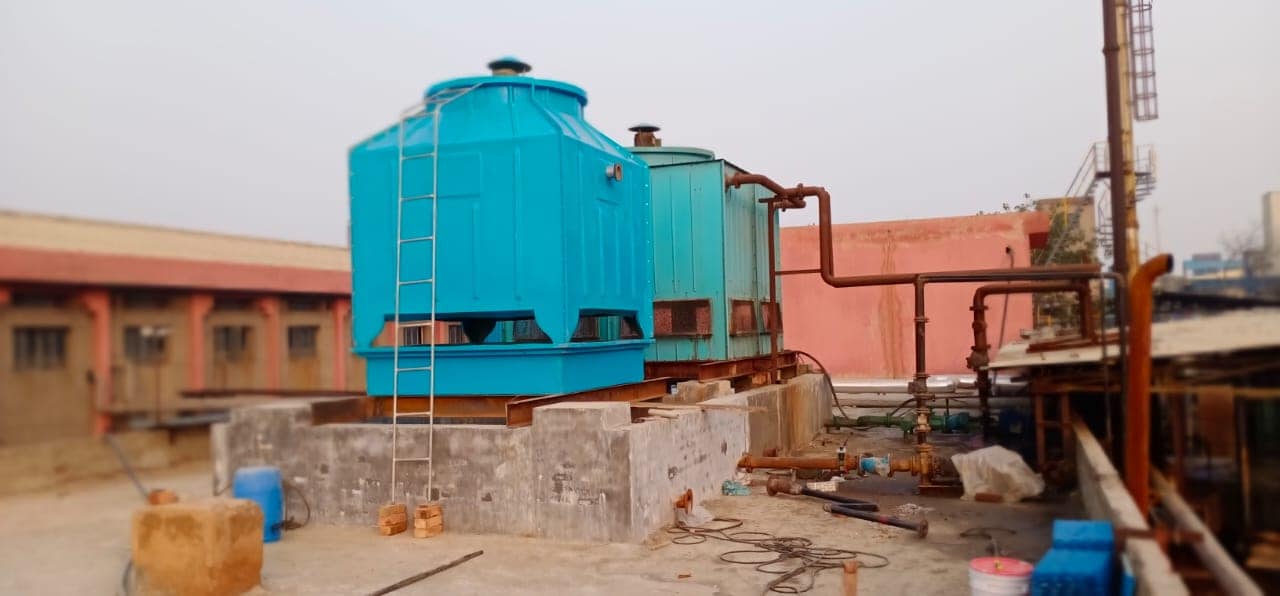
An FRP cooling tower is a cooling tower whose primary structure and key components are made from Fiber-Reinforced Plastic (also known as fiberglass). This material choice offers significant advantages over traditional materials like wood, steel, or concrete.
Why Choose FRP? The Core Advantages
The main reason industries choose FRP cooling towers is their outstanding resistance to corrosion and environmental degradation.
- Corrosion Immunity: FRP does not rust, rot, or chemically degrade when exposed to water treatment chemicals, salt air, or industrial pollutants. This is the key reason they are chosen for handling aggressive water chemistries or seawater in coastal/marine applications .
- Lightweight: FRP is about ten times lighter than concrete, making transportation, installation, and structural support requirements less demanding .
- Long Lifespan with Low Maintenance: Since FRP doesn’t corrode, the tower requires minimal upkeep and has a much longer service life compared to steel towers that need frequent repainting and rust repairs .
Common Designs and Applications
FRP cooling towers are available in both major design configurations:Counterflow: Air moves vertically upward, while water falls downward in the opposite direction. This is generally the most
- thermodynamically efficient design .
- Crossflow: Air moves horizontally across the falling water. This design often offers easier access for maintenance .
They are widely used in a range of industries where corrosion is a primary concern, including:
- HVAC systems for large buildings .
- Chemical and petrochemical plants .
- Power generation facilities .
- Marine and offshore cooling systems .
- Food and beverage processing .
Key Construction Details
A modern FRP tower is more than just a fiberglass shell. It’s an engineered system with crucial internal components:
- Frame and Casing: The structural frame and outer shell are constructed from pultruded FRP profiles or molded FRP panels, providing strength and corrosion resistance . Molding technology allows for aerodynamic shapes that improve fan performance .
- Fill Media: This is the “heart” of the tower, where water is broken into droplets to maximize air contact for efficient cooling. It is typically made from durable PVC or, in some advanced models, from FRP itself .
- Fan Systems: The fans are often made of corrosion-resistant FRP or specially designed steel to ensure long life in the humid environment . The fan stack (the cylindrical housing) is also frequently made of FRP .
- Drift Eliminators: These crucial components capture water droplets from the exhaust air to minimize water loss and prevent the aerosolization of bacteria like Legionella .
FRP vs. Traditional Materials
| Material | Key Advantage | Key Disadvantage |
| FRP | Excellent corrosion resistance, lightweight, long life, low maintenance . | Higher initial cost compared to some steel designs; complex repair procedures. |
| Steel (Galvanized) | Strong, widely available, lower initial cost . | Prone to rust and corrosion over time, requiring regular maintenance and eventual replacement. |
| Concrete | Extremely durable, good for very large towers . | Very heavy, expensive and time-consuming to construct, not resistant to all chemicals. |
Expert-Level Consideration: Closed-Circuit Models
For applications where water conservation is critical or the process fluid must be kept absolutely pure (such as in data centers or food production), FRP cooling towers are also available in closed-circuit models . In these designs, the fluid to be cooled flows through coils within the tower, and it is cooled by water and air circulating on the outside of the coils. This prevents contamination of the primary cooling fluid and reduces water loss